August 20, 2026
Best Earned Wage Access Apps: Fees and Limits Ranked
We compare DailyPay, Payactiv, Branch, EarnIn, and Chime MyPay on real fees, limits, and speed to help you choose.
Read article


Type "new cash advance app 2026" into Google and you get pages of results promising something fresh: a slicker interface, a bigger advance. Scroll through them and the picture changes fast. After reviewing company announcements and fintech trade coverage of the cash advance and earned wage access apps active this year, I found no widely reported major new consumer app launch in late 2025 or 2026. The real story is quieter: one federal rule reshaped how these apps talk about fees, and two established apps are testing higher limits for a slice of their users.
That gap between the ad copy and the actual product landscape matters, because it changes what you should be looking for. If you are hunting for a brand-new app because you assume newer means better terms, you are chasing something that mostly does not exist right now. What you should be tracking instead is what changed inside the apps you already know, and what a new federal advisory opinion means for every fee-free claim you are about to read. If you want the full framework for comparing apps on limits, cost, and speed, our guide to choosing a cash advance app covers that; this one sticks to what changed in 2026.
The honest answer: not much, at the app level. No major new consumer-facing cash advance or earned wage access app has been widely reported as launching in late 2025 or through 2026 so far. The aggregator roundup I checked ranks apps by launch date and lists apps that actually shipped a couple of years ago, not this year. If an app is being marketed to you as brand-new in 2026, it is worth double-checking when it actually launched before you treat that as a selling point.
This is a negative finding, meaning there is no primary source that can prove an absence. What I can tell you is that a review of company announcements and fintech trade coverage, including one industry aggregator's roundup of the market, turned up no dated 2026 launch announcement for a major consumer-facing app in this category. If one surfaces later this year, treat the launch date on the company's own press page as the anchor fact.
There is one identity change worth flagging, even though it predates 2026: Empower Finance announced its rebrand to Tilt on August 6, 2025, rolling out Tilt-branded credit cards alongside the switch. Users had to update their app by August 4, 2025 to keep the transition smooth. If you search for Empower now and land on Tilt's app-store listing, that is why. That's simply a rebrand: same company, new name.
Here is the piece of 2026 news that actually matters, and almost nobody outside fintech trade press has covered it plainly. The Consumer Financial Protection Bureau issued an advisory opinion, reported by Payments Dive, that took effect December 23, 2025, holding that certain earned wage access products are not "credit" under the Truth in Lending Act's Regulation Z. To qualify, a product has to meet four conditions: the amount can't exceed wages you've already earned, repayment happens through employer payroll deduction, the provider has no legal recourse against you and can't report you to a credit bureau if repayment comes up short, and there's no credit-risk underwriting involved.
Under that framework, optional expedite fees and voluntary tips do not count as finance charges. That is a real reversal. Payments Dive also reported that a July 2024 proposed rule, never finalized, would have classified most EWA payments as loans instead. The ground under "is this app legally a loan" has shifted twice in two years now, and that instability is exactly why you should treat any single "these apps are safe" list with some suspicion.
It's also the same four-part test that separates EWA from payday lending, covered in more detail in our comparison of earned wage access and payday loans.
That same test is why nearly every app marketing itself in 2026 leans so hard on phrases like "no mandatory fees" and "optional tip." Structuring the product to fit the CFPB's four-part test keeps it out of lending law entirely, which is a business decision as much as a consumer benefit. That does not make the fee-free claim false. The claim protects the company's legal position at least as much as it helps you, so read the fine print with that in mind.
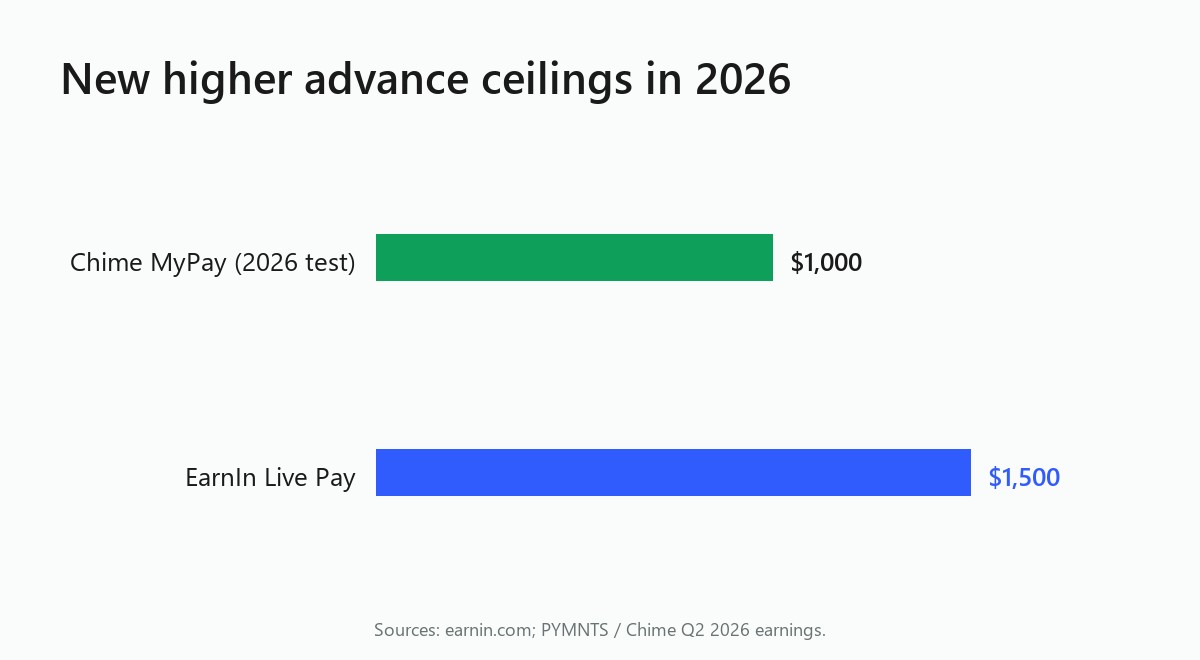
Two established apps have real, sourced changes worth your attention this year, and both come with a catch: eligibility. EarnIn's own Live Pay product page says the feature, available through the EarnIn Card, lets users stream earned wages in real time up to $1,500 per pay period, with no interest and no credit check, though the exact amount depends on eligibility and usage history. EarnIn's own product page also states the card carries a $2.99 monthly fee with autopay enabled, or $12.99 monthly plus a one-time $5 fee without autopay, and a $2.99 ATM withdrawal fee.
Live Pay launched in July 2025, and by March 11, 2026, EarnIn reported it had crossed 1 million Live Pay transactions, with more than 600,000 people having joined the pre-launch waitlist and active users opening the app 50 or more times a month, according to Forbes. That milestone is the closest thing to genuine 2026 news about an existing app's real-time-pay feature moving from a pilot into mainstream use. EarnIn also told Forbes that users saw an average 21-point credit score increase after four months on Live Pay, but that figure is EarnIn's own claim relayed by a reporter, not an independently verified study, so treat it as the company's marketing framing.
Chime's MyPay product is testing advance limits up to $1,000 for select members its own models identify as able to manage larger advances, according to Chime's Q2 2026 earnings call, as reported by PYMNTS. Chime management signaled plans to keep raising limits further. PYMNTS also reported that MyPay generated $4.5 billion in quarterly originations and remains available only in select states, with Chime working to expand it.
Set EarnIn's confirmed $1,500 Live Pay ceiling next to Chime's $1,000 test limit and the takeaway is the same for both: your own eligibility determines whichever number you would actually get. That limit depends on your account history with that specific app, how long you have used it, and how the app's own model scores your usage pattern.
I looked specifically for any named app that dropped a subscription or membership fee in 2026. I found nothing dated, verified, or attributable to a specific company. That same aggregator roundup tosses around vague fees-are-coming-down language, but it does not point to a confirmed source. If you see an app marketing itself as having "just gone free," treat that claim with real skepticism until you can verify it against the company's own current fee schedule. If skipping a subscription fee altogether is what actually matters to you, our comparison of apps with no monthly fee covers the ones that already do that today, rather than waiting on one to "go free."
What you can verify instead is the CFPB's four-part test described above. Ask whether the app limits advances to wages you've already earned, whether repayment runs through payroll deduction, whether the company has any legal recourse or credit-bureau reporting against you if you can't repay, and whether it runs a credit check on you. An app that clears all four is structured to be fee-optional by design, and its "free" claims hold up. An app that fails one or more of those tests but still calls itself fee-free is making a marketing claim, and that distinction is worth ten minutes of your time before you link a bank account.
Long-standing apps like Brigit and MoneyLion advertise advance ceilings this review could not confirm as 2026 changes, and this site's own ranking of cash advance apps with high limits already covers those figures in detail, so I won't restate specific numbers here. What matters for this article is the pattern: a re-advertised limit is not automatically a 2026 development, even when a roundup site presents it inside a "what's new" section. Check the app's own current fee and limit page directly if a specific number matters to your decision.
A brand-new or recently rebranded app has no track record. That sounds obvious, but it has real consequences you can measure. There is no multi-year complaint history to check against the Better Business Bureau or your app store's review archive.
Nothing proves it pays out on time when the app is under load, say during a holiday week when everyone requests an advance at once. Nobody can say whether the underwriting model behind its eligibility decisions has been tested against a full economic cycle, or just a few quiet months. That doesn't make a new app untrustworthy so much as unproven: it hasn't yet earned the kind of evidence you can actually check.
Compare that to EarnIn's Live Pay, which has eight months of transaction data behind its 1 million-transaction milestone, or Chime's MyPay, which has originated billions in quarterly volume disclosed in its Q2 2026 earnings call. Neither app is flawless, and both carry fees and limits you need to read closely. But both have a paper trail you can actually check. A new app asking for your bank credentials has nothing comparable yet, and that gap is the reason a vetting checklist matters more than chasing whatever looks freshest in your app store's "you might also like" row.
Before you hand any cash advance or EWA app read access to your bank account through a service like Plaid, run it through these six checks. None of them take more than a few minutes, and together they tell you more than any star rating on its own. For a deeper look at bank-linking permissions and each app's security track record, see our breakdown of cash advance app safety.

One more thing worth asking directly: what happens if repayment fails on the date the app expects it? Some apps retry automatically and stack a fee for each attempt. Others pause your account until you manually repay. Find that answer in the terms ahead of time, before an overdraft ever forces the question.
What actually changed this year is a regulatory opinion that clarified how fee-optional EWA products avoid being classified as credit, plus two existing apps raising their ceilings for the users who qualify. That is less exciting than a new-app roundup, but it is what actually happened, and it is more useful to know before you connect a bank account to anything.
Your best move right now is boring but effective: verify the app you are considering against the checklist above, read its current fee schedule directly from the company rather than a secondhand summary, and treat any "new" or "just changed" claim as a fact to check.
No widely reported major new consumer cash advance app launched in late 2025 or 2026. The real 2026 changes are inside existing apps: EarnIn's Live Pay hit 1 million transactions by March 2026, and Chime's MyPay is testing higher limits for select users. Verify any "new app" claim before trusting it.
A CFPB advisory opinion effective December 23, 2025 clarified that earned wage access products meeting four specific conditions, including no credit-risk underwriting and payroll-deduction repayment, are not classified as credit. That legal clarity is why apps now lean heavily on optional-tip and fee-free language in their marketing.
Empower Finance rebranded to Tilt on August 6, 2025, and launched Tilt-branded credit cards alongside the change. Users needed to update their app by August 4, 2025 to complete the transition. If you are searching for Empower in 2026, you are looking for the same company under its new name, Tilt.
Check whether the tip or expedite-fee slider defaults to zero the moment you request an advance, rather than only in the terms of service. Then confirm the app repays itself through payroll deduction and skips a credit check before approving you; failing either is worth a second look.
No. EarnIn's Live Pay ceiling of $1,500 per pay period depends on eligibility and usage history, and Chime's $1,000 MyPay test limit applies only to select members its models identify as able to manage larger advances. Treat both numbers as eligibility-based ceilings: your own qualification determines whether you would ever see them.

We compare DailyPay, Payactiv, Branch, EarnIn, and Chime MyPay on real fees, limits, and speed to help you choose.
Read article
Which apps really work without a direct deposit, what each one checks instead, and what the workaround costs. Eligibility rules read August 12, 2026.
Read article
Earned wage access fees add up in quiet ways. See what a single $100 advance really costs once tips and instant fees are counted.
Read articleSee how the top earned wage access apps stack up on fees, limits, and speed. View the full ranking