October 2, 2026
Cash Advance Apps That Work With Chime (2026): Verified List
Chime's own SpotMe and MyPay fees and limits, plus which cash advance apps confirm Chime support on their own help pages.
Read article

You searched for a cash advance app without direct deposit, picked one a roundup recommended, linked your bank, and got told you have no qualifying deposits. That isn't a glitch and it isn't your bank's fault. The list was wrong.
Start with Brigit, which two of the highest-ranking articles for this search name as a no-direct-deposit option. Brigit's own eligibility page, read on August 12, 2026, requires at least three recurring deposits from the same employer or deposit source, then rules out the exact people running this search:
ATM deposits, paper checks, cash transfers, or paychecks with irregular pay schedules do not qualify at this time.
That sentence sits on Brigit's help center. It isn't a soft preference or a "we may ask for extra documents." It's an exclusion, written by the company, aimed at four groups of people at once.
Those roundups are stale in other ways too. Empower rebranded to Tilt in August 2025 and empower.me now redirects to tilt.com, so any article still recommending "Empower" hasn't been checked in a year. EarnIn's live product is Cash Out Link, an account opened with Lead Bank that charges a flat fee per request and no longer takes tips.
No app reads the words "direct deposit" anywhere. It reads your transaction history through a bank connection and hunts for recurring electronic credits from a payer it can recognize, arriving in amounts and on dates that look like a paycheck. The requirement is a pattern, not a payroll setting.
That's why dropping "direct deposit required" from the marketing changes so little. An app can honestly market itself as a cash advance app without direct deposit and still decline you, because your deposits are manual, uneven, or invisible to it.
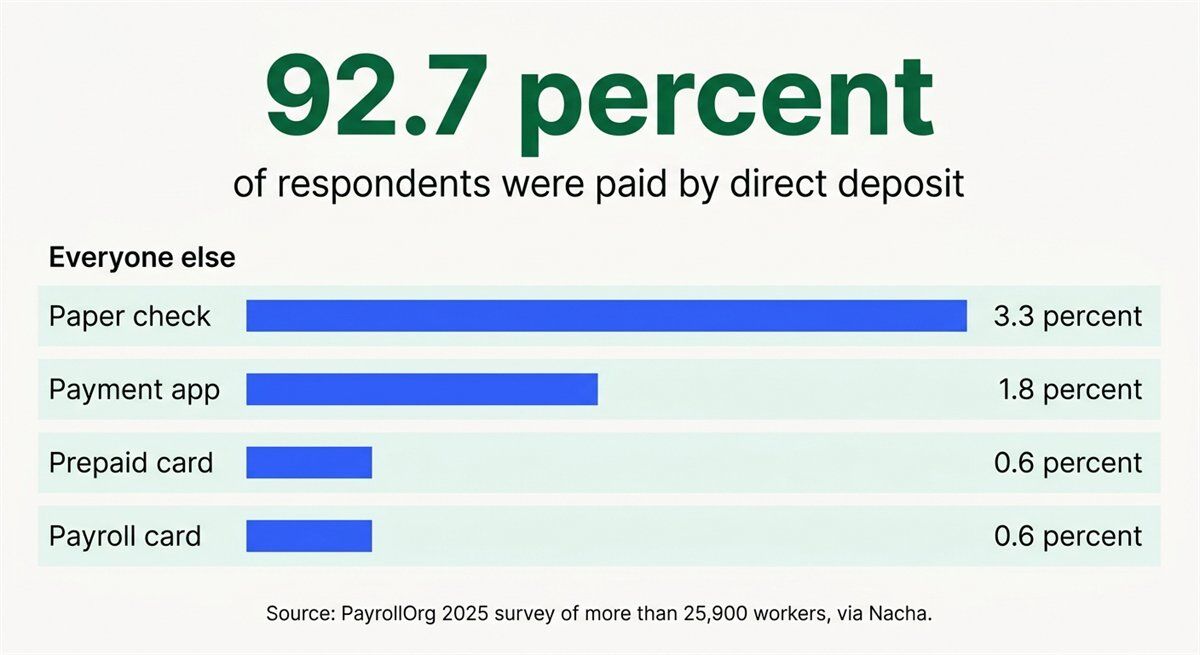
Scale of the problem: in PayrollOrg's 2025 Getting Paid in America survey of more than 25,900 respondents, reported by Nacha, 92.7 percent said their wages arrive by direct deposit. Paper check accounted for 3.3 percent, an online system such as PayPal or Venmo 1.8 percent, prepaid reloadable cards 0.6 percent, and payroll cards 0.6 percent, which is 6.3 percent across those four methods. It was a self-selected online survey run during National Payroll Week, not a probability sample of US workers.
When an app drops the direct deposit rule, it swaps in one of four substitutes. Knowing which one you're facing tells you whether you have a shot.
Every rule below comes from the app's own help center, terms, or product page, all read on August 12, 2026. These pages change without notice, which is exactly how competing articles end up recommending an app that excludes you.
Current's paycheck advance terms, effective July 30, 2026, show what these rules look like in contract language rather than marketing language. The document excludes "non-direct-deposit ACH transfers, inter- or intra-bank peer-to-peer transfers, transfers made to debit cards from digital wallets or P2P services (PayPal, Venmo, Cash App, Zelle, Google Pay, Facebook Pay, or other similar services), mobile check deposits, and cash deposits."
Read that against how you actually get paid. If you photograph your paycheck into your banking app, mobile check deposits are named. If a client pays you through Zelle or Cash App, those are named too. Current does reserve the right to advance you money before it sees an eligible deposit, in its sole discretion, and says that choice "shall not constitute a permanent waiver." A discretionary exception isn't a qualification path.
This is where most readers should stop shopping for apps. Employer-side earned wage access runs on hours worked in a payroll system, not deposits in a bank, so a paper check doesn't disqualify you at all. Payactiv's earned wage access page says exempt, non-exempt, part-time, and salaried workers can all reach earned wages from day one through an opt-in enrollment.
Payactiv's published pricing shows what lacking a direct deposit costs in dollars. A bank ACH transfer taking one to three business days is free. A real-time transfer to the Payactiv Visa Card is free if you have one successful direct deposit of $200 or more to that card per pay period, and $2.49 if you don't.
Instant transfer to a non-Payactiv debit or payroll card runs $3.49, and Walmart cash pickup is also $3.49. The Payactiv card transfer is the clean comparison: free with a qualifying direct deposit to that card, $2.49 without one. Payactiv programs are configured per employer, so your own fees may differ from the published schedule.
ZayZoon pays out to your bank account, its own Visa prepaid card, or instant gift cards, so nothing about your employer's payment method has to change. DailyPay solves it differently by ending the paper check: it deposits your pay into the account you set in the app. All three need your employer to participate, so check whether your employer already offers daily pay before paying any app a subscription.
Here's the answer the roundups skip: every consumer cash advance app in this article needs a checking account it can link and read, which is why the employer-side route above is the only one that pays out without one. Cash in your pocket is invisible to all of them, and Current's terms name cash deposits as ineligible.
The FDIC's 2023 National Survey of Unbanked and Underbanked Households, released November 12, 2024, found 4.2 percent of US households (5.6 million) had no bank or credit union account, and 14.2 percent (19.0 million) were underbanked. If you're in the first group, no app on this page will serve you, and app-hopping won't change that.
There is a slower path that works. Open a checking account, then deposit your cash on a consistent schedule, the same day each week or each pay cycle, into that one account rather than splitting it. Account-age rules above run two to three months, so treat this as a two-to-three-month project, not a fix for this Friday, and get comfortable managing deposits that arrive out of sync while you wait.
EarnIn's Cash Out Link is the one product here whose documentation names benefits income directly. Its income verification article lists a paycheck from an employer, Social Security, Supplemental Security Income, and Veterans Affairs benefits as supported, verified through GPS location signals, a work email, or a guided flow for benefits recipients.
One complication matters. Executive Order 14247 required federal agencies to stop issuing paper checks for most payments as of September 30, 2025, moving recipients to direct deposit or the Direct Express prepaid card, per the federal explainer. Direct Express is not a checking account an app can link, so benefits landing there need to reach a linkable bank account first.
Qualifying by a substitute route almost always costs more than qualifying the ordinary way. Say you need $150 today through EarnIn's Cash Out Link. The service fee is $1.99 on every approved request, including standard ACH that takes one to two business days. Lightning Speed on a request above $75 up to $150 adds $5.99. Total: $7.98, which is 5.32 percent of the $150 you asked for, on a product capped at $150 a day and $1,000 per pay or income period.
Subscriptions stack on top of that. Tilt's $8 a month is $96 a year whether you take an advance or not, and Vola's membership from $3.99 a month is $47.88 a year.
You also can't fall back on an APR to compare these. The CFPB withdrew its earned wage access advisory opinion in May 2025 and took the position in December 2025 that these products are generally not subject to Regulation Z. There's no standardized disclosure box here, so you compare dollars per advance yourself, and the instant-transfer fee is where that math usually turns.
Rerouting your paycheck to satisfy an app guarantees nothing. Complaint narratives in the CFPB Consumer Complaint Database show the pattern repeatedly: one MoneyLion user who switched a direct deposit specifically to qualify wrote that "they couldn't give me reason why I couldn't get a cash advance" (complaint 6307920). A Current user found the offer gone at the moment of request: "There was no cash advance available. It was gone" (complaint 15674153).
Offers also reprice constantly. Dave states eligibility refreshes daily at midnight, and Tilt warns eligibility can change quickly.
Advertised maximums rarely match a first advance, because a published ceiling describes the best-qualified user rather than an offer to you. Cleo AI agreed to pay $17 million in March 2025 to settle FTC allegations that it deceived consumers about how much money they could get and how fast, detailed in the FTC's announcement.
Based on their own documentation read on August 12, 2026, Dave, Cleo, Albert, Vola, Tilt, SoLo Funds, and Gerald publish no direct deposit requirement. Each substitutes something else: deposit-pattern analysis, its own bank account, a purchase gate, or peer funding. Brigit and Current both require qualifying deposits.
Sometimes, but not from Brigit, which excludes paper checks by name, or Current, which excludes mobile check deposits. Your stronger route is employer-provided earned wage access such as Payactiv or ZayZoon, which qualifies you on hours worked rather than deposits.
Not directly. Every consumer cash advance app covered here requires a checking account it can link and read, and Current's terms name cash deposits as ineligible. The practical path is opening an account and depositing cash on the same schedule each pay cycle for two to three months to build a visible pattern.
None of the apps reviewed here publish a pay-stub-upload path on their own help pages, despite several roundups claiming otherwise. EarnIn's Cash Out Link verification article lists only GPS location signals, a work email, or a guided flow for benefits income. Check inside the app rather than trusting a third-party list.
Rarely, because most apps need to link a checking account and debit it on your payday. Payactiv is the useful exception: it pays out to a non-Payactiv debit or payroll card instantly for $3.49, or offers Walmart cash pickup for the same $3.49, per its published pricing schedule.
No. Approval also turns on account age, balance, transaction volume, and repayment capacity, and offers move daily. Dave states eligibility refreshes at midnight each day. One CFPB complaint narrative describes a MoneyLion user who switched a direct deposit to qualify and was still declined without an explanation.
EarnIn's Cash Out Link lists Social Security, SSI, and VA benefits as supported income types, verified through a guided flow for benefits recipients. The catch is that benefits paid onto a Direct Express prepaid card cannot be linked, so the payments would need to arrive in a checking account instead.

Chime's own SpotMe and MyPay fees and limits, plus which cash advance apps confirm Chime support on their own help pages.
Read article
Gerald advertises zero fees, but a store purchase unlocks the transfer. Limits, speed, eligibility, and who it actually suits.
Read article
We verified Money App's fees, limits, and BBB record so you know exactly what to expect before you link your bank account.
Read articleSee how the top earned wage access apps stack up on fees, limits, and speed. View the full ranking