September 25, 2026
Earned Wage Access Explained: How EWA Works
What is earned wage access? How the two EWA models work, what they cost, and how to tell if your employer offers it.
Read article

The claim is true. When you open a cash advance app with no credit check, nobody pulls your FICO score before deciding whether to front you 100 dollars. It is not the same thing as nobody looking. Something still gets read. Something still gets scored, and an answer comes back in seconds. The file it comes from is one you write yourself, every day, without meaning to: your checking account.
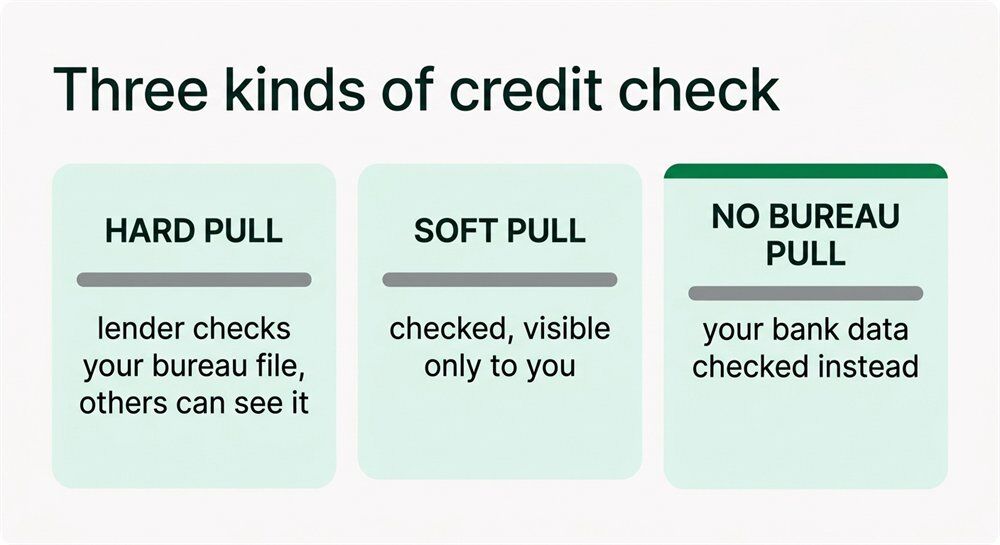
Three different things get called a credit check, and only one costs you anything. A hard inquiry is a lender's request to see your credit report for a lending decision. Experian, which runs one of the three nationwide bureaus, puts the typical cost of a single hard inquiry at fewer than five points, and says inquiries stay on your report for two years but stop affecting your score after one.
A soft inquiry is a look at your file for screening, prequalification, account review, or your own score check. You see it when you pull your report. Other lenders do not, and it costs you nothing.
Most direct-to-consumer advance apps do neither. No request reaches Experian, Equifax, or TransUnion, so nothing lands on your report at all, in either form. The decision happens somewhere the bureaus never see.
If a collections account or a thin file has been getting you turned down everywhere, that is good news. Take twenty advances, repay every one on time, and your score on payday twenty-one is what it was the day you signed up. The mechanism that shields you from the denial locks you out of the credit for the repayment.
Skipping the credit check is not a courtesy. It is a legal condition, and the reason is now written down.
On December 23, 2025, the CFPB issued an advisory opinion concluding that a "Covered EWA" product is not credit under Regulation Z, the rule that carries Truth in Lending Act disclosure duties. Goodwin's analysis lists the conditions, and two of them decide this article: the product must "use payroll process deductions" and "involve no credit risk assessment of individual workers". Underwriting you like a lender would make the provider one.
Another condition is non-recourse. Morrison Foerster's write-up quotes the standard: the provider "does not seek repayment beyond the payroll deduction, does not refer the obligation to a third-party debt collector or credit reporting agency". Read that list as a design spec and the category snaps into focus.
Here is the part almost nobody states honestly. Most apps do not clear the payroll-deduction condition, because they repay themselves by debiting your checking account on payday rather than pulling from the payroll system, so they fall outside the Covered EWA definition. Goodwin is careful about what follows: the opinion does not say products outside that definition are therefore credit. Their status is unresolved, and employer programs repaid by payroll deduction work differently from the app on your phone.
Not everyone accepts the Bureau's framing. The National Consumer Law Center, a consumer advocacy group, rejects it outright: "Earned wage payday loans are loans, and just like traditional payday loans they trap consumers in a cycle of debt with exploding fees," says NCLC's Lauren Saunders, who points to federal decisions in several states rejecting similar claims by EWA lenders. Treat the December 2025 opinion as where the regulator stands today, not as a closed question.
Underwriting still happens. It just runs on the account you linked. Five signals carry most of the weight:
NerdWallet's review of Klover lists the app's requirements as a US location, an active checking account in good standing for at least 90 days, and at least three direct deposits from the same employer in the last 60 days, with the names matching. Not one item on that list is about you as a borrower. Every one of them is about the account, which is why some providers can advance without a direct deposit at all.
Does reading a bank file actually predict anything? FinRegLab, an independent research nonprofit, tested cash-flow underwriting and found that it ranks risk among applicants who look identical under a traditional score, and helps most for people with too little history to score at all. In its simulations at mainstream risk cutoffs, models using cash-flow data increased approvals by roughly 4 percent.
The connection is read-only, and that phrase does real work: the app cannot push money out through it. Read-only does not mean it sees less. It means it cannot move anything while it looks at everything.
Plaid, the data aggregator behind a large share of these connections, names the categories in its End User Privacy Policy. Account identifiers include "account name, account type, account ownership, branch number, account number, routing number, and sort code." Balances cover "current and available balance." Transactions carry "amount, date, payee, type, quantity, price, location, involved securities, and a description." Identity data includes "name, email address, phone number, date of birth, and address information".
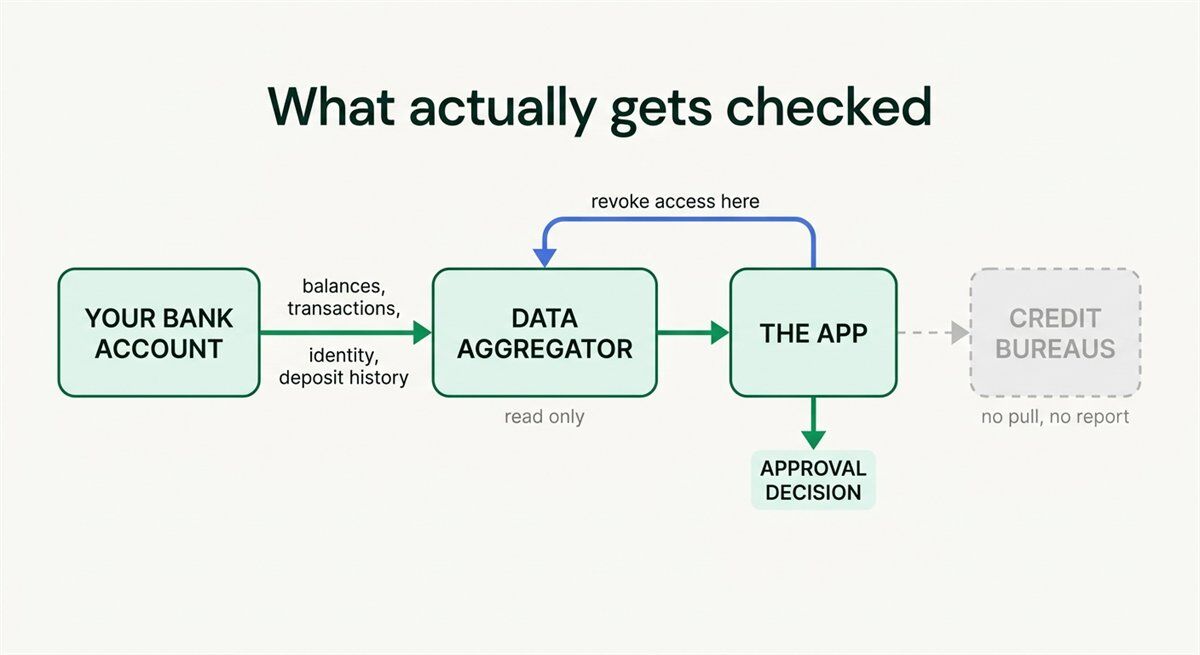
Read that transaction list again and find the word "location." Merchant location travels with the purchase record. People searching for a cash advance app that does not use Plaid are reacting to exactly this, and the instinct is not paranoid, just imprecise. The worry is not that a pipe exists, but how much rides through it and who keeps a copy at the far end.
Plaid says in the same policy that it is not a consumer reporting agency itself. The aggregator is plumbing, not a bureau. What the app does with its copy is governed by the app's own privacy policy, which is a separate document, and separate again from whether these apps are safe to install at all.
Some providers verify employment directly. EarnIn's help center describes a GPS earnings feature that adds earnings based on your work address: it requires a fixed physical work location, rules out remote work and travel during working hours, and expects your phone on site. EarnIn says it does not track your hours and confirms work status through a work email or GPS.
Klover states the trade in its own marketing, promising cash advances "by leveraging your most valuable asset: your data" on the same page that advertises no credit check. NerdWallet's review adds the detail that matters: users are auto-enrolled in a points program collecting demographic, device, geolocation, payment, and other sensitive data shared with advertising partners, and opting out by email may affect access to the advance. The check is skipped, and something else gets priced in its place.
Then there are the bureaus you have never checked. The CFPB's own company record describes Clarity Services, a nationwide specialty consumer reporting agency owned by Experian, as collecting information on payday loans, installment loans, and other financial services aimed at subprime markets. Teletrack is the Equifax-owned equivalent. No public disclosure from Dave, Empower, MoneyLion, or Klover confirms that any of them pulls either file, and you can request your own Clarity report free once every 12 months.
Mostly, no. NerdWallet's review states plainly that Klover runs no credit check at signup and does not report your repayment to the credit bureaus. Silence in both directions is the norm across the category.
One distinction gets mangled constantly. Dave's privacy policy says personal information may be shared with third parties "such as identification verification companies, consumer reporting agencies, payment validation companies, law enforcement agencies, or others". Sharing data with a consumer reporting agency to verify who you are is a different act from reporting your repayment history to one. The second builds a file about your borrowing, and that policy does not say Dave does it.
Deleting the icon ends nothing. There are two layers here, and the app on your home screen is neither of them.
Layer one is the aggregator connection. Plaid Portal, at my.plaid.com, shows the accounts you have connected to apps through Plaid and the data shared with each, and gives you controls to terminate those connections. Plaid's policy says that when a developer removes a connection, "Plaid's systems are designed to automatically delete your personal data."
Underneath that sits the copy the app already pulled. The deletion promise governs what Plaid holds, not what lives in the app's own database. Cutting the connection stops future sharing, but it does not reach backward, so ask the app directly, in writing, and keep the reply. Cancel any subscription separately too, because deleting an app does not stop a monthly fee.
Federal law has an answer on paper. Under 12 CFR 1033.421, an authorized third party must limit its collection, use, and retention of your data to what is "reasonably necessary to provide the consumer's requested product or service," which rules out targeted advertising, cross-selling, and data sales. The same section caps an authorization at one year and requires a revocation method "as easy to access and operate as the initial authorization".
Now the honest part. The CFPB opened a reconsideration of the rule in August 2025, and Moore and Van Allen reports that on October 29, 2025 the US District Court for the Eastern District of Kentucky enjoined the Bureau from enforcing it while that reconsideration runs. The rights sit in the rulebook and are not currently being enforced, so your working tools today are the aggregator's portal and the app's own policy.
Under the Fair Credit Reporting Act at 15 U.S.C. 1681m, anyone who takes adverse action based in whole or in part on information in a consumer report has to tell you, name the agency that supplied it, and tell you about your right to dispute and to a free copy of the report within 60 days.
Every word of that duty depends on a consumer report being used. No report, no trigger, no FCRA notice owed. That is the unsatisfying but accurate answer to why an app can decline you and reply with nothing you can act on.
Whether the Equal Credit Opportunity Act and Regulation B impose their own notice duty on an advance denial is a separate and genuinely unsettled question. ECOA defines credit on its own terms, and the December 2025 advisory opinion addressed Regulation Z only. Nobody should tell you confidently that no notice is ever owed here, including me.
What a denial does mean is narrower than it feels. It is a read of your cash flow on the day you asked. Nothing enters a file. A different provider running a different model on the same account can approve you an hour later.
Four triggers explain most rejections, and all four are checkable:
An approval here is not a compliment, and a denial is not a mark against you. Both describe one bank account as it looked on the day you asked, and that is something you can change faster than a credit score.
Most do not contact Experian, Equifax, or TransUnion, so there is no hard or soft inquiry on your credit report. They underwrite from your linked checking account instead, reading deposit patterns, balance lows, overdrafts, and account age. The CFPB's December 2025 advisory opinion makes running no credit risk assessment a condition for staying outside Regulation Z.
The advance itself will not, because no inquiry is made and no repayment history is furnished to Experian, Equifax, or TransUnion. Watch the auto-debit instead: if it overdraws your account, your bank's own fees and consequences still apply, and those are a separate matter from your credit report.
The advance product itself does not build credit, since repayment is not reported to Experian, Equifax, or TransUnion. Some providers sell a separate card or credit-builder account that does report, which is a different product with different terms. Check which one you enrolled in.
Plaid's End User Privacy Policy lists account and routing numbers, current and available balances, transaction records including amount, date, payee, description and location, and identity data such as name, email, phone, date of birth, and address. The connection is read-only, so it cannot move money.
Terminate the connection at the aggregator's portal, such as my.plaid.com, then email the app asking it to delete the data it already collected, then cancel any subscription separately. The federal revocation right in 12 CFR 1033.421 is not currently being enforced, following an October 29, 2025 injunction, so use the portal.
A denial reflects your bank data on the day you applied: an account open too briefly, deposits that vary in size or source, a balance that went negative, or a name mismatch. Because no consumer report was used, the FCRA adverse action notice is not triggered, which is why an app can decline without explaining. Whether ECOA requires a notice here is unsettled.
Generally no. NerdWallet's review of Klover confirms it does not report repayment to the bureaus, and the CFPB's Covered EWA conditions bar a qualifying provider from referring the obligation to a debt collector or credit reporting agency.

What is earned wage access? How the two EWA models work, what they cost, and how to tell if your employer offers it.
Read article
Don't want Plaid reading your bank data? See which cash advance apps offer a real non-Plaid path, and what you trade off to get it.
Read article
See exactly how cash advance apps work, from linking your bank to the payday auto-debit, so nothing about them feels mysterious.
Read articleSee how the top earned wage access apps stack up on fees, limits, and speed. View the full ranking