September 9, 2026
Cash Advance Apps That Don't Use Plaid (2026)
Don't want Plaid reading your bank data? See which cash advance apps offer a real non-Plaid path, and what you trade off to get it.
Read article


Picture a warehouse worker three days from payday with a car repair bill due today. She's already worked the hours, and the shift is logged. The paycheck just hasn't landed yet. That gap between work done and money in the bank is exactly what earned wage access exists to close.
If you've seen "EWA" mentioned in an HR onboarding email or noticed an app promising instant access to your pay, you've bumped into earned wage access. Earned wage access, usually shortened to EWA, lets a worker draw on wages they've already earned before the regular payday arrives. It sounds simple because, at the core, it is.
How that money reaches your account, what it costs to get there, and whether the law treats it like a loan all depend on which version of EWA you're using.
Strip away the branding and every EWA transaction follows the same basic sequence. A worker clocks hours. Those hours get logged, either through an employer's payroll and time-tracking system or estimated from a worker's bank-account activity. A provider verifies, or estimates, how much the worker has earned so far in the current pay period.
From there, the worker requests an advance on some portion of that amount, and the advance gets issued. Then, on the actual payday, the advance gets repaid, either automatically or through the normal paycheck process. That last step, repayment, is where the two models diverge sharply, and it's worth understanding before you ever tap "request advance" on anything.
The Congressional Research Service, which studies these products for Congress, lays out the mechanical split clearly: one model ties directly into payroll data, and the other doesn't touch payroll at all.
Think about what each version actually requires to work. A payroll-linked provider needs your employer's cooperation and a data feed it can trust, so it knows with certainty that you worked the hours you say you worked. A bank-linked provider needs none of that access, but it also has no certainty, only a pattern it's reading from your deposit history. That difference in what each model can actually verify is the root of nearly everything else that separates them, from how much they'll let you draw to how they get repaid.
Here's the distinction that matters most for a reader trying to make sense of EWA. Is it coming through your employer, or did you download it yourself?
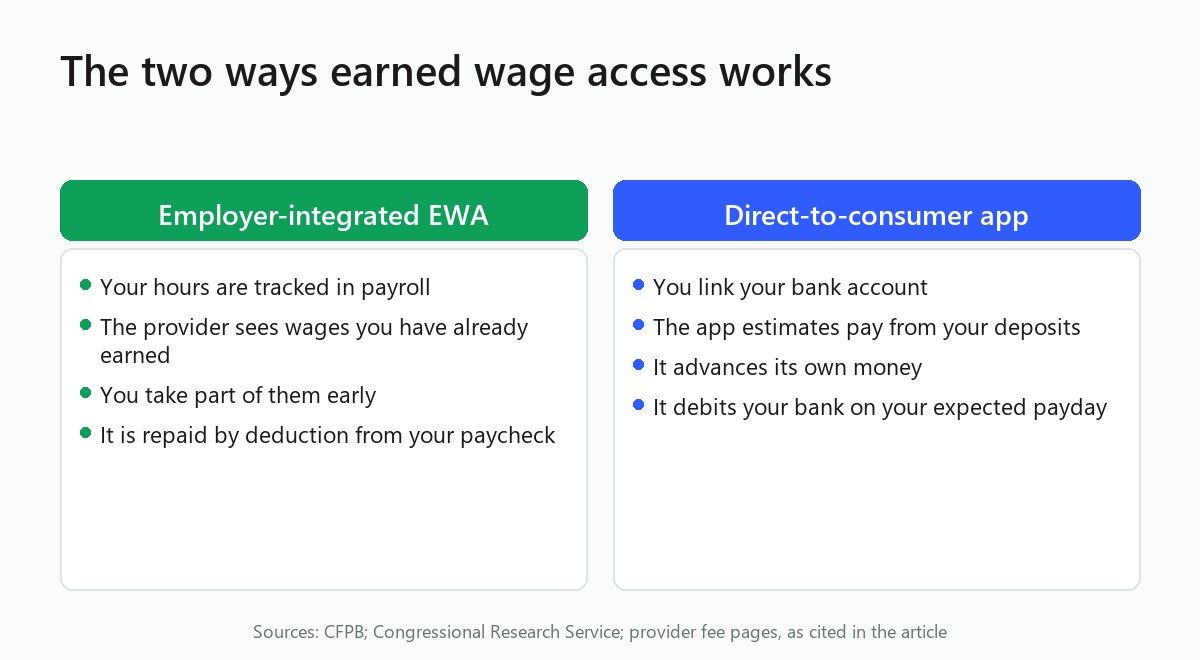
Employer-integrated EWA is offered as a payroll benefit. Your employer partners with a provider that plugs directly into the company's time-and-attendance and payroll systems. Because the provider can see actual hours worked and actual pay rates, it caps what you can draw at wages you've genuinely accrued. Repayment happens through an automatic payroll deduction on your normal payday, and the provider never touches your personal bank account at all.
Direct-to-consumer EWA works differently because it has to. These are apps you find and sign up for on your own, with no connection to your employer's payroll system. Since the app can't see your actual timesheet, it estimates your earnings from your bank-transaction history and your typical deposit pattern.
It advances its own money, not money your employer has released, and recovers it by debiting your linked checking account on a payday the app has to guess at. That guess is where real friction shows up.
A recurring complaint from EarnIn users illustrates the same friction from another angle: the app disconnecting from a linked bank account and requiring re-verification, which can lock a worker out of an advance for a day or two right when it's needed most.
A worker whose pay date shifts by even a day can end up with a direct-to-consumer app pulling its repayment before the paycheck actually clears. That pushes the checking account negative right when the worker can least afford it. An employer-integrated advance, tied to the same payroll system that issues the paycheck, generally can't make that mistake, because it's repaid from the payroll run itself rather than a guess about your bank activity.
For the full breakdown of how these two models compare on cost, our dedicated comparison of employer EWA versus consumer apps is worth reading next.
There is no single price tag for earned wage access, and any article that tries to give you one number is oversimplifying. Cost depends heavily on which model you're using and which specific company you're using. A few named examples make the pattern clear.
Payactiv, an employer-integrated provider, caps access at 50% of accrued wages, waives its fee entirely if the employer maintains a $200 direct-deposit minimum for the pay period, otherwise charges $1.99, and structures its advances as a self-funded factoring arrangement, according to its own fee schedule.
On the direct-to-consumer side, EarnIn's own fee schedule caps standard advances at $150 a day and $1,000 a pay period, with a tiered instant-transfer fee between $3.99 and $5.99. Chime MyPay, which sits closer to the payroll-adjacent end of the direct-to-consumer category, lets eligible users draw $20 to $500 a period and charges roughly 3% for instant transfers, landing between $2 and $5, according to its published rates.
Costs don't average out into a single category figure; stacking these companies into one number would flatten a real difference between how employer-backed and app-based products are built. Our earned wage access fees breakdown covers the full cost mechanics provider by provider.
One more figure is worth knowing, with a clear caveat attached to it. California's Department of Financial Protection and Innovation found, in an analysis of 2021 data covering nearly 6 million EWA transactions across seven companies in the state, that the effective APR on tip-based advances averaged 334%, with fee-based advances averaging 331%, numbers comparable to licensed payday lenders in California.
That figure reflects the direct-to-consumer style of product specifically, not employer-integrated advances. California has since built a newer registration and annual-reporting regime for EWA providers, but no updated public APR figure has come out of it yet. Treat the 334% and 331% numbers as a historical snapshot from 2021 of how expensive a small, short-term advance can look once annualized, not as today's rate.
This is the question regulators can't seem to settle, and it matters because the answer decides whether a provider has to follow lending laws, disclose an annual percentage rate, and cap what it charges the way a payday lender would.
The federal government's position just shifted again. In an advisory opinion effective December 23, 2025, the Consumer Financial Protection Bureau stated that what it calls "Covered EWA" products, those that draw only on wages already accrued using actual payroll data, get repaid through payroll deduction, carry no recourse against the worker if a deduction comes up short, and involve no credit-risk underwriting of the individual worker, are not "credit" under the Truth in Lending Act.
That opinion formally reverses a 2024 proposed rule from the same agency that had leaned the opposite way, toward treating many EWA products as regulated credit. Worth saying plainly: this is the CFPB's current position, as of December 23, 2025, not a permanent legal settlement. An advisory opinion carries less legal weight than a formal regulation, and this Bureau has already reversed itself once on this exact question. It could do so again.
States haven't waited around for Washington to decide. Five states have passed their own laws concluding that qualifying EWA is not a loan under their state definitions: Nevada, Missouri, Kansas, Wisconsin, and South Carolina. None of these states left EWA unregulated, though. Each built its own licensing or registration regime specific to EWA providers, so "not a loan" doesn't mean "no rules."
Connecticut went the other direction entirely. Its law, signed by Governor Ned Lamont and effective October 1, 2025, classifies an earned-but-unpaid wage advance under $750 as a small loan requiring a license under the state's Small Loan Act, according to Bloomberg Tax's coverage of the statute. It caps the finance charge at $4 per advance or $30 per month and requires providers to offer at least one no-cost option. Our Connecticut earned wage access law page covers the details in full.
Some providers have also faced legal challenges from state attorneys general arguing that certain products function like loans regardless of how they're marketed. That's a reminder that "not a loan" is a live legal argument in some places, not a universally settled fact. Texas, California, Florida, and New York each take their own regulatory approach too, and each has a dedicated page on this site walking through the specifics. For a direct comparison between EWA and the payday loans it sometimes gets lumped in with, our EWA versus payday loans guide breaks down the legal and cost differences side by side.
If your employer offers EWA as a benefit, it usually shows up in one of two places: your HR onboarding materials or your payroll app itself. Check your benefits portal for a line item naming a specific provider, such as DailyPay or Payactiv, or wording about early access to wages you've already earned.
Your paycheck may already come through a payroll app on your phone, in which case it's worth looking for a tab or button related to early access to earnings before assuming the benefit isn't there. If a line item on your pay stub or benefits portal is unclear, your HR contact or payroll department can confirm whether it's an EWA benefit in a quick conversation, rather than leaving you to guess. Not sure where to start? Our guide on checking whether your employer offers DailyPay or a similar benefit walks through exactly what to look for and who to ask.
An employer that doesn't offer EWA doesn't lock a worker out of the concept entirely, since direct-to-consumer apps don't require employer participation at all. That accessibility is real, but so is the tradeoff.
Without a payroll connection, these apps are working from estimates rather than verified hours, and the fee structures differ from what an employer-sponsored benefit would offer. If you're weighing which app fits your situation, our comparison of the leading earned wage access apps lays out the options.
Earned wage access can genuinely help close a short, predictable gap. Think of the kind a shift worker hits when a bill lands three days before payday and the money to cover it is already sitting there, earned, just not yet paid out. Reaching for it once in a while, for a gap you can point to, is a different thing entirely from pulling an advance every single pay period.
That second pattern deserves a second look. If an advance has become part of how you cover routine expenses rather than an occasional bridge, the fees add up over a year in a way that's easy to lose track of, even at a few dollars a transaction. For a closer look at whether it fits your situation, our earned wage access self-check walks through the questions worth asking before you sign up for anything.
Earned wage access is a way for a worker to receive part of the wages they've already earned in a current pay period before the scheduled payday, either through an employer-sponsored benefit or a standalone app.
They work differently. A payday loan is new borrowed money repaid with interest, while EWA advances wages you've already earned for a fee, recovered from your paycheck or bank account. Connecticut still regulates EWA as a small loan, and some state attorneys general have challenged the "not a loan" framing, so the answer can depend on your state and product.
Under a CFPB advisory opinion effective December 23, 2025, earned wage access products that meet four conditions, including repayment through payroll deduction and no credit-risk underwriting of the individual worker, are not classified as "credit" under the Truth in Lending Act. That's the CFPB's current position, not a permanent legal settlement, and it only applies to products meeting all four conditions.
No, not for direct-to-consumer apps. Those are downloaded and used independently of any employer relationship. Employer-integrated EWA, by contrast, only works if your employer has partnered with a provider and connected it to their payroll system.
Nevada, Missouri, Kansas, Wisconsin, and South Carolina have each ruled that qualifying EWA is not a loan. Connecticut regulates it as a small loan instead. Texas, California, Florida, and New York each take their own approach; see our state law pages for where you live.

Don't want Plaid reading your bank data? See which cash advance apps offer a real non-Plaid path, and what you trade off to get it.
Read article
No credit check does not mean no underwriting. See what cash advance apps really read in your bank data, and what a denial means.
Read article
See exactly how cash advance apps work, from linking your bank to the payday auto-debit, so nothing about them feels mysterious.
Read articleSee how the top earned wage access apps stack up on fees, limits, and speed. View the full ranking