September 25, 2026
Earned Wage Access Explained: How EWA Works
What is earned wage access? How the two EWA models work, what they cost, and how to tell if your employer offers it.
Read article


If you've ever paused before tapping "Link Bank Account" inside a cash advance app, wondering why a $75 advance requires handing a company called Plaid access to months of your transaction history, you're not overreacting. A genuine cash advance app that doesn't use Plaid does exist, but the honest answer is narrower than most comparison lists make it sound. A small number of apps document a real non-Plaid path in their own help centers. Several others get listed as "Plaid-free" by roundup sites that never checked the app's own disclosure page, and it turns out they run on Plaid anyway.
Plaid is a financial data aggregator, a company that connects your bank account to the apps you choose to use and relays account and transaction data between the two. Cash advance apps lean on aggregators like Plaid because they typically skip a traditional credit check when deciding how much to advance you. What they need instead is a fast read on your income pattern and your current balance, and Plaid is built to deliver that in seconds rather than days.
Once you link your bank through Plaid, the app can see your recent deposits, how often they land, and whether your balance dips low before payday. That transaction history works as an underwriting signal, doing much of the job a credit score does at a traditional lender. Empower's own support page describes this sequence directly: the app connects an external account through Plaid, then determines Cash Advance eligibility after that link is complete.
FloatMe's help center describes a similar arrangement, where Plaid handles both the account connection and the repayment collection. The speed is the entire point here. Plaid condenses what would otherwise be a slower manual review into an instant handshake, which is why an instant or same-day advance almost always assumes a Plaid connection somewhere in the pipeline. Our guide to how the bank-linking step fits into the larger process walks through the rest of the approval flow.
Plaid groups what it collects and can share into named categories, and knowing them cuts through a lot of the vague "it reads your bank data" framing you'll find elsewhere. According to Plaid's own data-handling disclosure, those categories include Auth (your verified account and routing numbers), Identity (your name, address, and other account-holder details), Transactions (Plaid says up to 24 months of categorized transaction data), Balance (real-time balance checks), Investments (retirement, brokerage, and crypto holdings), Liabilities (credit card and mortgage data), and Identity Verification (the checks apps use to confirm you are who you say you are).
A cash advance app typically only needs a slice of that full list. Auth confirms the account is real, while Balance and Transactions supply what the app needs to size your advance. It rarely needs your Investments or Liabilities data, though the technical connection can, depending on how the app configures its Plaid integration, be capable of requesting more than it strictly uses for underwriting.
Plaid also states that you control whom your data is shared with, for what purpose, and for how long, and that the company does not sell or rent your personal information; access can be reviewed or revoked at any time through Plaid Portal, Plaid's own dashboard for connected apps. Those are Plaid's own policy commitments, a company promise it sets and can change itself, distinct from a guarantee written into federal law. For a broader look at how these apps handle account access, see our coverage of app security and bank access permissions.
Other financial data aggregators operate in the broader fintech market too, and some financial apps build their bank-linking on a different vendor entirely. None of the cash advance apps in this research documents using an alternative aggregator instead of Plaid on its own help pages, so Plaid is named specifically here because that's what these apps themselves disclose.
Two structurally different answers exist for a reader who wants to skip Plaid, and they solve the problem differently. One keeps Plaid on the table but makes the connection optional. The other skips bank-data aggregation of any kind, Plaid included, by pulling from payroll instead.
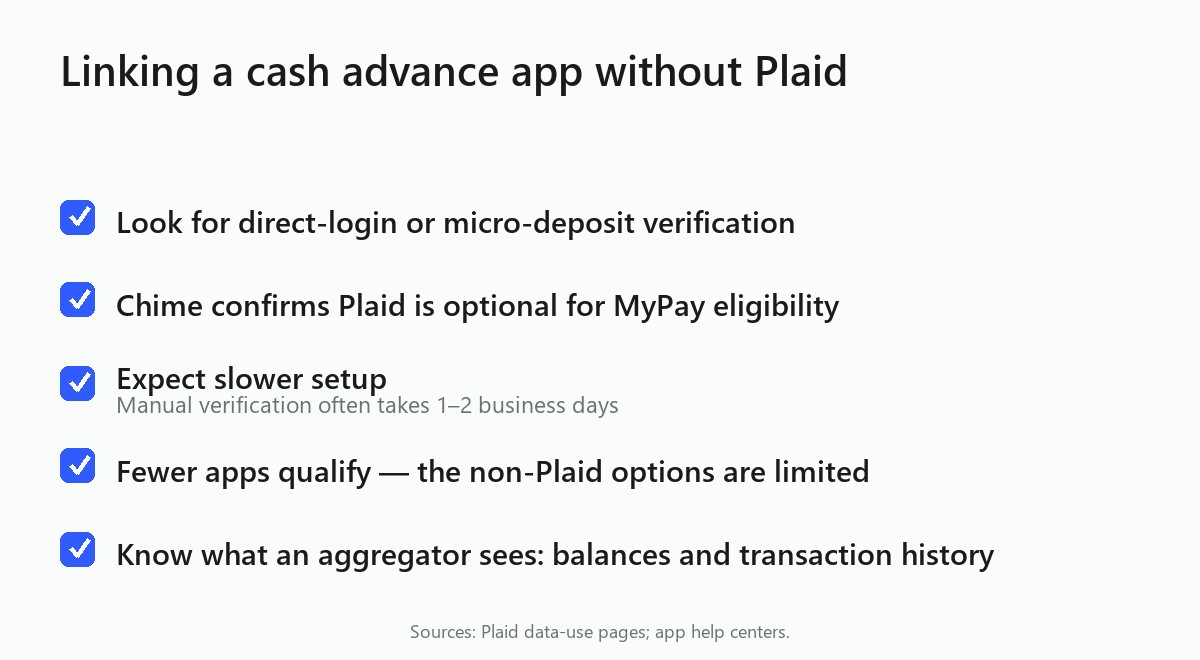
Chime MyPay is the cleanest example we found of an app that documents Plaid as optional rather than mandatory. Chime's own help center states plainly, "Linking to Plaid is optional and may allow you to access more from MyPay."
In practice, that means a Chime member can base MyPay eligibility on their existing Chime Checking Account activity, a source Chime already manages internally, rather than authorizing a fresh Plaid connection to an outside bank. The same help center page also describes linking work email or work location data, or connecting through Pinwheel, a payroll-data connector that operates separately from Plaid, as additional ways to expand what MyPay can see.
The distinction that matters here is narrow. Chime still asks for some data to size your advance, but the source of that data doesn't have to be a Plaid connection to an outside account. For a Chime member who already banks there and doesn't want a second company reading transaction history from an external account, that existing-activity path is a real, Chime-documented non-Plaid option.
The other route around Plaid skips bank-account data altogether, because it isn't looking at your bank account in the first place. Employer-sponsored earned wage access, often shortened to EWA, works through your employer's payroll and time-tracking systems instead of your bank.
Payactiv is the clearest documented example available. Its own site describes integrating directly with an employer's payroll and HR systems through a Census Feed for basic employee and pay information, a Time & Attendance Feed for hours already worked, and a Deduction Feed that reports advances back to payroll for repayment. No bank-data aggregator sits anywhere in that chain, Plaid or otherwise, because eligibility is calculated from hours you've already logged on the clock rather than a running balance in a bank account.
This is a structurally different answer than an app that simply makes Plaid optional: the underlying product runs on payroll data instead of bank data by design. The practical catch is availability. Employer-based EWA isn't something you download and sign up for individually the way a bank-linked app works; it depends on whether your employer has adopted a program like Payactiv or a similarly structured payroll-integration product from another provider.
For a reader specifically worried about a third party reading transaction history, this model is the more complete answer of the two. Your employer already has your hours and pay rate on file to run payroll, so nothing new gets exposed to an outside aggregator, Plaid or otherwise, that your employer didn't already hold as part of paying you. If your employer offers one, it sidesteps bank-account linking entirely. For a full cost comparison between this model and bank-linked apps, our breakdown of employer-based options that skip bank-linking entirely goes into more detail.
Several apps show up on "Plaid-free" lists across comparison sites, but two of the most commonly cited ones say the opposite about themselves once you check their own pages.
Possible Finance's own help center describes verifying account ownership "when you link a primary account with Possible through Plaid." That's Possible's own stated language, and it directly contradicts any list naming Possible as a Plaid-free alternative.
FloatMe has the same problem. Its help center states that the app "accesses banking information, makes deposits, and collects repayment using Plaid," with the connection running through Plaid Portal. Like Possible, FloatMe shows up regularly on roundup lists as a non-Plaid pick, and its own disclosure, cited earlier in this article, says otherwise.
The pattern extends beyond these two. Brigit's help center confirms it "works with Plaid" for bank connections. EarnIn's bank-connection troubleshooting article walks through resolving errors "if you encounter issues connecting your bank through Plaid," confirming Plaid is part of its verification stack as well. Current, a banking app that also offers advances, titles its own external-account help article "How do I link my Current Account through Plaid."
None of this means these apps are doing anything wrong. Plaid is a mainstream, widely used tool across this industry, and using it is the default rather than the exception. Older reviews and outdated roundups also get recycled across the web faster than app verification methods actually change, so a claim published once tends to get copied onto the next comparison site without a re-check. It just means a list calling one of these apps "Plaid-free" didn't check the app's own page before publishing.
This matters in practice. Picking an app because a roundup calls it Plaid-free, then hitting Plaid's own consent screen mid-signup, defeats the purpose you started with. Checking the app's own help center before you download it takes a few minutes and settles the question with certainty, in a way a third-party list cannot.
Avoiding Plaid comes with real costs, and it's worth naming them plainly instead of pretending the choice is free.

Verification usually takes longer. A manual or micro-deposit verification path, the kind of check an app runs when it isn't using an instant Plaid connection, commonly takes one to two business days rather than the near-instant connection Plaid provides, according to FloatMe's and EarnIn's own help center pages, both cited earlier in this article, describing this exact tradeoff.
Your starting limit may run lower too. Plaid-linked apps look at transaction history to size an advance, and an app without that same depth of visibility, or one that hasn't built a long relationship with your account yet, has less financial history to underwrite against. That tends to produce a smaller or more cautious starting limit, though actual limits vary by app. Our ranking of cash advance apps with high limits explains why slower verification often means a lower starting limit to begin with.
The pool of participating banks and credit unions shrinks as well. Workers who bank with a smaller institution sometimes report that Plaid can't find or connect to their bank at all, one of two common frustrations with Plaid-based linking generally (the other being discomfort with a third party seeing months of transaction history instead of just a balance). A manual or non-aggregator verification path doesn't inherit Plaid's reach, so an app avoiding Plaid may simply not support your bank yet.
Your list of apps narrows too, and that's the honest bottom line. Most cash advance apps default to Plaid because it's the fastest, most broadly supported option to build against. Once you rule out apps that use Plaid, the field left standing is small: an optional-Plaid model like Chime MyPay, and employer-based EWA if your workplace happens to offer it. That's a real, if short, list, and our guide to how to choose a cash advance app walks through weighing a short list like this one against cost and speed.
These tradeoffs don't make Plaid the wrong choice for every reader, and they don't automatically make avoiding it the right one either. If speed and a higher starting limit matter most to you right now, an app that uses Plaid is probably still the more practical pick. If avoiding a third-party aggregator matters more, the non-Plaid path documented above is worth the tradeoff.
For consumers who care more about access to funds than avoiding a specific bank-linking service, it may also make sense to look beyond EWA apps. Other online cash advance options can connect consumers with lenders and lending partners, giving them another route to explore when an app does not meet their needs.
Plaid says it does not sell or rent your personal data and that you control who can access it, with the ability to review or revoke access anytime through Plaid Portal. That's a company policy rather than a law, so trusting it means trusting Plaid's own stated practices, not a legal guarantee.
Yes. Plaid Portal, Plaid's own dashboard for connected apps, lets you review every app connected to your data and revoke any one of them individually, at any time. Revoking access there stops that app from receiving new data through the Plaid connection going forward.
Often, yes. Apps that rely on deep transaction history to size an advance tend to offer less when that history isn't available through an instant connection, though limits vary by app and by your verified income, and none of the apps checked for this article publishes a non-Plaid limit figure.
No, but most confirmed in this research do. Brigit, Empower, FloatMe, Possible Finance, EarnIn, and Current all confirm Plaid use in their own help centers, each cited earlier in this article. Chime MyPay documents Plaid as optional, and employer-based programs like Payactiv skip bank-data aggregation altogether.
An app where Plaid is optional, like Chime MyPay, may still request other data instead, but it doesn't require a Plaid connection specifically, as its help center describes earlier in this article. A genuinely non-Plaid model, like employer-based EWA, never asks for bank-account data as part of how it works at all.

What is earned wage access? How the two EWA models work, what they cost, and how to tell if your employer offers it.
Read article
No credit check does not mean no underwriting. See what cash advance apps really read in your bank data, and what a denial means.
Read article
See exactly how cash advance apps work, from linking your bank to the payday auto-debit, so nothing about them feels mysterious.
Read articleSee how the top earned wage access apps stack up on fees, limits, and speed. View the full ranking