August 25, 2026
Emergency Cash Advance App: Fastest Options & Cost
Bill due this week? Compare the fastest emergency cash advance apps, real instant-transfer fees, and cheaper options to try first.
Read article


You've probably already done the responsible thing: you searched "cash advance app reddit" before you downloaded anything, because the app store reviews all sound suspiciously alike and the company's own website is obviously not going to tell you where it falls short. That instinct is a good one. When money is tight enough that you're considering an advance on your own paycheck, you want the version of the story that isn't written by marketing.
Here's the honest answer to what you'll find if you type "money app cash advance reddit" into a search bar and start reading: a lot of scattered opinions, a handful of recurring themes, and very little consensus on any single "best" app. What does repeat, thread after thread and subreddit after subreddit, is a set of specific complaints and a set of specific pieces of advice. This piece pulls those patterns together, cross-checks them against actual regulatory records where they exist, and skips the parts nobody can verify.
One thing worth saying up front: this article does not quote specific Reddit posts, usernames, or upvote counts. Anyone who tells you exactly what a specific thread said, with a specific number attached, is either linking you to it or making it up. What follows instead is the pattern, described honestly, and backed by the enforcement actions that happen to mirror it almost exactly.
People asking about the best cash advance app on Reddit are usually sorting the same handful of names: Dave, EarnIn, Brigit, MoneyLion, Klover, Cleo, Empower, Chime's MyPay, and Varo. None of them gets treated as a clear winner. Community sentiment across personal-finance discussion tends to split less by "good app versus bad app" and more by how each one handles the two things people actually get burned on: what it takes from your account, and how hard it is to walk away once you've signed up.
A pattern worth naming directly: the apps that draw the most skepticism tend to be the ones that have also drawn regulatory scrutiny. That overlap is a useful cross-check on community sentiment, even though it is no guarantee that every complaint online is accurate.
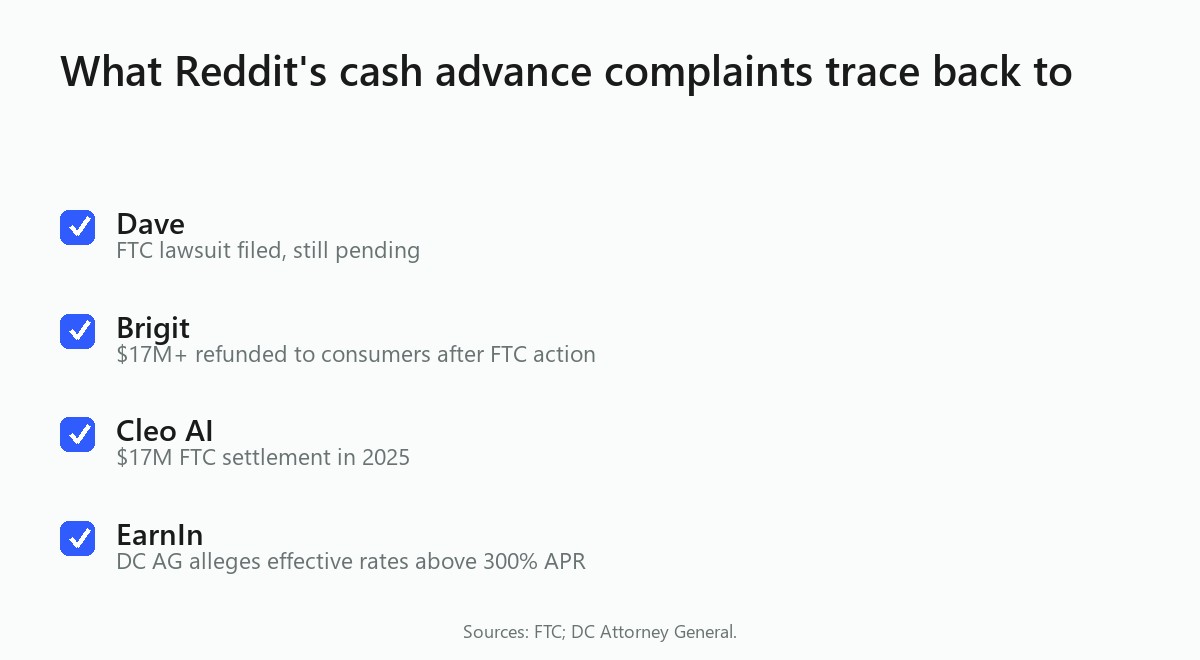
The Federal Trade Commission's case against Dave, filed in late 2024, alleges deceptive marketing about advance amounts and tips charged without real consent. The Justice Department later filed an amended complaint on the FTC's behalf, naming CEO Jason Wilk and seeking civil penalties; the case remains pending as of this writing. The FTC also sued Bridge It, Inc., which operates Brigit, alleging its "instant" advance promises of up to $250 were deceptive and that its $9.99-a-month membership was hard to cancel, and later sent more than $17 million in refunds to affected users. Cleo AI agreed to a $17 million FTC settlement in March 2025 over similar claims: users had to enroll in an auto-renewing $5.99 to $14.99 monthly plan before the app would even tell them their real advance amount.
DC's Attorney General sued EarnIn in November 2024, alleging the app's "Lightning Speed" fees plus tips pushed effective rates above 300% APR for some users, more than 12 times the district's 24% rate cap, and that EarnIn operated without a required DC lending license, affecting more than 20,000 DC consumers according to the complaint.
The four enforcement actions above are the ones this piece verified. No enforcement record was checked for the other apps mentioned here, including MoneyLion, Klover, Empower, Chime's MyPay, and Varo, so their absence from this list means nothing either way, not a clean bill of health. This article intentionally does not rank these apps against each other on price or speed. If you want a framework for comparing apps side by side on fees, limits, and eligibility, that's a separate exercise from sentiment reading, best done before you commit to one.
Across personal-finance discussion, one arc recurs often enough to stand out: someone takes a small advance, expects it to come out on a specific date tied to their paycheck, and instead sees it pulled early, sometimes before the paycheck has actually landed. The overdraft or low-balance scramble that follows is the emotional center of a lot of these posts.
The mechanism behind it isn't mysterious once you understand how these apps estimate repayment dates. Most cash advance apps predict your next payday using your recent deposit history rather than your actual employer's pay schedule. If your pay date shifts, even by a day, because of a holiday, a processing delay, or a schedule change your employer didn't flag to you, the app's estimate and your real bank balance stop matching. The advance still gets pulled on the date the app predicted, whether or not the money you were counting on has actually arrived.
This is also where a lot of the "these apps read your bank account" unease comes from. The apps need transaction-level access to make that repayment prediction at all, which is a legitimate design choice, but it means most users connect an account without fully realizing how much transaction history they're handing over.
Another theme that recurs often is tipping: specifically, whether skipping the tip on an advance quietly costs you access later. This is one of the harder patterns to verify precisely, because no app publishes its internal limit-setting logic. No federal law caps these fees or tips the way many states cap payday loans, which is part of why "is this even legal" comes up so often in these threads. But the suspicion isn't coming from nowhere.
Regulators have alleged, in two separate cases, that "voluntary" tips weren't functioning as voluntary in practice. The DC Attorney General's case against EarnIn, cited above, alleges tips defaulting between $1 and $14 per transaction, layered onto the app's own fees, as part of what pushed effective costs above 300% APR. The FTC's case against Dave, also cited above, alleges tips were charged without consumers meaningfully consenting to them.
There's also a useful legal test buried in the Consumer Financial Protection Bureau's (CFPB) advisory opinion on earned wage access: a tip only stays exempt from being treated as a real finance charge if it's genuinely optional, meaning the provider doesn't make it needlessly difficult to say no. When a tip prompt is designed to be hard to skip, or when future advance amounts seem to track past tipping behavior, that's exactly the design pattern regulators have flagged as a problem, not a coincidence users are imagining. If you want the fuller math on what tips and instant fees actually add up to on an annualized basis, run the real numbers before you decide whether tipping makes sense for you.
The practical takeaway that shows up again and again in newcomer advice: skip the tip on your first advance or two and watch what happens to your next offered limit. It's not a guaranteed test, since limits move for other reasons too, but it's the cheapest way to get your own data point instead of relying on someone else's guess.
A related and separately common complaint: a limit that starts reasonable and then drops, sometimes sharply, without an explanation the user can point to. The pattern people describe is consistent even when the reason isn't: a first or second advance goes fine, the app offers a modest amount, and then a later advance offer shrinks even though nothing about the user's income or repayment history obviously changed.
Let's be precise about what can and can't be said here. No verified source explains exactly what triggers a given limit cut for a given app, and this article isn't going to guess at a cause. What can be said honestly is that this experience repeats across enough different app names to be worth taking seriously, not a one-off glitch. Anyone shopping around based on advertised limits should understand why the advertised limit rarely matches your first advance, let alone your fifth.
Several of the higher-limit or faster-advance features on these apps sit behind a monthly membership, and cancellation friction is a consistently frustrated topic in ongoing discussion. Again, this isn't just a vibe. The Brigit case cited above turned on exactly this: a $9.99-a-month membership the FTC alleged was difficult to cancel, tying members to fees for a feature they'd stopped wanting to use, with the agency's refund action returning more than $17 million to affected consumers.
Cleo AI's settlement follows a near-identical shape: users were required to enroll in an auto-renewing plan, priced between $5.99 and $14.99 a month, before the app would disclose the actual advance amount they'd be getting, which is a fairly aggressive way to convert a "check what you'd get" moment into a recurring charge. When people online describe hunting through settings menus or messaging support just to cancel a $5 or $10 subscription, it matches what regulators alleged in these two cases. Reading the cancellation policy before you subscribe beats hunting for it afterward.
The last recurring theme is shorter but still a common worry among first-time users: discomfort with linking a bank account through Plaid or a similar service. People want to know what the app can see, how long it keeps that access, and what happens if they disconnect it later. Those are fair questions, and they deserve a fuller answer than fits here. This site covers exactly that ground, including how these apps handle your bank data once it's connected, if that's the piece of the decision you're still stuck on.
Strip away the app-specific arguments, and the advice that repeats across this whole category is remarkably consistent. It's also genuinely useful, which is more than can be said for most internet financial advice.

If that last point sounds like it applies to you more often than you'd like, put together a plan to cut down how often you need one of these apps at all, rather than just picking a "better" one.
Complaints alone don't make an app unsafe, but they're worth checking against real enforcement history. Look up whether the app has a documented FTC or state case tied to your concern, read the fee and cancellation terms before you link a bank account, and start with the smallest advance available so any surprise costs less.
A clear consensus doesn't exist across community discussion, and no data source ranks these apps by actual sentiment volume. What repeats instead is a rough split: apps tied to a documented enforcement action draw more scrutiny than apps without one, though that absence isn't proof of safety.
No cash advance app publishes the formula behind its limit decisions, so no source confirms one specific cause. What users describe consistently is the pattern itself: a modest early limit that later shrinks without explanation, which is why an app's advertised maximum rarely matches what you're actually offered.
Tips on these apps are usually presented as optional. The CFPB's advisory opinion on earned wage access says a tip counts as truly optional only if it's genuinely easy to decline. Regulators have alleged, in cases against EarnIn and Dave, that some tip prompts functioned like required charges, so skipping the tip is a fair test.
Yes. The FTC has sued Dave and Brigit over deceptive marketing and hard-to-cancel memberships, and settled with Cleo AI for $17 million over similar claims. DC's Attorney General separately sued EarnIn in November 2024, alleging fees and tips pushed effective rates above 300% APR.

Bill due this week? Compare the fastest emergency cash advance apps, real instant-transfer fees, and cheaper options to try first.
Read article
Need quick cash now? Six ways to get 200 dollars today, ranked cheapest first, from 0 dollars to 60 dollars over 30 days, with the math shown.
Read article
A practical plan to treat cash advance apps as a bridge, not a habit, and shrink the advance you need each payday to zero.
Read articleSee how the top earned wage access apps stack up on fees, limits, and speed. View the full ranking