September 29, 2026
Paycheck Budget Planner: Weekly & Biweekly Bill Plan
Build a paycheck budget planner that assigns every bill to the check that covers it, plus a worked biweekly example and a fill-in table.
Read article

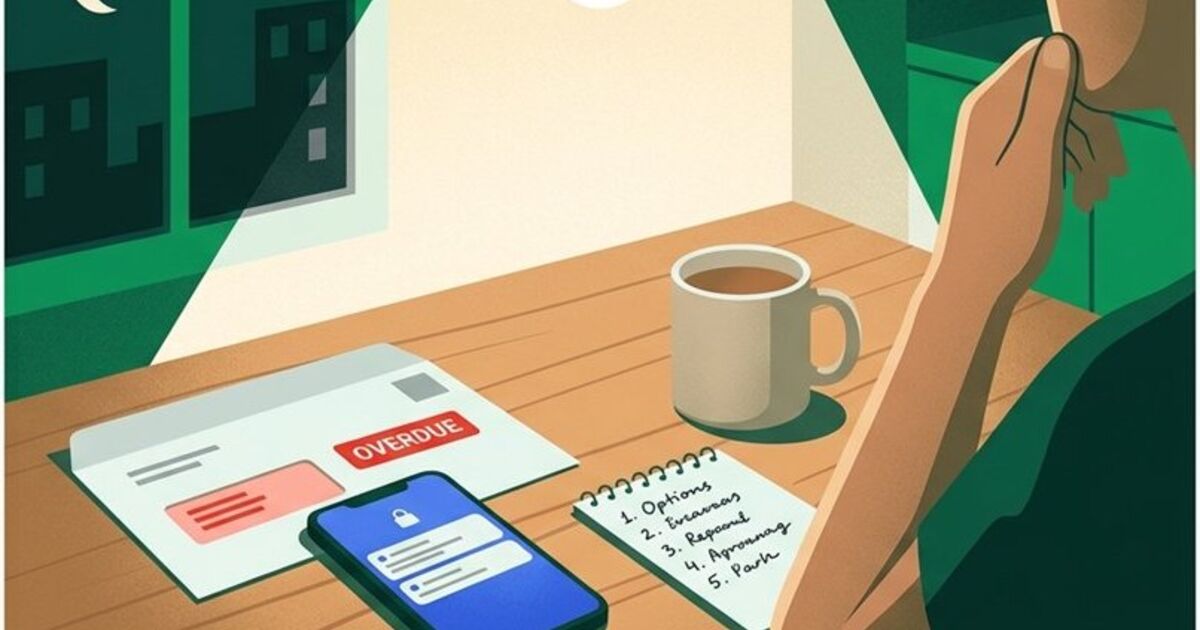
Something is due today. The balance says no, payday is still days out, and you're typing "quick cash now" into your phone with your stomach in a knot. I've sat at kitchen tables with people in exactly that hour, and the shortfall is rarely the part that stings most. What stings is knowing the same 200 dollars can cost you nothing or cost you 60 dollars over the next month, and the only thing that changes the price is which door you walk through first.
Search results for this are mostly side-hustle lists. A gig that pays out next Friday does not stop a shutoff notice tonight. So instead of ways to make money, what follows is an order to work through, cheapest first, with the arithmetic shown at every step.
One amount, one clock: 200 dollars, in hand today, cleared 30 days from now. Every figure below comes from a rate or fee that a regulator or a lender has actually published, not from someone's estimate of an average.
Why 30 days instead of the two weeks a payday loan usually runs? Because a credit union payday alternative loan carries a one-month minimum term under federal regulation. Price everything on a two-week clock and you quietly delete the cheapest borrowing option on the page. Thirty days is the only frame where all six choices stand next to each other honestly.
These get skipped, and not because people have never heard of them. They get skipped because asking feels like begging. That feeling is the single most expensive thing in this article. A hardship request isn't a favor you're asking a stranger for; it's a routine transaction the company has staffed a department to handle, with a script, a form, and a queue.
The CFPB's guidance is blunt on the timing: contact the company you owe before you fall behind, because many creditors run hardship programs (sometimes called accommodations), and enrolling before you go late can protect how the account gets reported. Once you've missed the payment, your options narrow fast. The agency walks through how to start with your credit card company.
Some employers will advance part of an already-earned paycheck through payroll at no cost to the worker. Practice varies too much between companies for any national figure to mean anything; what matters is your handbook and your payroll contact. Ask whether an advance exists, what the limit is, and how the repayment comes back out. Our walkthrough on checking whether your employer offers daily pay covers who to ask. Worst case, you hear no, and it cost you one phone call.
Selling is the only option on this page that puts cash in your hand without creating a repayment. Local marketplace pickup, a pawn shop sale (a sale, not a pawn loan), or a buyback counter at an electronics or game store will all move something today. You will get less than the item is worth. Nobody is owed anything on the 30th, and that is worth more than the discount you took.
Take Chase's published pricing and terms for a widely held card (disclosure LGC64645): the cash advance fee is either 15 dollars or 5 percent of the transaction, whichever is greater, and the cash advance APR is 28.49 percent variable. Run 200 dollars through it:
The trap is not the rate. It is the timing. That same disclosure states that interest on cash advances starts on the transaction date, which means there's no grace period at all. Paying your statement in full does not rescue you here the way it does on a purchase, because the meter started the second the money left the ATM. Any ATM operator surcharge sits on top of that.
Look up your own card first. The number lives in the pricing and terms table, in the row marked cash advance, and the CFPB notes that a card's cash advance rate is commonly higher than the purchase rate you're used to seeing.
A payday alternative loan (PAL) sounds like marketing language, but it's a product federal credit unions may offer under 12 CFR 701.21(c)(7), and the regulation sets hard ceilings: principal between 200 and 1,000 dollars, a term of one to six months, an application fee capped at 20 dollars, an APR capped at 28 percent, and no more than three PALs per borrower in any rolling six-month period. Those caps are law, which means you can hold a credit union to them. You can read the rule yourself in Cornell's copy of 12 CFR 701.21.
Priced at the legal maximum on both sides:
Two caveats, not buried at the bottom. PALs I requires that you have been a member of the credit union for at least one month, so for most people reading this at 9pm on a Tuesday, it is not a today option. There is a second version, PALs II, with different terms (up to 2,000 dollars, a term of one to 12 months, the same 20 dollar fee cap and the same 28 percent APR cap), so ask the credit union directly when you would be eligible. Also worth knowing: PALs amortize, so someone repaying in installments pays less than 4.60 dollars in interest. That's the ceiling, not the typical.
Advance apps sit inside this middle band, but their price is assembled from parts: an optional tip, sometimes a monthly membership, and an instant transfer fee that exists only because you can't wait for the free transfer. The mix differs by app, so no single number slots into this ladder. We price them individually elsewhere on the site, in our breakdown of what a single advance costs once tips and instant fees are counted, in our comparison of how earned wage access and payday loans stack up on cost, and in our guide to apps that skip the credit check. One rule of thumb survives every app: if you can wait for the free transfer, the advance gets a lot cheaper.
An overdraft fee is a flat charge per item, not a percentage, and that flatness produces the ugliest math on this page, because the fee doesn't care whether you went over by 200 dollars or by 6. The CFPB puts the typical fee at 35 dollars in its analysis of how overdraft fees price people out of banking.
You may have read that these fees were about to be capped at 5 dollars. They weren't. Congress nullified the CFPB rule that would have done it through a Congressional Review Act resolution signed on May 9, 2025, months before the rule's October 2025 effective date, and a rule struck down that way cannot be reissued in substantially the same form without new authorization from Congress. Treat 35 dollars as the current price, not a legacy one someone has since fixed. The repeal is laid out in the Congressional Research Service's insight on the overdraft rule.
CFPB research on single-payment auto title loans found they typically come due in 30 days at an APR of around 300 percent. Applied to 200 dollars: 200 x 3.00 = 600.00 a year, divided by 365 is just over 1.64 dollars a day, times 30 days = 49.32 dollars.
Sanity-check that in your head. Three hundred percent a year is 25 percent a month, and a quarter of 200 dollars is 50 dollars. The number that should actually stop you is not measured in dollars, though. In that same 2016 research, the CFPB found that one in five single-payment title loan borrowers had the vehicle seized for failing to repay. If the car is how you get to the job that funds the repayment, the downside here is not a fee. It is the job.
Borrow 200 dollars at the 15 dollars per 100 the CFPB cites as common on a two-week term and you owe 230 in two weeks, because 200 divided by 100 is 2, times 15 is 30.00 dollars in fees. Annualize it and (30 / 200) x (365 / 14) gives 391 percent, which is where the agency's "almost 400 percent" comes from. The full range runs from 10 to 30 dollars per 100, all of it set out on the CFPB's page about the costs and fees for a payday loan.
That two-week figure is not the fair comparison, though, because most of these loans do not end in two weeks. CFPB research published in 2014 found more than 80 percent of payday loans are rolled over or followed by another loan within 14 days. Roll it once to reach the same 30 days everything else on this page is measured across, and you have paid 60.00 dollars in fees and you still owe the original 200.
Charges vary state by state. The 15 per 100 is what the CFPB cites as common, not a legal cap, and some states prohibit storefront payday lending outright. Check your own state's rules before you assume the number is yours.
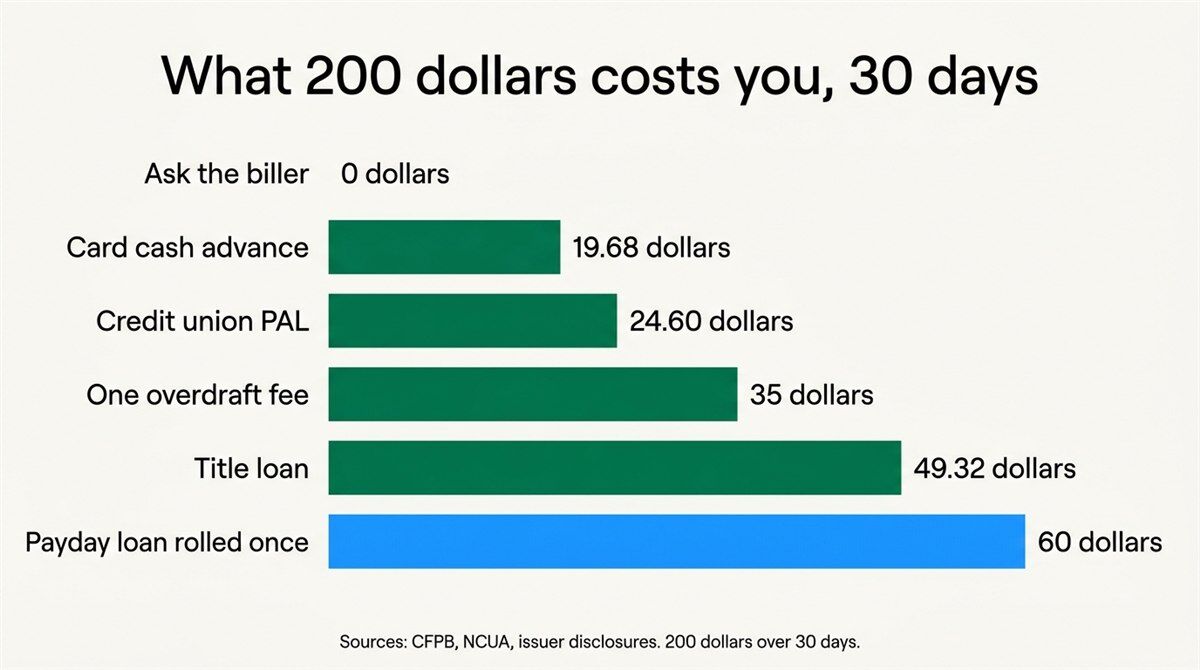
Same 200 dollars. Same 30 days. Six prices:
The payday path costs 3.05 times what the credit card cash advance costs for identical money over an identical month (60.00 divided by 19.68). Nobody picks the 60 dollar door because they compared the options and preferred it. They pick it because it was the one open at 9pm, and because the free options at the top required a conversation they were dreading.
"Quick cash now" is a phrase scammers buy ads against, precisely because it finds people moving too fast to check. One rule filters out most of them.
Under the FTC's Telemarketing Sales Rule, a telemarketer who guarantees you a loan or credit cannot legally ask you for payment up front. Three tells repeat: approval promised before anyone has looked at your finances, a fee demanded anywhere from 25 dollars to several hundred, and a request to pay by wire transfer, gift card, or cryptocurrency. The agency lists them in its guidance on advance-fee loans.
Now the distinction that matters, because I don't want you walking away from a legitimate loan. Real lenders do charge application, origination, and appraisal fees. A credit union PAL application fee is capped at 20 dollars by federal rule and is completely above board. What no legitimate lender does is promise approval in exchange for that fee, or ask you to send it by gift card. Guaranteed approval, plus money demanded up front, plus an untraceable payment method equals fraud, every time. Report it to the FTC and to your state attorney general.
Once tonight is handled, the thing that keeps you off this ladder next time is shrinking the gap itself, which is what our guide to building an emergency fund on a low income is built for.
Not borrowing it. Calling the biller to move a due date or open a hardship plan costs 0 dollars, and the CFPB advises contacting the company before you fall behind. Selling something for same-day cash also creates no repayment. If you must borrow, a credit card cash advance was cheapest here at 19.68 dollars over 30 days.
On these numbers, yes, by a wide margin. Taking 200 dollars as a cash advance at a 15 dollar fee and 28.49 percent APR costs 19.68 dollars over 30 days. A payday loan at 15 dollars per 100 costs 30 dollars for two weeks, or 60 dollars once rolled to reach the same 30 days.
Usually not the same day. A PALs I loan from a federal credit union requires that you have been a member for at least one month, so it works as a this-week setup rather than a tonight fix. PALs II terms differ, so ask the credit union directly when you would become eligible.
Because it is a flat fee per item, not a percentage of what you overdrew. The CFPB puts the typical overdraft fee at 35 dollars whether the shortfall was 6 dollars or 200. On 200 dollars over 30 days that is an effective annual rate of 212.9 percent, and every additional item adds another full fee.
Ask one question: are they guaranteeing approval and asking for money before funding anything? Under the FTC's Telemarketing Sales Rule, a telemarketer who guarantees a loan cannot legally request payment up front. Any demand to pay by wire transfer, gift card, or cryptocurrency is the clearest fraud signal there is.

Build a paycheck budget planner that assigns every bill to the check that covers it, plus a worked biweekly example and a fill-in table.
Read article
We read through Reddit's cash advance app threads to sort real complaints from real advice, app by app.
Read article
Bill due this week? Compare the fastest emergency cash advance apps, real instant-transfer fees, and cheaper options to try first.
Read articleSee how the top earned wage access apps stack up on fees, limits, and speed. View the full ranking