August 19, 2026
Quick Cash Now: 6 Options Ranked by Real Cost
Need quick cash now? Six ways to get 200 dollars today, ranked cheapest first, from 0 dollars to 60 dollars over 30 days, with the math shown.
Read article


The mail is stacking up on the counter, and one envelope has a due date that already passed. Maybe it's the electric bill, maybe it's a car repair standing between you and getting to work Monday. If you're typing "emergency cash advance app" into your phone right now, you're not shopping around. You already know you need cash today or tomorrow, not next Friday.
That's the exact moment this guide is for: which app can actually get money into your account before the bill goes past due, what that speed really costs, and whether the fee is smaller than the problem you're trying to avoid. None of that decision has to happen in a panic. It just has to happen fast, and it helps to know the real numbers before you're staring at a fee screen with your thumb over the "confirm" button.
Every emergency cash advance app makes roughly the same promise: money now, a small fee, repayment on your next payday. Whether that promise helps you or costs you more than it's worth comes down to math you can check in about two minutes. Run through these four questions before you tap "advance."
None of these questions are meant to slow you down for the sake of it. They exist because the difference between a helpful advance and a costly one usually comes down to whether you can answer all four before you tap confirm, not to which app you happen to pick. A minute of math now is cheaper than a surprise withdrawal landing on the wrong day next week.
If you answered yes to the first three and no to the last one, an advance is probably doing its job: bridging a gap you can already see the other side of. If you're not sure, a calm self-check on whether an advance fits your situation can walk you through it in more depth before you commit to a fee.
Fee schedules on these apps change without much notice, so treat the figures below as accurate for August 2026 and confirm the exact cost inside each app before you accept an advance. They're ranked here by how fast the money is genuinely usable, not by whatever number shows up in an app store description.
Dave's own fee disclosure shows that a transfer into a Dave Checking account is free and lands in seconds, the fastest option in this entire rundown. Send that same advance to an external debit card instead, and it costs a 1.5% express fee and arrives within about an hour. Choose the free standard route to an outside bank account by ACH (Automated Clearing House), and it's free again, but it takes three business days, too slow for a bill due this week.
The catch is that the seconds-fast option only exists if you already have a Dave Checking account open before the emergency hits. Without one, you're on the one-hour, 1.5% route like most first-time users, which is still faster than waiting on a paycheck but not the headline "seconds" number you might see advertised.
EarnIn's fee page lists Lightning Speed at $3.99 for a cash-out of $75 or less and $5.99 for anything above that, a flat fee no matter how far past $75 you go, which is worth knowing if you're deciding how much to pull. NerdWallet's review of the app confirms Lightning Speed delivers within minutes, compared with 1 to 2 business days for the free standard option. Unlike Dave's fastest tier, Lightning Speed doesn't require opening a new specialty account first, which makes it one of the more realistic minutes-not-hours options for someone using an advance app for the first time this week.
Brigit's live cash advance page states Express Delivery arrives in about 20 minutes for most users, well ahead of the 1 to 3 business days that standard delivery takes. The page notes only that a fee may apply to Express Delivery, without listing an exact dollar amount, so confirm the actual cost inside the app before you accept it. Standard delivery costs nothing, which makes it the better pick whenever your due date gives you a few days of room to work with.
MoneyLion's Instacash page puts standard delivery at free and 2 to 5 business days, too slow for most emergencies. The Turbo option arrives within minutes if you have a RoarMoney account, or up to about four hours to an external bank account, still fast enough for a same-day bill. Turbo carries a sliding fee that increases with the size of the advance, so confirm the exact number in the app before accepting. A RoarMoney account, MoneyLion's own banking product, gets you the fastest tier the same way a Dave Checking account does for Dave, so the fastest number on the page isn't always the one you'll actually get.
These four aren't the only cash advance apps out there, and ranking by pure speed only tells part of the story. If this isn't a one-time emergency and you're thinking about which app to keep on your phone long-term, a broader framework for comparing apps beyond a single emergency covers fees, limits, and eligibility side by side. And once this week's bill is handled, it's worth understanding how instant-transfer fees work across cash advance apps generally, since the pricing logic behind that "express" button is the same one driving every option above.
An advance fee sounds small next to an overdraft charge or a utility reconnection fee, and sometimes an advance really is the cheapest tool on the table. But it's rarely the first call worth making, mostly because most of the options below cost nothing at all if you catch them before the due date passes. A five-minute phone call can sometimes save more than an entire month of advance fees. Work through these in order first.

On December 23, 2025, the Consumer Financial Protection Bureau published an advisory opinion, covered by PYMNTS, stating that certain earned wage access products, the kind offered directly through an employer and repaid only through payroll deduction, aren't "credit" under the Truth in Lending Act. The opinion also states that optional expedite fees or voluntary tips on those specific products aren't finance charges either. On those employer-partnered products, that's part of why an expedite fee isn't disclosed as an APR the way a traditional loan's cost would be.
That opinion is narrower than it sounds. It applies to qualifying employer-partnered earned wage access products, not automatically to standalone consumer cash advance apps like Dave, EarnIn, Brigit, or MoneyLion, which are a different product class built around your general banking activity rather than a specific employer partnership. The accurate way to describe these four apps is that they present a flat fee or a percentage instead of an APR because they don't hold themselves out as installment credit in the first place, not because the December 2025 opinion says so, which simply doesn't decide their status one way or the other. Calling them unregulated overstates it, and the distinction matters if you're weighing an advance fee against what a payday loan would cost for the same amount.
None of this means an advance app is something to avoid. Used the way they're designed, for a genuine one-time gap with a repayment date you can see clearly, a fee of a few dollars, like EarnIn's $3.99 to $5.99 Lightning Speed charge, that keeps the lights on or gets your car running is often the cheapest, fastest tool actually available to you this week. These apps exist because paychecks and bank transfers don't always move at the speed a bill collector does.
A late electric bill can trigger a reconnection fee on top of the original balance, and a bounced rent check can cost far more than an advance app's express fee once your bank and your landlord both charge for it. Measured against those real costs, the fee is often doing exactly what it's priced to do.
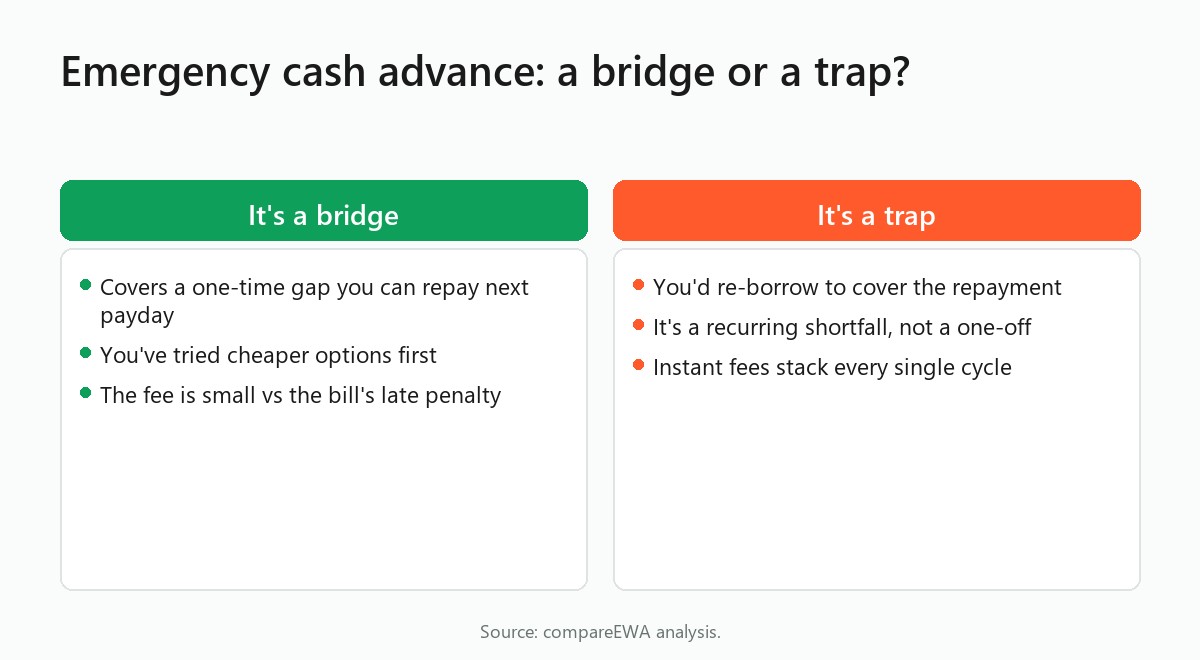
Risk shows up in repetition. If you notice you're opening the app three paychecks in a row, or the advance keeps eating a chunk of the next check before it even lands, the bridge is turning into the shortfall itself. Treat that as a signal, not a failure.
It's worth building a buffer so the next emergency doesn't need an app at all, even a small one saved a few dollars at a time. A cushion of a couple hundred dollars is often enough to skip this whole decision the next time a bill lands wrong, and you don't have to save it all at once to get value from it. The first fifty dollars you set aside is the fifty that keeps a small surprise from ever becoming an emergency in the first place.
Dave's transfer to a Dave Checking account arrives in seconds, the fastest option covered here, though it requires having that account open already. Without it, EarnIn's Lightning Speed lands within minutes and Brigit's Express Delivery in about 20 minutes for most users, making them realistic same-day options for someone using an advance app for the first time.
These apps are generally structured around your bank account activity and income pattern rather than a traditional credit pull, though approval and eligibility criteria vary by provider and can change. Confirm each app's specific approval process before applying, since terms are not identical across apps.
An advance fee, often a flat few dollars (EarnIn's Lightning Speed runs $3.99 to $5.99) or a small percentage (Dave charges 1.5% for an express transfer to an outside debit card), tends to cost less than a two-week payday loan, which often carries a higher effective cost. Weigh the fee against the loan before assuming either is cheaper.
Ask the biller for a hardship plan or short extension, call 211 or check LIHEAP if it's a utility bill, ask your bank about a fee-free overdraft grace window, and confirm whether your employer already offers free early pay. Each can solve the same gap without a fee, given even a day or two to work with.

Need quick cash now? Six ways to get 200 dollars today, ranked cheapest first, from 0 dollars to 60 dollars over 30 days, with the math shown.
Read article
A practical plan to treat cash advance apps as a bridge, not a habit, and shrink the advance you need each payday to zero.
Read article
How to build an emergency fund on a low income, with realistic weekly amounts and habits that make a starter buffer stick.
Read articleSee how the top earned wage access apps stack up on fees, limits, and speed. View the full ranking