August 26, 2026
New Cash Advance Apps 2026: What Actually Changed
See which new cash advance apps in 2026 are real changes, not hype, plus a quick checklist to run before you link your bank account.
Read article


If you searched for an app like Tilt cash advance, you're probably already comfortable with the idea of a cash advance app and you just want to know if Tilt is the right one, or if something else fits your paycheck better. I read every fee page these five apps publish, line by line, the way a lender reads a contract, and cross-checked what each one claims against what it actually discloses. Here's how Tilt stacks up against Earnin, Dave, Brigit, and MoneyLion on the four things that actually determine what an advance costs you: subscription cost, advance ceiling, funding speed, and who qualifies.
Tilt is the rebranded name for Empower, which changed its identity in August 2025. If you remember Empower's cash advance product, you already know Tilt's mechanics.
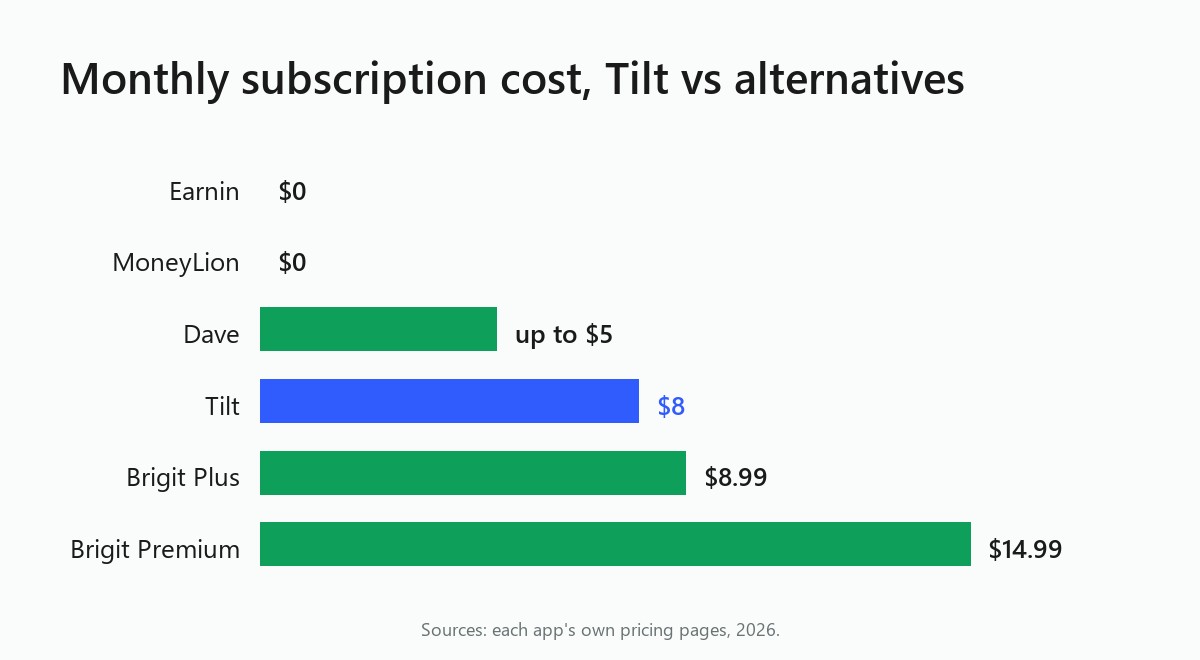
It advances $10 to $500, and that ceiling can grow over time with a history of on-time repayment (Tilt's cash advance page). The app charges an $8 monthly subscription, and new customers get a 14-day free trial before it starts billing; returning customers get charged right away. The only guaranteed way to skip the fee entirely is canceling before that trial ends, since it isn't structured as an opt-out-while-subscribed charge, according to Tilt's own support article on hidden fees.
Standard delivery takes about one business day and costs nothing. Instant delivery, which Tilt says arrives in roughly 15 minutes for 98% of advances, is optional and comes with a fee that scales with the advance size according to Tilt's support page on instant delivery. Tilt doesn't publish the exact fee tiers on any page I could verify, so treat "fees apply" as the honest answer here, not a specific dollar figure. The same holds for a few other fees in this comparison: Brigit's express charge and MoneyLion's Turbo fee are published only as vague or image-based figures on the companies' own sites, so I'm describing those qualitatively too instead of guessing at a number.
There's no credit check. Underwriting looks at how consistent your income deposits are, your spending patterns, and your paycheck timing, and it accepts gig, freelance, and benefits income as long as the deposits land with reasonable regularity. Residents of Connecticut, Maine, and Washington, D.C. can't use Tilt at all, per Tilt's FAQ page.
One number worth knowing before you apply: Tilt's own site reports an average advance offer of $98 for first-time customers and $172 for returning customers as of the second quarter of 2026 (Tilt's cash advance page). That gap matters. A brand-new Tilt user shouldn't expect to walk in and get $500.
I'm scoring each alternative against Tilt on the same four criteria, the same framework this site uses to compare any cash advance app, since that's what actually changes what an advance costs you and how fast you get it:
Worth naming up front: none of these five apps report advances as loans to credit bureaus, and none charges interest. They run on subscriptions, per-transfer fees, or tips instead of an APR.
A December 2025 Federal Register clarification put most earned-wage-access products like these outside Truth in Lending Act disclosure requirements, which is a big part of why you won't find an APR quoted on any of these five apps' pages the way you would on a payday lender's site. That doesn't mean the fees are free money. It just means you have to do the math yourself, which is the whole point of this comparison.
Earnin is the app to know if a monthly fee is a dealbreaker. It advances up to $150 a day, capped at $1,000 per pay period (Earnin's cash advance page). That pay-period total sits well above Tilt's $500 ceiling. The daily figure works the other way, though: Earnin's $150-a-day cap is smaller than what Tilt can hand you in a single advance, so Earnin's advantage comes from stacking smaller daily draws across a pay period rather than from a bigger single advance.
There's no subscription and no mandatory fee of any kind, since the whole model runs on optional tips instead. Instant transfers through Lightning Speed start at $3.99 and arrive in roughly 30 minutes; pricing for larger advances isn't broken out on Earnin's site. Standard transfer takes one to three business days and is free. That combination means the base advance genuinely can cost $0 if you're willing to wait.
Eligibility works differently here too. Instead of judging general income-deposit consistency, Earnin verifies your income through timesheets, location tracking, or a direct connection to your employer's system (Earnin's cash advance page). That makes it the strongest fit for hourly and shift workers who clock in and out somewhere, especially those without a long banking history for an algorithm to study. If you drive for a living or punch a time clock, Earnin's verification method probably fits your income better than Tilt's deposit-pattern approach does.
Dave's ExtraCash product advances $25 to $500, which ties Tilt's ceiling on paper. Dave's own page is upfront that not everyone gets there: "not all members qualify," and the company says only a few members qualify for the full $500 (Dave's ExtraCash page).
Cost is where Dave gets more complicated than Tilt. There's a membership fee of up to $5 a month, plus a mandatory service fee on every single transfer, set at whichever is greater: $5 flat or 5% of the advance. Want the advance on an external debit card faster than standard? That's an optional 1.5% express fee on top.
Say you take a $200 advance through Dave to an external card. The service fee alone runs $10, since 5% of $200 beats the $5 flat minimum, and the express fee for faster delivery to that card adds another $3. That's $13 in fees before you've paid a cent toward the membership.
Funding speed is genuinely Dave's strongest feature: instant delivery to a Dave Checking account happens in seconds, about an hour to an external debit card with the express fee, or three business days free to a regular bank account (Dave's ExtraCash page). Underwriting has no credit check and instead reviews your income history, spending, and at least three recurring deposits. One thing worth flagging: the FTC sued Dave in November 2024, alleging it did not adequately disclose ExtraCash fees, a useful reminder to read the fee page closely rather than take an app's marketing at face value, on Dave or any competitor.
Brigit's Instant Cash advances run $50 to $500 depending on what it calls your financial health, and like Dave, Brigit says plainly that not all members qualify for the top of that range (Brigit's explanation of how Instant Cash works). Where Brigit differs from Tilt is the subscription structure: instead of one flat $8 fee, Brigit runs two paid tiers, Plus at $8.99 a month and Premium at $14.99 a month, with Premium bundling in free express delivery as part of the higher price.
Delivery on the standard track takes two to three business days and is free on either tier. Express delivery on the Plus tier arrives in about 20 minutes for what Brigit describes only as "a small fee," with no published dollar amount attached.
If Tilt's $8 flat rate appeals to you but you want a guaranteed way to avoid ever paying an extra delivery charge, Brigit's Premium tier is the more predictable monthly cost, since $14.99 covers both the subscription and express funding in one number. You're paying more up front for that predictability. Underwriting reviews your average account balance, spending habits, and how regular your paycheck is, with no credit check involved.
MoneyLion's Instacash has the highest single-advance ceiling in this comparison. The standard limit is $500, matching Tilt, but it climbs to $1,000 in one advance if you open a MoneyLion Spend or RoarMoney account and keep qualifying recurring direct deposits flowing into it (MoneyLion's Instacash page). Earnin also reaches $1,000, but only by adding up daily draws across a full pay period, not as a single advance.
RoarMoney itself carries no subscription fee, and base Instacash access doesn't require one either, which puts MoneyLion's baseline cost at $0 a month against Tilt's $8. Turbo, MoneyLion's instant delivery option, arrives within minutes for a fee the company says varies by advance size and destination account, published only as an image table on MoneyLion's site, not as specific dollar tiers you can quote.
Free delivery runs one to two business days to a MoneyLion Spend account, or two to five business days to an external bank. Eligibility requires a checking account open at least two months, a positive balance history, and regular recurring deposits, with no credit check (MoneyLion's Instacash page). If your goal is the single highest advance available in this group and you're willing to open a MoneyLion account to unlock it, Instacash beats Tilt's ceiling by $500.
Here's the same data lined up by app, so you can compare without flipping back through five sections:

Earnin is built for this. There's no subscription and no required charge of any kind, since the whole model runs on optional tips and an optional instant-delivery fee you can skip by waiting one to three days. That structural difference matters more than it looks: a subscription app like Tilt or Brigit keeps charging in months you don't take an advance, while a pay-per-use app like Earnin only costs you money when you actually use it. If your priority is apps that skip the monthly subscription entirely, that trait matters more than a higher ceiling, so lean toward the pay-per-use side of this comparison.
MoneyLion's Instacash wins outright at $1,000 as a single advance, but only if you open a Spend or RoarMoney account and maintain qualifying recurring deposits. Earnin can also reach $1,000, but only across a pay period, not in one advance. If you'd rather not open a new account to get there, Dave and Tilt both cap out at $500, though Dave's own page admits few members actually reach that ceiling, and Tilt's real-world average sits closer to $98 for new users and $172 for returning ones. For a fuller look at how the highest-limit cash advance apps stack up beyond this group of five, it's worth comparing ceilings across the wider category before you settle on one.
Dave's instant delivery to a Dave Checking account happens in seconds, faster than any timeline the other four apps publish for their instant options. If you need cash in a specific outside bank account instead of a new Dave account, that seconds-fast option doesn't apply, and you're back to comparing Tilt's roughly 15-minute window against Earnin's 30-minute Lightning Speed and Brigit's roughly 20-minute express delivery. How instant funding actually gets priced varies enough across these apps that speed and cost aren't the same decision.
All five apps skip a hard credit check, which is the baseline for this whole category. The real difference is what each one substitutes for credit history. Earnin leans on timesheets and employer connections, which favors hourly workers.
Tilt, Dave, Brigit, and MoneyLion all look at deposit consistency and spending patterns instead, which favors anyone with a stable, if modest, direct-deposit history, including gig and freelance income that lands with reasonable regularity. If your income is irregular in timing more than in amount, Tilt's stated acceptance of gig, freelance, and benefits income makes it worth a closer look.
Yes. Earnin charges no subscription and no mandatory fee, running instead on optional tips. MoneyLion's base Instacash access also requires no subscription. Tilt's $8 monthly fee only stops if you cancel before the 14-day free trial ends.
MoneyLion's Instacash goes up to $1,000 as a single advance with a qualifying Spend or RoarMoney account and recurring deposits, the highest single-advance ceiling among these five. Earnin can reach $1,000 too, but only by adding daily $150 draws across a pay period, not in one advance. Without the extra account, Dave and Tilt both cap at $500.
No. Tilt, Earnin, Dave, Brigit, and MoneyLion all skip a credit check and instead evaluate your bank account activity, income deposits, or employment verification to decide what you qualify for. None of the five reports your advance to the credit bureaus either, so taking one won't move your score in either direction.
Empower rebranded to Tilt in August 2025. The underlying cash advance product, its $10 to $500 range, and its $8 monthly subscription carried over under the new name. If you still see "Empower" mentioned in older reviews or bookmarks, that's the same company and the same advance terms under its current name.
Tilt's own support page states that 98% of instant advances arrive within about 15 minutes, with a fee that scales by advance size under its Terms of Service. Tilt doesn't publish exact fee tiers for that speed, so confirm the charge in-app before you request it.
Nothing stops you from having accounts with several of these apps. Each one reviews your bank activity before approving an advance, and Earnin checks hours worked instead, but none of them knows what you owe the others. Stacking advances across apps can strain a paycheck fast, so treat each advance as money already spoken for.

See which new cash advance apps in 2026 are real changes, not hype, plus a quick checklist to run before you link your bank account.
Read article
We compare DailyPay, Payactiv, Branch, EarnIn, and Chime MyPay on real fees, limits, and speed to help you choose.
Read article
Which apps really work without a direct deposit, what each one checks instead, and what the workaround costs. Eligibility rules read August 12, 2026.
Read articleSee how the top earned wage access apps stack up on fees, limits, and speed. View the full ranking