August 28, 2026
Best $100 Cash Advance Apps: Real First Limits
Only need $100 to payday? See which cash advance apps actually front $100 to new users, and what it really costs with instant fees.
Read article

If you searched "cash advance app no bank account," there's a good chance you already got burned once: a roundup post promised a prepaid card would work everywhere, and you got rejected at the linking screen anyway. Multiple published articles ask this exact question, whether specific apps "actually work with Netspend" or whether a prepaid card can get a cash advance at all, because the marketing copy and the actual signup screen keep disagreeing with each other.
This article is for someone with a prepaid card, or a Chime, Cash App, or Varo account, instead of a traditional checking account at a bank or credit union. That's a different situation than having a bank account with no direct deposit set up, and the internet mixes the two up constantly.
The frustration here comes from apps that advertise broad compatibility and then reject your card at signup, after you've already handed over a pay stub or linked a Plaid connection. That back-and-forth costs you something a warehouse shift doesn't give back: time you could've spent on an app that would've actually worked. So let's go app by app, verify what's actually required against each company's own terms, and be honest about how narrow this lane really is.
Almost every cash advance app runs on the same plumbing. You link a checking account through Plaid or a similar connector, the app reads your transaction history to estimate what you're owed, and it deposits your advance into that same account. When repayment comes due, the app auto-debits the account it deposited into, since that loop is the whole business model: deposit in, debit out, same account both times. Before you link anything, it helps to know how to check whether an app is safe to link your account to, since that Plaid connection hands over real transaction data.
A prepaid card breaks that loop in a way that makes lenders nervous. Many prepaid cards aren't built to accept ACH pulls the way a checking account is, and some don't expose the transaction history an app needs to verify your income pattern in the first place. That mismatch is the mechanical reason a prepaid card often doesn't qualify, even when an app's marketing copy doesn't spell out the limitation outright.
The underlying rails just weren't built for a prepaid balance, so the app can't do the two things it needs to do: see your income coming in, and pull repayment back out, through that kind of card. Once you understand that mechanical reason, the eligibility screen is easier to read: each requirement maps to one of those two functions, deposit-in or debit-out.
Dave's own product page states its bank-account requirement outright. EarnIn and MoneyLion don't publish current terms anywhere this article could verify, so treat those two as unconfirmed rather than assume either way.
Dave (ExtraCash) is direct about it on its own product page: you download the app, link your bank account, and open an ExtraCash account to see if you qualify. That linked bank account is the core requirement, full stop.
EarnIn is trickier to pin down. Its help center pages are not publicly accessible, so this article can't verify what EarnIn currently requires. Conflicting claims exist across the web, including at least one competing article claiming EarnIn accepts prepaid cards. Given that contradiction, check EarnIn's own current terms directly in the app at signup instead of trusting any secondary source, this one included.
MoneyLion's Instacash is the same situation. MoneyLion has not published eligibility terms anywhere this article could confirm, so nothing here states what Instacash currently requires. Check MoneyLion's own eligibility page directly before you spend time on an application, since secondary sources have already gotten other apps in this list wrong.
The picture actually changes with a small handful of apps that don't require you to already have a traditional bank account. Instead, they let you open a fintech account through the same app, and that new account becomes the "bank account" the advance runs through. Chime MyPay and Varo Advance are the two verified examples of this path, and Cash App Borrow may work similarly, though this article could not confirm its current terms. It's worth understanding exactly how the two verified ones work before you spend an afternoon on either.
Chime MyPay requires an active Chime Checking Account in good standing. That's non-negotiable, and it holds true even in the "external account depositor" version of the product, where your paycheck lands somewhere else first: you still need the Chime account itself, plus a linked external account through Plaid, according to Chime's own help center. The upside for someone in your position: opening a Chime account doesn't require you to already have a traditional bank account. You're building the account MyPay needs from scratch, which is exactly what makes this workable if you don't already bank anywhere.
Varo Advance requires an active Varo Bank Account with a positive balance, and LendEDU's reporting describes it as best suited for existing Varo customers. Here's the nuance worth sitting with: Varo is a chartered bank, Varo Bank, N.A. Opening a Varo account means actually becoming a banked customer, through an institution built for people who weren't banked before. If your goal is to stop being unbanked altogether, Varo does double duty: it gets you access to Varo Advance and gives you an actual bank account in the process.
Signing up for Cash App itself doesn't require a traditional bank account. This article could not independently confirm Borrow's specific eligibility requirements or how the advance is delivered, since the only sourcing available was a secondary summary, not Cash App's own documentation. If Borrow shows up as an option in your app, check the current terms directly inside Cash App before counting on it.
This is where most searchers actually want an answer, and it's the part other roundups get wrong most often. A general-purpose reloadable prepaid card, once registered, carries real legal protections. The Consumer Financial Protection Bureau's prepaid account rule under Regulation E (12 CFR 1005.18 through 1005.20) requires fee disclosures and gives registered GPR cards error-resolution and unauthorized-transaction protections comparable to a bank debit card.
Register your card. That single step is the difference between a card with real dispute rights and one without, and it costs you nothing but a few minutes on the issuer's website or app.
Legal protection isn't the same thing as app compatibility, though. Despite what you'll read on some listicle sites, a bare prepaid card doesn't satisfy the requirements at Dave, Chime, or Varo, the three apps this article verified directly, for the same plumbing reason covered earlier: many prepaid cards don't support the ACH debit an app needs for repayment, and they often don't expose enough transaction history to verify income.
Klover's own blog, addressing this exact question, frames the realistic baseline as needing some "qualifying account": a digital checking account, a prepaid card with direct-deposit capability specifically, or a Bank On-style account, rather than any prepaid card off the shelf. That's a company blog with an obvious interest in steering you toward its own product, but the framing matches what Chime and Varo require in practice: an account built to receive deposits and support debits. A card that only holds a balance doesn't clear that bar.
Fewer households are leaning on prepaid cards than a few years ago, for what it's worth. The FDIC's 2023 survey found 5.9% of US households used prepaid cards that year, down from 6.9% in 2021. The fintech-account path is becoming the more common route for people without a traditional bank, even as prepaid cards stick around as a tool.
Strip away the marketing and this is what's left. Chime MyPay and Varo Advance are the two verified genuine no-bank-account cash advance options, and each one runs through opening a fintech or bank account first. Cash App Borrow may offer something similar, but its current terms are unconfirmed, so treat it as a maybe, not a given.
Dave requires a traditional linked bank account, confirmed on Dave's own product page. EarnIn and MoneyLion could not be independently confirmed either way, so check both directly before assuming compatibility.
If a page tells you five or six major apps all "work without a bank account," read that as a signal the page didn't check each app's actual terms. This article did the app-by-app check on purpose, because that contradiction between what some sites claim and what apps actually require is exactly what sends people in your situation in circles. A framework for comparing apps beyond eligibility alone (fees, advance limits, how fast the money lands) matters once you've cleared this first hurdle, but eligibility is the gate you have to get through before any of that comparison is useful.
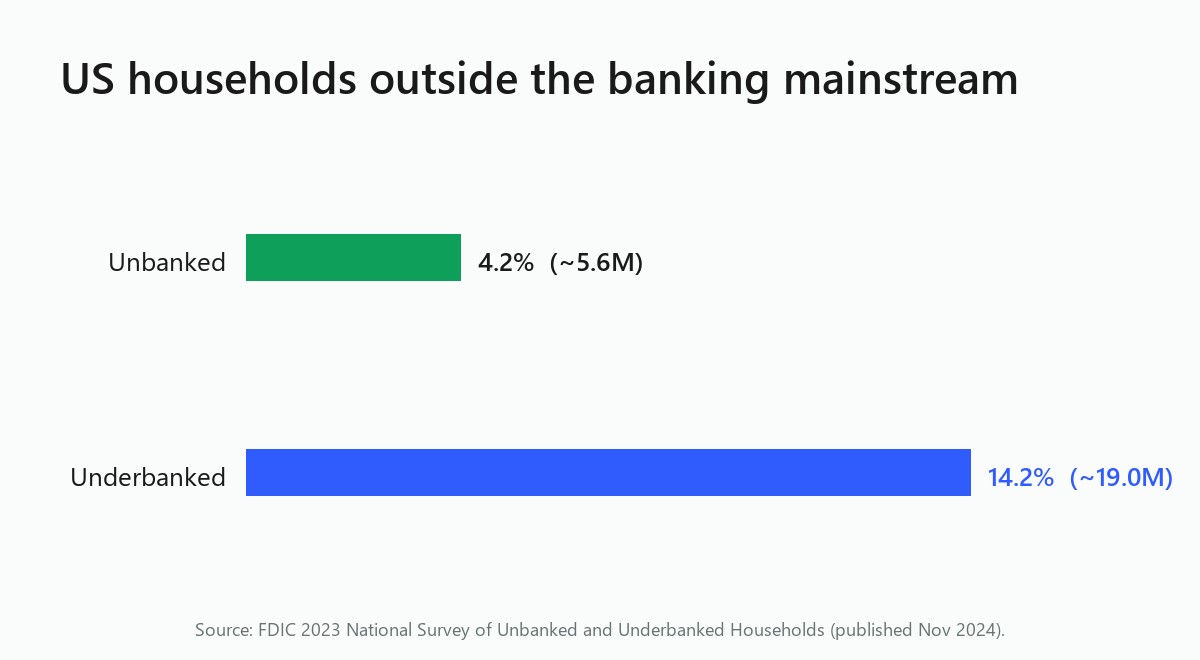
The numbers show you're not the only one in this exact spot. The FDIC's 2023 survey counted 4.2% of US households, about 5.6 million, as fully unbanked, which is who this article is written for. Another 14.2%, roughly 19.0 million households, are underbanked, meaning they do have an account but still lean on prepaid cards and check cashers outside the banking system, a related but different situation from having no account at all, per the same FDIC survey cited earlier. Combined, that's tens of millions of households dealing with some version of this problem, which is exactly why so many search-engine roundups exist to answer it, even the ones that get the details wrong.
The most realistic move, if a cash advance app is actually the goal, is to open a low-fee or no-fee account first, the kind built for people without existing bank history rather than a standard account that assumes you already have one. Klover's blog describes this as a "Bank On-style account," and that's a reasonable term to search for when comparing options.
Once that account is open and active, Chime MyPay or Varo Advance become realistic options in a way a bare prepaid card never will be. It's an extra step, and I won't pretend it isn't. But it's a faster and more honest path than cycling through apps that were never going to approve a prepaid card in the first place, and it leaves you with something more useful than an approved advance: an actual bank account with your name on it.
After that account and an advance app are both working, the next problem is usually the one that actually matters long term: not needing the advance every single pay period. A plan to shrink how much you need to borrow each payday is worth building alongside whichever app you land on, since the app itself only ever bridges you to the next payday.
Generally no, not with a bare prepaid card alone. Dave requires a traditional linked checking account, confirmed on Dave's own product page; EarnIn and MoneyLion's current requirements could not be independently confirmed, so check them directly. Chime MyPay and Varo Advance offer a verified path that runs through opening their own account first.
EarnIn's current eligibility requirements could not be independently confirmed, since its help-center pages are not publicly accessible. Competing sites publish conflicting claims about whether EarnIn accepts prepaid or Chime accounts, so confirm the current terms directly in the EarnIn app before assuming either way.
Varo is a chartered bank, Varo Bank, N.A. Opening a Varo account to use Varo Advance means becoming an actual banked customer, with a real account and routing number in your name. That same account also gives you access to Varo Advance, so one signup covers both the account and the advance.
A registered general-purpose reloadable prepaid card carries fee-disclosure and error-resolution protections under the Consumer Financial Protection Bureau's Regulation E prepaid account rule, similar to a bank debit card. That protection doesn't guarantee an app will accept the card, since acceptance depends on each app's own linking rules. Register any card before linking it.
Open a low-fee account built for people without existing bank history first (Klover's blog calls this a "Bank On-style account"), then apply through Chime MyPay or Varo Advance once it's open and active. This beats repeatedly testing prepaid cards against apps built around a traditional or fintech checking account requirement.

Only need $100 to payday? See which cash advance apps actually front $100 to new users, and what it really costs with instant fees.
Read article
See how pay advance apps move money through payroll, who pays Payactiv, DailyPay, and Branch fees, and what it costs versus overdraft.
Read article
Cash advance apps were built around a steady paycheck. See what counts as gig income, why your limit is low, and how to actually qualify.
Read articleSee how the top earned wage access apps stack up on fees, limits, and speed. View the full ranking