October 7, 2026
Can You Borrow Money From Venmo? What It Actually Offers
Venmo doesn't lend money or offer cash advances. Here's what it actually offers, what cash advance apps really do, and how to ask a friend safely.
Read article


A warehouse picker on the second shift feels the truck alternator go a week before payday. She's got $40 in checking and a $220 repair bill. The app her employer added to onboarding last spring shows a running total of hours already worked this pay period, and she opens it to see a number she can tap to move some of that money today. Pay advance apps like this one leave plenty of workers guessing at what happens next: whether her boss is footing a bill somewhere, whether this is a loan with her name on a credit file, or whether the app is just quietly pulling from her bank account the way the cash advance app her cousin uses does.
None of those guesses is quite right, and the confusion is common. "Pay advance app" gets used as a catch-all for two products built on completely different plumbing. One moves money through your employer's payroll system. The other links straight to your personal bank account and has nothing to do with your employer at all.
Knowing which one you're holding changes who is on the hook for the fee, how the money gets paid back, and what protections apply if something goes wrong.
It matters because the stakes aren't abstract. A picker who taps the wrong assumption into a budgeting decision can end up owing more than she planned for, or getting surprised by a debit she didn't see coming. A driver waiting on a deposit, a server counting tips between shifts, anyone whose income doesn't land on a tidy calendar has a real reason to know exactly which plumbing they're dealing with before they tap anything.
The first type is payroll-integrated earned wage access, sold to your employer and wired into its payroll and timekeeping systems. Payactiv, DailyPay, and Branch are the three most common names workers run into this way. Your employer chooses the vendor, and the app only knows what your employer's payroll system tells it: hours logged, wage rate, and what's already accrued but not yet paid out.
Direct-to-consumer apps are the second type, ones you find and sign up for on your own, no employer involved. These apps link to your personal bank account, estimate your pay based on deposit history, and advance money against a paycheck they're guessing is coming. This article is about the first kind. If you want the full walkthrough of how the bank-linked apps operate, that's covered start to finish in our guide to how bank-linked cash advance apps work.
The mechanics matter more than the marketing here, because the funding source and repayment method are what actually determine your risk. Here's the plumbing, piece by piece.

Your employer's payroll run does not change when you tap an advance. Payactiv structures its advances as a factoring transaction: you're effectively selling Payactiv a present right to a slice of wages you've already earned but haven't been paid yet, and Payactiv fronts that cash from its own balance sheet and credit facilities, reporting a recoupment rate above 97% on these advances, meaning it gets repaid on all but a small fraction, according to Payactiv's own earned wage access explainer.
DailyPay and Branch run on the same category of payroll-integrated plumbing, though the exact funding mechanics behind each one aren't spelled out publicly the way Payactiv's are. What's confirmed in Branch's own earned wage access page: its version of early access, the Core model, lets a worker access up to 50% of earned wages before payday.
This is the detail that separates payroll-integrated EWA from nearly everything else in the short-term cash space. Repayment runs through payroll deduction: your employer's own payroll system takes it out of your next paycheck, typically inside the same two-week pay cycle you drew the advance from, per Payactiv.
That distinction is why the picker in our opening scenario never sees a surprise debit hit her checking account. The provider gets paid when payroll runs, out of wages that were already hers. Nobody is chasing her bank balance in between.
Direct-to-consumer apps repay themselves differently: through a direct ACH debit pull from your linked bank account on a date the app estimates, based on when it thinks your paycheck lands. If that estimate is off, or your balance is thin that day, you can end up with an overdraft caused by the very app meant to help you avoid one. That entire mechanism, along with tipping structures and instant-transfer fees on the consumer side, is walked through in our guide to how bank-linked cash advance apps work.
The short version for our purposes: payroll deduction versus bank debit is the real dividing line. Keep that distinction in your head as you read the rest of this piece.
Each of the three payroll-integrated providers structures its fee differently, and none of them generalizes cleanly to the other two. Here's what each one actually charges, by name.
Payactiv is free when the advance lands on a Payactiv Card with direct deposit. A standard transfer to an outside bank account costs $1 per day of access, and an instant transfer adds $1.99 on top of that. Payactiv caps total fees at $3 for one week of access or $5 for two weeks, according to the company's own fee breakdown.
DailyPay's standard transfer, which takes one to three business days, is free. An instant transfer costs a flat $3.49, according to DailyPay's own current fee page, though the exact instant-transfer fee is set by your employer's contract with DailyPay, so what you're charged can vary by workplace. Some employer and paycard combinations, including ADP's Wisely card, come with one fee-free instant transfer per week before the $3.49 kicks in.
Branch's standard access, either to the Branch Wallet or via standard ACH to your own bank account, is free. An instant transfer to a debit card carries a small fee, roughly $3 to $5, though Branch's own site doesn't publish exact dollar tiers for that instant option.
All three companies state that the advance itself costs the employer nothing. That's a claim worth flagging as vendor marketing rather than independently audited fact; none of these figures come from a neutral third party checking the companies' books.
The regulatory ground under this whole category shifted twice in about thirteen months, and most existing coverage hasn't caught up. In December 2020, the Consumer Financial Protection Bureau issued an advisory opinion saying certain no-cost, employer-partnered EWA programs aren't "credit" under federal truth-in-lending rules, as long as they meet four conditions: advances limited to wages already accrued (not projected), repayment through payroll deduction, no collections or credit reporting if a deduction comes up short, and no underwriting based on your creditworthiness, according to a summary of the advisory opinion by the law firm Davis Wright Tremaine. The CFPB rescinded that opinion in January 2025.
In December 2025, the CFPB issued a replacement advisory opinion built on essentially the same four conditions, but it extended non-credit treatment to direct-to-consumer apps too, not only employer-partnered ones, provided they meet the same structural test. The agency's stated reasoning, per Davis Wright Tremaine's analysis of the opinion, was that the historic differences between employer-partnered and direct-to-consumer EWA have eroded over time.
What that means for you: the legal protection turns on whether a product caps advances at accrued wages, repays through payroll deduction (or an equivalent no-recourse structure), skips credit reporting, and doesn't underwrite based on your credit. It does not turn on whether your employer happens to be involved. A direct-to-consumer app built the right way can qualify for the same non-credit treatment as Payactiv or DailyPay, and a poorly structured employer-linked product theoretically wouldn't. Ask what the product actually does before assuming its category tells you everything.
Numbers make this easier to hold onto than percentages alone. Here's what a single shortfall costs across the options a worker in a cash crunch typically weighs:
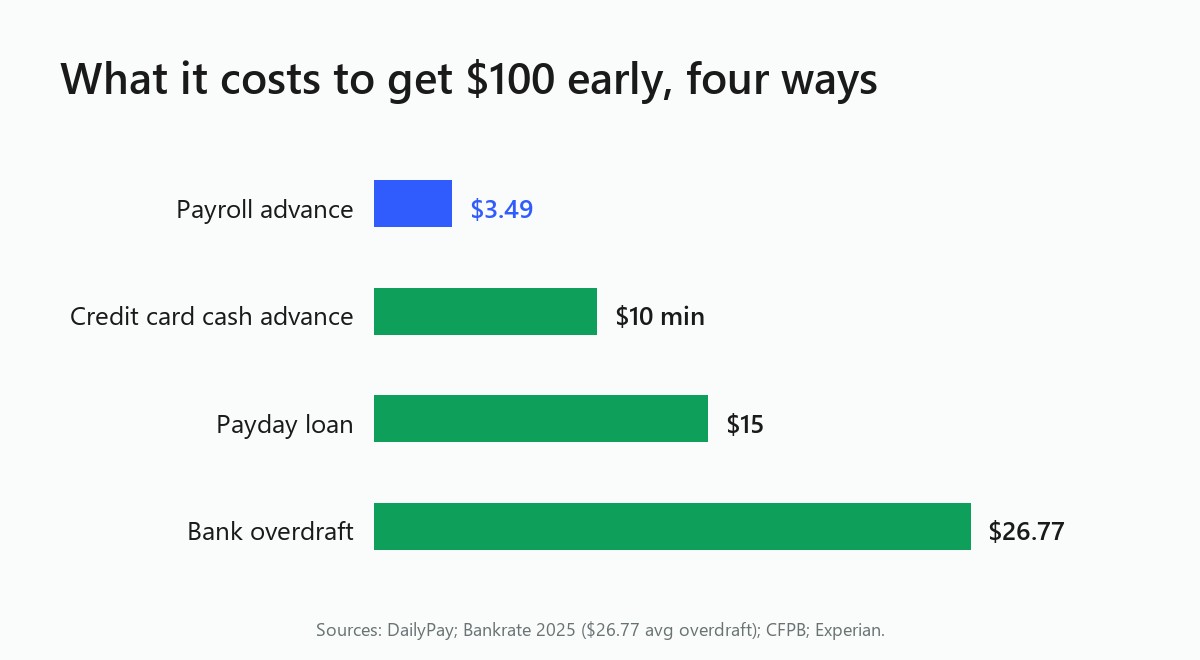
Put side by side, the gap is stark: a payroll-linked advance capped at a few dollars sits nowhere near an overdraft fee that can wipe out $26.77 in one swipe, let alone a payday loan running triple-digit APR. This isn't a full head-to-head verdict between EWA and consumer cash advance apps; that comparison, including which model wins on total cost for a given paycheck cycle, lives in our guide to which model actually costs less.
Before you pull money against a paycheck that hasn't landed yet, a few quick questions tell you what you're actually signing up for:
That percentage-cap question trips people up more than any other. Branch's Core model, for example, caps access at 50% of earned wages before payday; other payroll-integrated providers set their own limits well under the full accrued amount, a detail that becomes a frequent surprise once someone tries to pull more than the app actually allows.
For a broader look at what hourly and shift workers can safely pull early without straining the following paycheck, see earned wage access for hourly employees. And if a provider is asking for bank login credentials rather than working through your employer's payroll feed, how these apps handle your bank access and data is worth a read first.
Payactiv, DailyPay, and Branch each state that the employer bears no direct cost for offering earned wage access, earning revenue instead from optional instant-transfer fees workers choose to pay. These are vendor statements, not independently audited figures, so treat them as the companies' own claims rather than confirmed fact.
Under the CFPB's December 2025 advisory opinion, a pay advance that caps access at already-accrued wages, repays through payroll deduction, carries no recourse or credit reporting, and skips creditworthiness underwriting generally falls outside the legal definition of credit. That treatment now applies to qualifying direct-to-consumer apps too, not just employer-integrated ones.
Branch's Core model, for example, caps access at 50% of earned wages before payday. Other payroll-integrated providers set their own limits, generally well under your full accrued wages, and the exact cap otherwise depends on your employer's contract with the provider.
Some workers turn to direct-to-consumer apps that link to a personal bank account instead of payroll. These apps repay themselves through a bank debit pull on a date they predict, a mechanism separate from the payroll deduction your employer controls. Check first whether your employer has already added a payroll-linked option; it typically costs less and carries no debit-timing risk.
The CFPB issued its original non-credit advisory opinion in December 2020, rescinded it in January 2025, then replaced it with a broader opinion in December 2025 that extends the same non-credit conditions to direct-to-consumer apps. The agency's stated reason was that the structural differences between employer-partnered and direct-to-consumer products had eroded over time.

Venmo doesn't lend money or offer cash advances. Here's what it actually offers, what cash advance apps really do, and how to ask a friend safely.
Read article
Cash App Borrow lets you take $20 to about $500 for a flat fee with a real APR equivalent. See how to unlock it and how it compares to an EWA advance
Read article
Most cash advance apps only deposit to your bank. See which ones issue a debit card you can use at an ATM, and what it costs.
Read articleSee how the top earned wage access apps stack up on fees, limits, and speed. View the full ranking