September 8, 2026
ATM Cash Advance App: Which Apps Give You a Card
Most cash advance apps only deposit to your bank. See which ones issue a debit card you can use at an ATM, and what it costs.
Read article


Picture a warehouse picker on a Tuesday afternoon, phone out on a break, opening Cash App to check a balance before the vending machine. There's a new tile on the home screen: Borrow. No memory of applying for anything.
No email that explained what it is. Just an offer sitting there, promising money in seconds.
That's often how Borrow shows up, since there's no application step to warn you first, and it's also where a lot of confusion starts. Is this the same thing as an earned wage advance, the kind that pulls from hours already worked? It isn't, and the difference matters for what you'll owe and when.
Cash App Borrow is a short-term loan. It comes from a chartered bank, not from Cash App itself and not from your paycheck. The lender is Square Financial Services, Inc. (SFS), an FDIC-insured, Utah-chartered industrial bank that operates as an independently governed subsidiary of Block, Inc., the same parent company behind Cash App.
SFS received FDIC approval to offer this exact loan product, taking over from an external bank partner Block had used before, according to a Block Inc. investor news release. That release doesn't name the earlier partner, so neither will we.
Here's the part that's easy to miss on the app itself: because SFS is a bank and Borrow is a loan, it falls under the Truth in Lending Act. That means Cash App is legally required to hand you a Summary of Loan Terms, a document that spells out the APR, the finance charge, and the payment schedule before you accept the money, according to the Borrow loan agreement. You won't see that math on the marketing page. You'll see it in the app, at the moment you're offered a specific amount.
An earned wage advance works on a different legal footing entirely. Under the CFPB's advisory opinion from December 2025, qualifying earned wage access products aren't treated as "credit" under Regulation Z at all, because you're pulling money you've already earned rather than borrowing against future income. That's the real dividing line between Borrow and EWA, and it's worth sitting with for a second: one is a bank loan with a disclosed APR, the other is a draw against wages you've already worked for. If you want the fuller picture of how EWA products generally operate, our guide to how cash advance apps work breaks down the mechanics.
There's no application button anywhere in Cash App for Borrow, and that trips people up. You don't fill out a form. Cash App reviews your account activity in the background and decides whether to show you the offer, which is exactly why it can appear one week and vanish the next without any notice explaining why.
According to Cash App's own eligibility information, most people become eligible once they deposit at least $300 a month in paychecks directly into Cash App, or link an external bank account that receives at least $500 a month in deposits. Beyond that baseline, Cash App says keeping an active Cash App Card, carrying a balance in the app, and spending $500 or more a month on the Cash Card or through Cash App Pay all improve the odds of an offer showing up.
There are also hard eligibility rules that have nothing to do with activity: you need to be 18 or older, the verified legal owner of the account (a sponsored or family account won't qualify), and you can't be a resident of Colorado, Iowa, or Oregon, where Borrow isn't offered at all. If you're in one of those three states and the tile never shows up, that's the reason, not something wrong with your account.
So if the picker on break sees Borrow disappear the following month, it's likely tied to a dip in deposit activity or card spending, not a punishment for anything. Cash App doesn't publish the exact scoring behind the offer, so the honest answer is that the algorithm reviews your account and you either qualify that day or you don't.
The advertised ceiling is $500, and Cash App's own page frames it as "borrow up to $500 instantly." Treat that as a ceiling, not a guarantee. The minimum loan is $20, and first-time borrowers typically see an offer up to about $400, with the idea that the amount can grow over time as you repay on schedule.
That gap between $400 and $500 matters if you're planning around a specific bill. A driver who needs $475 for a tire repair shouldn't assume Cash App will offer that amount on a first try. The realistic range for someone new to Borrow sits up to about $400, with $500 as the number Cash App advertises rather than a figure every eligible user is handed.
Cash App's marketing page tells you that you'll "pay only a flat fee," but it doesn't put a percentage on that promise anywhere a reader can see without accepting the offer first. LendEDU reports Cash App Borrow charges a 5% flat fee on the amount borrowed. The loan agreement itself defers the exact rate to the in-app Summary of Loan Terms rather than stating a number on a public page, so check that document for your exact fee before you accept.
Take that 5% figure and run it out over a year, and the picture gets clearer. Cash App Borrow is repaid in a lump sum four weeks after you take it, though the app also offers pay-as-you-receive-cash and weekly-installment options, per the loan agreement. A year holds roughly thirteen four-week periods.
Multiply that 5% fee by thirteen and you land at approximately 65% APR (5% x 13 ≈ 65%), which is the same as saying 5% x 365/28 days ≈ 65.2%. Cash App's public Borrow page doesn't state an APR; this is a computed figure, worked out from the fee LendEDU reports and the four-week term Cash App itself discloses.
Put in dollars: borrow $100 and LendEDU's reported 5% fee means you owe $105 back in four weeks. Borrow an offer up to about $400 and the fee comes to $20, for a total repayment of $420. That's the actual math a server or delivery driver should carry into the decision, not the vague "flat fee" language on the landing page.
Repayment is due as one lump sum on the Due Date listed in your Summary of Loan Terms, unless you've chosen one of the installment options. Miss that date, and the loan agreement lays out what happens next: Overdue Interest accrues on the unpaid balance at 1.25% per week, calculated every seven calendar days and not compounding.
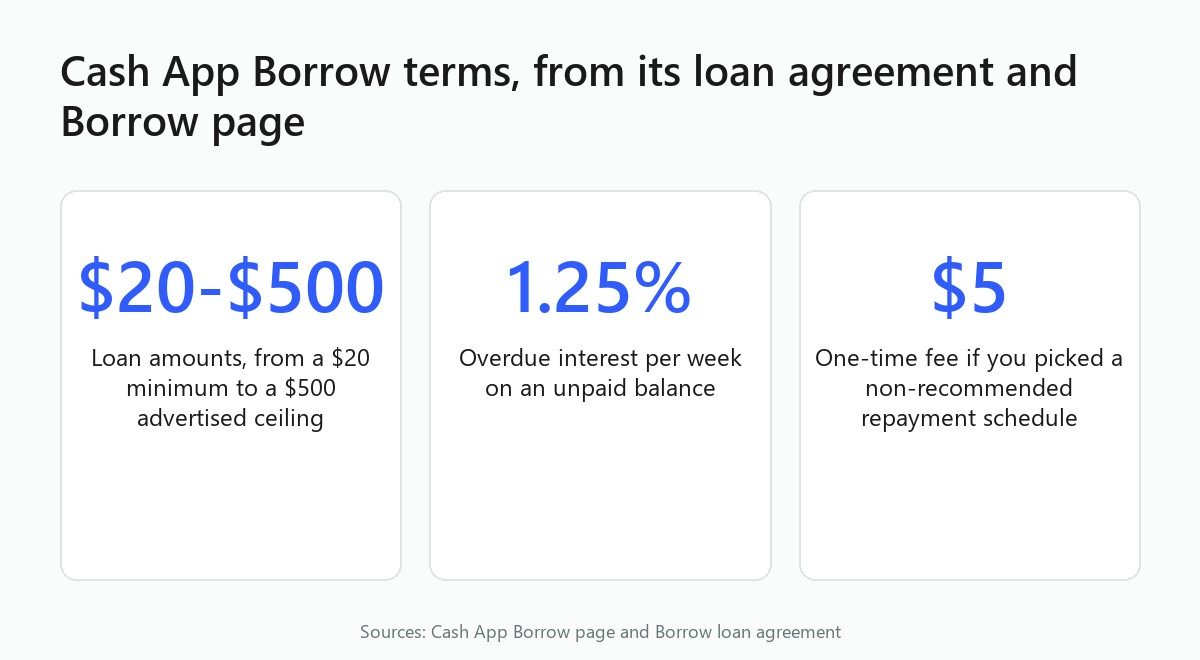
There's also a separate, one-time $5 Outstanding Balance Fee, but it only applies if you chose a repayment schedule other than the one Cash App originally recommended to you. That fee is tied to the repayment structure you picked when you accepted the loan, not to a missed date by itself.
For a gig worker whose income swings week to week, that 1.25% weekly overdue rate adds up faster than it sounds. A missed due date on a $400 loan means about $5 in overdue interest the first week alone, on top of whatever's still owed. The overdue rate is modest compared to a payday-loan-style fee spiral, but it keeps growing every week the balance sits unpaid.
Yes, eligibility isn't permanent in either direction. Since Cash App reviews account activity on an ongoing basis rather than approving you once and locking that decision in, someone who didn't qualify last month can become eligible the next if their deposit pattern or card usage shifts. The same works in reverse: an offer that showed up in July can quietly disappear in August if spending or deposits drop off.
What changes the odds, based on Cash App's own guidance, comes down to the same factors that unlock the offer in the first place: consistent paycheck deposits of $300 or more a month directly into Cash App, or linked-account deposits of $500 or more a month, alongside active use of the Cash App Card and regular spending through the app. It's a review that happens on Cash App's own timeline, based on activity Cash App is already watching.
Line the two products up at the same dollar amount and the comparison gets a lot more honest. EarnIn's Lightning Speed fee of $3.99 applies to transfers between $10 and $75, so $75 is the amount to test on both sides.
At that matching $75 amount, Cash App Borrow's $3.75 fee actually comes in about 24 cents cheaper than EarnIn's $3.99. Those two products aren't structurally the same thing, though, and that's worth saying plainly instead of glossing over. Cash App Borrow is credit: a loan against your future income, disclosed as such, with an APR you can calculate because the default lump-sum option repays on a fixed four-week schedule. EarnIn's advance draws against wages you've already earned and repays automatically from your next paycheck, and the CFPB's December 2025 advisory opinion treats qualifying earned wage access products as outside the definition of credit under Regulation Z.
Comparing a flat fee on an EWA draw to an annualized loan APR is a little like comparing a toll to a mortgage rate; the mechanics differ even when the dollar amounts land close together.
Still, for a worker deciding between the two on a given week, the flat-dollar comparison is the one that matters at the register, and at $75 the two products sit about 24 cents apart. Borrow more than that $75 mark and the picture can shift, since EarnIn's fee tiers change above that transfer size while Cash App Borrow's percentage stays fixed. If you're weighing the fee structures of EWA products more broadly, our breakdown of how EWA fees work goes deeper into how those charges are typically built.
The bigger risk with Borrow sits less in the fee and more in that four-week repayment clock. EarnIn's advance generally repays itself the moment your paycheck lands, so there's rarely a due date to track separately. Cash App Borrow puts that due date on you, and if your income is irregular, that's the part of the math that deserves the most attention.
Cash App Borrow is a real bank loan from Square Financial Services, not an earned wage advance, and that distinction shapes everything about how it's priced and repaid.
None of that makes Borrow a bad product. It makes it a specific one: useful if you know exactly when you'll have the cash to repay it in a lump sum, and worth comparing against an EWA advance if your paycheck timing already lines up with what you need to cover. For a fuller framework on weighing one against the other, our guide to choosing a cash advance app walks through the questions worth asking before you tap either kind of offer. And if you're still deciding whether any advance app is worth trusting with your bank data in the first place, our piece on whether cash advance apps are safe covers what to check first.
No. Cash App Borrow is a bank loan issued by Square Financial Services, Inc., an FDIC-insured subsidiary of Block, disclosed under the Truth in Lending Act with a stated APR. An earned wage advance draws against wages already worked and, under the CFPB's December 2025 advisory opinion, qualifying EWA products aren't classified as credit under Regulation Z at all.
There's no application form. Cash App reviews account activity and extends the offer automatically to eligible users, typically those depositing $300 or more a month in paychecks into Cash App, or $500 or more a month into a linked external account, along with active Cash App Card use.
The minimum loan is $20. First-time borrowers typically see offers up to about $400, and Cash App advertises $500 as its ceiling on the marketing page, though that top figure isn't a guaranteed maximum for every user. The amount you're offered can grow over time if you take a loan and repay it on schedule, though Cash App's page doesn't say how quickly that ceiling rises.
Yes. Eligibility is reviewed on an ongoing basis rather than decided once, so a change in your deposit pattern or Cash App Card spending can make the offer appear later even after an earlier review didn't qualify you. Cash App doesn't publish the exact scoring behind that review.
LendEDU reports a 5% flat fee on the amount borrowed, repaid in four weeks. Annualized across roughly thirteen four-week periods in a year, that works out to approximately 65% APR (5% x 13 ≈ 65%), a figure computed from the reported fee and the disclosed repayment term rather than a number Cash App publishes on its public Borrow page.
Overdue Interest accrues at 1.25% per week, non-compounding, on the unpaid balance. A separate one-time $5 Outstanding Balance Fee can also apply, but only if you selected a repayment schedule other than the one Cash App originally recommended.
No. Cash App Borrow isn't offered to residents of Colorado, Iowa, or Oregon, per Cash App's own eligibility page. If you live in one of those three states, the Borrow tile won't appear in your app regardless of your deposit activity or Cash App Card spending, since the exclusion is based on residency rather than account behavior.

Most cash advance apps only deposit to your bank. See which ones issue a debit card you can use at an ATM, and what it costs.
Read article
Cash advance apps without a bank account are rare. See which ones actually work with a prepaid card or Chime, Varo, or Cash App instead of a bank.
Read article
Only need $100 to payday? See which cash advance apps actually front $100 to new users, and what it really costs with instant fees.
Read articleSee how the top earned wage access apps stack up on fees, limits, and speed. View the full ranking