September 30, 2026
Maryland Earned Wage Access Law: What Changed
Maryland now licenses EWA and cash advance apps, caps fees, and bans tips. Here's what the law requires and what to check before you use one.
Read article


South Carolina has its own earned wage access (EWA) law, and it has been enforceable for more than a year. Governor Henry McMaster signed the South Carolina Earned Wage Access Services Act on May 21, 2024, and it took effect six months later, on November 21, 2024. If you use an app that advances you money against wages you have already earned, this statute, codified at South Carolina Code Section 39-5-810 through Section 39-5-890, sets the ground rules for that app. Here is what it actually requires, who enforces it, and what it means the next time you tap "get paid now."
Yes, and it has been law for well over a year now. South Carolina became the fifth state to pass a dedicated earned wage access statute, following Nevada, Missouri, Kansas, and Wisconsin, according to Goodwin Law's summary of the Act published at signing. Senator Tom Davis sponsored the bill, the House and Senate finished their work on it by May 9, 2024, and the governor's signature made it Act 190.
This is a codified statute with its own article in the South Carolina Code, not a proposal sitting in committee or a patchwork of informal guidance. A provider that ignores it is operating outside the law.
That matters for how you read anything you find about this topic online. Much of the coverage written when the bill passed aimed at compliance departments, not at the person actually using one of these apps before payday. The statute has not changed since taking effect, so the practical question for a South Carolina worker is simpler than the legal analysis: what does this law promise you, and what should make you suspicious of an app that ignores it?
The South Carolina Department of Consumer Affairs, known as SCDCA, holds sole authority over earned wage access under the statute's own article in the South Carolina Code. That is worth stating plainly, because some other states hand this job to a banking regulator. Kansas, for example, assigns its earned wage access rules to a banking regulator instead of a consumer-protection agency.
South Carolina did not follow that path. Lawmakers instead routed this entire framework through SCDCA, the same agency that already fields general consumer complaints and debt-collection oversight in the state.
Why does the choice of regulator matter to you? SCDCA exists to field consumer complaints, so a South Carolina resident with a problem involving an earned wage access provider has an agency whose entire job is protecting consumers, rather than one focused primarily on bank safety and soundness. If you ever need to escalate a dispute with an app, SCDCA is where that escalation goes.
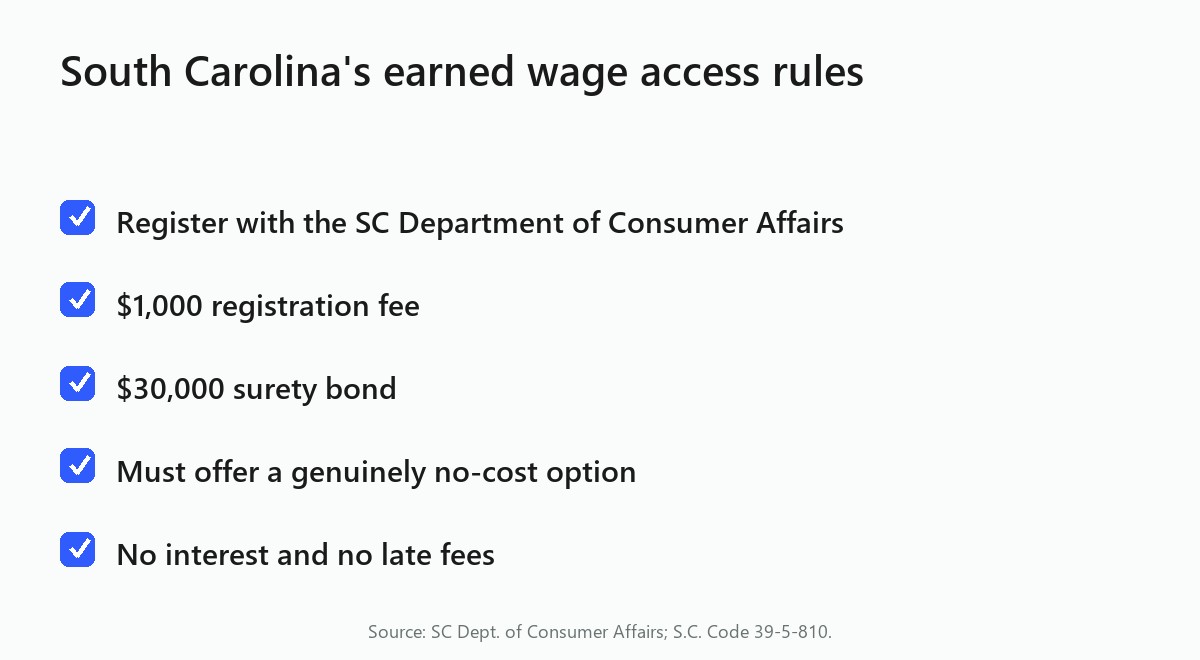
Section 39-5-830 of the Act sets the entry requirements, and the National Law Review's breakdown of that section confirms they apply to any company offering earned wage access to South Carolina residents, even one with no physical office in the state. Three requirements do the heavy lifting.
The law also recognizes two kinds of providers: employer-integrated services, which work through your paycheck and payroll system, and consumer-directed services, which connect straight to your bank account and estimate what you have earned without your employer's involvement. A company can register as either type or both, and the distinction shapes how the app verifies your income before it advances you anything.
One carve-out worth knowing: banks, credit unions, savings and loan associations, savings banks, and trust companies do not have to register under this Act at all. If your paycheck advance comes through your own bank's app rather than a standalone earned wage access company, banking law governs that product instead of this statute.
The clearest consumer protections in the statute sit in Section 39-5-850, which reads like a bill of rights for anyone using these apps. A registered South Carolina earned wage access provider cannot do any of the following.
There is one affirmative duty tucked into that same section too: if the provider's own mistimed repayment attempt causes your bank account to overdraft, the provider has to reimburse you for the resulting fee. This is one of the more practical protections in the statute, since a mistimed debit hitting an account before payday is a common complaint about these apps generally. The trigger is the provider's own mistimed debit, not any overdraft on your account, and once that happens the fee is on the provider.
South Carolina's compliance standards live in Section 39-5-840, and the headline requirement, as the National Law Review's breakdown of the Act also notes, is this: every registered provider must offer at least one reasonable way to get your earned wages with no cost attached. The law does not cap what a faster, paid option can cost. It simply requires that a free path exist alongside it. A mandatory free option tells you that you never have to pay to access money you have already earned, even if the app would rather sell you on the instant-transfer version.
Providers also have to disclose all terms, conditions, and fees before you use the service, disclose that the no-cost option exists, and give you a way to file a complaint, either through their own contact information or SCDCA's. If a provider asks for a tip, the statute requires it to make clear that the tip is voluntary and not a condition of getting your advance. That single line addresses a complaint common to earned wage access apps generally, including outside South Carolina: on-screen tip prompts that are technically optional but designed to feel like refusing help if you decline.
South Carolina's law does not ban tip prompts outright. It does require the app to be honest that skipping the tip does not change whether you get the advance.
The statute answers that directly. Section 39-5-860 classifies amounts advanced through a registered provider as a fee-for-service product, not a loan: the associated fees are not finance charges, and the provider is not treated as a lender under the South Carolina Consumer Protection Code, a classification Payactiv's own summary of the section confirms as well. That classification is settled law in South Carolina, in force since November 2024, and it is worth being precise about what it means.
An EWA advance in South Carolina is structurally different from a payday loan even though both hand you cash before your next paycheck. A payday loan charges interest and can trigger a debt collection process if you fail to repay it. A South Carolina earned wage access advance, under Section 39-5-850, cannot charge interest and cannot be collected through a lawsuit or a debt buyer at all.
South Carolina's approach here is a state-level choice, not a universal rule. Connecticut instead treats these advances as loans under its lending law, so a different rulebook governs them there. Where you live changes which set of rules actually governs the app on your phone.
SCDCA does not have to wait for a lawsuit to act. Under Sections 39-5-880 and 39-5-890, the agency can issue a cease-and-desist order against a provider, require refunds to affected consumers, and deny, suspend, or revoke a company's registration outright. SCDCA also holds general authority to impose administrative penalties on a provider that violates the Act.
How large a penalty can run is not documented in any published summary of the Act, so treat the size of a fine as unknown. A provider that disagrees with an SCDCA enforcement action can appeal through the South Carolina Administrative Law Court.
There is a paperwork requirement behind all of this that is easy to miss but genuinely useful. Section 39-5-870 requires every registered provider to file an annual report to SCDCA disclosing its gross revenue, every consumer complaint it received and how each was resolved, its total transaction count, and the total dollar amount of proceeds and fees or tips it collected, a requirement the National Law Review also flags in its breakdown of the Act. That reporting cycle did not exist before November 2024, which means the state now has a running record of complaint volume by provider.
Registration under Section 39-5-830 is not optional, and it is not something a provider gets to skip because it is based out of state. Any company offering earned wage access to you while you are physically in South Carolina must register with SCDCA regardless of where its headquarters sits. The most direct way to confirm a specific app's status is to contact SCDCA directly and ask.

SCDCA's core mission is enforcing consumer protection law in South Carolina, which makes it the right first call if you are unsure whether the service you use is operating within the rules, or if you want to file a complaint about one that is not. Before you tap "get paid now" on any app, look for the basics the law requires: a clearly presented no-cost option, upfront disclosure of any fee before you accept it, and language that makes clear a tip is optional. An app that buries the free option, or that frames tipping as a condition of getting your money, is falling short of what South Carolina's statute requires.
South Carolina sits in a specific lane among the states that have taken up earned wage access. Nevada was first to pass a dedicated statute and built the registration-and-bonding template that later states, including South Carolina, largely followed. Connecticut took a different route entirely, folding these advances into its existing lending law and treating them as loans instead. Other states, including Texas, have no earned wage access statute at all, leaving apps operating there under whatever general consumer protection law already exists, with none of the specific bond, disclosure, or no-cost-option requirements South Carolina now has on the books.
An Associated Press feature by reporter Cora Lewis, carried by Chicago's WTTW, profiled Anna Branch, an administrative assistant in Charleston who started using the EarnIn app after her work hours were cut. Her account, published in April 2024, predates South Carolina's law by seven months, so it says nothing about whether any app was following the new statute. What her account does capture is the appeal of these apps to someone living paycheck to paycheck: she described the app's ads as feeling like the algorithm was reading her mind, promising up to $100 that week with repayment due the following pay period.
That instinct, needing cash before payday and finding an app that makes it one tap away, is exactly the transaction South Carolina's law was written to regulate.
Yes. The South Carolina Earned Wage Access Services Act took effect on November 21, 2024, and is codified at South Carolina Code Section 39-5-810 through Section 39-5-890. It is a settled, in-force statute, not a pending bill.
It is a state law requiring companies that advance South Carolina residents money against wages already earned to register with the state, post a $30,000 surety bond, and follow a set of disclosure and consumer-protection rules laid out in the statute's own sections.
The South Carolina Department of Consumer Affairs, or SCDCA, is the sole regulator. South Carolina assigns this job to its general consumer-protection agency, unlike Kansas, which puts earned wage access under a banking regulator instead.
No. The law sets no numeric limit on what a paid, expedited transfer can cost. Instead, it requires every provider to offer at least one no-cost way to get your money, so a free option must always be available even though a faster paid option is not capped.
South Carolina says no. Section 39-5-860 states that these advances are not loans, the fees are not finance charges, and providers are not lenders under South Carolina law, as Payactiv's summary of the statute confirms as well. That is different from Connecticut, which classifies these products as loans.
Registration is mandatory for any provider offering the service to South Carolina residents, wherever the company is based. The most reliable way to confirm a specific app's status is to contact SCDCA directly and ask whether the provider is registered.

Maryland now licenses EWA and cash advance apps, caps fees, and bans tips. Here's what the law requires and what to check before you use one.
Read article
Missouri regulates earned wage access under RSMo 361.749. See what registration, fee, and tip rules apply and what it means for you.
Read article
Wisconsin regulates earned wage access under Wis. Stat. ch. 203: DFI licensing, a $5-$7.50 fee cap, and rules on tips and credit checks.
Read articleSee how the top earned wage access apps stack up on fees, limits, and speed. View the full ranking