August 27, 2026
Wisconsin Earned Wage Access Law: Fee Cap & Rules
Wisconsin regulates earned wage access under Wis. Stat. ch. 203: DFI licensing, a $5-$7.50 fee cap, and rules on tips and credit checks.
Read article


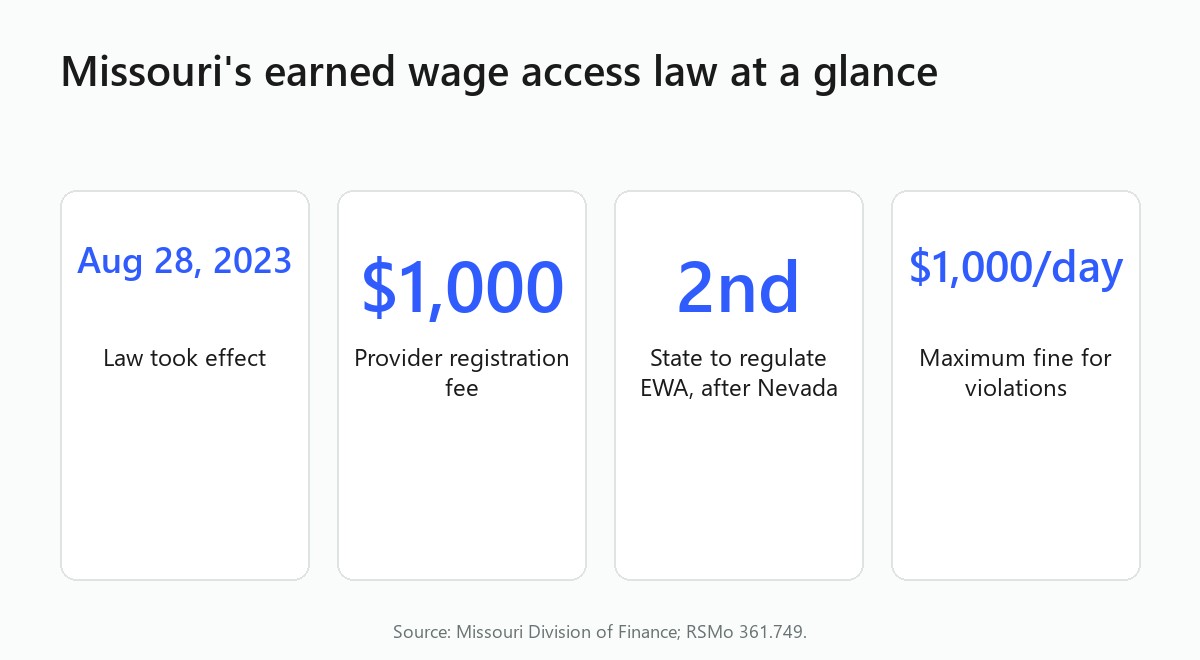
Missouri has regulated earned wage access since August 28, 2023, when RSMo 361.749 took effect and made the state the second in the country, after Nevada, to license and oversee EWA providers directly. If you are a Missouri worker who taps an app for part of your paycheck before payday, that statute is the reason your provider has to register with a state regulator, tell you what a tip actually is, and leave your credit score alone. Here is what the Missouri earned wage access law actually requires, who enforces it, and what to do if a provider ignores it.
Earned wage access, often shortened to EWA, lets a worker draw on wages already earned during the current pay period before the regular payday arrives, usually through an app that advances part of that pay and automatically recovers it once the paycheck lands. Missouri's statute is what puts specific, enforceable rules around that transaction inside the state's borders.
Missouri's earned wage access law lives in state statute, not just an agency policy. The state legislature passed Senate Bill 103 during its 2023 session, and it became law as RSMo 361.749, titled "Earned wage access services," effective August 28, 2023. Bloomberg Tax's payroll desk covered the same effective date and fee structure when the law took hold.
The state was not first, though. Nevada acted first, and Missouri followed soon after with a similar registration model, making it the second state in the country to regulate EWA providers by name, according to a Goodwin Law client alert published when the law passed. The following year, when Kansas became the fourth state to pass its own EWA law, a separate Goodwin Law alert on Kansas's EWA law listed the enactment order as Nevada, Missouri, and Wisconsin ahead of Kansas, which matches Missouri's position as the second state.
The law has been enforceable for nearly three years now, long enough that registration is live, complaints have a real address to go to, and the fine authority behind it has existed the whole time.
Missouri assigned oversight of EWA providers to the Division of Finance, an agency inside the Department of Commerce and Insurance. The Division's EWA program page lists its office at the Truman State Office Building in Jefferson City, with a phone number of (573) 751-3242 and an email address of finance@dof.mo.gov for questions.
Under the statute, a company cannot legally offer earned wage access services to Missouri residents without registering with the Division first. That is the piece worth remembering: if an app is legally operating in Missouri, the Division of Finance is supposed to have a registration on file for it, filed inside the Division's consumer credit licensing section.
The Division's program page does not list a public lookup tool where a Missouri consumer can check a specific provider's registration status directly. Calling or emailing the Division is currently the more reliable way to confirm it, not a self-service search.
Registering is not free, and it is not a one-time formality. A provider pays $1,000 for its initial registration, which covers the application, the Division's investigation, and licensing through June 30 of that cycle. After that, the same $1,000 comes due every year by July 1 to renew.
Beyond the fee, a registrant has to hand over company information, list its corporate officers, directors, and principals, and sign a sworn statement that the company is financially capable of operating as an EWA provider. If the registration changes hands, say a provider is sold or restructured, the Division's director has to approve the transfer before it is valid.
In plain terms, a sworn financial capability statement is the registrant certifying, under oath, that it has the money and operational capacity to keep advancing wages and honoring repayments without collapsing mid-cycle. It is a signed certification filed with the registration paperwork.
One thing worth flagging honestly: neither the Division's program page nor the legal alerts covering the statute mentions a bonding or minimum net worth requirement. That is not the same as Missouri having none, only that none turned up in the sources checked, including the Division's own program page.
Not every company handling paycheck advances has to go through this process. Banks, credit unions, and other entities already authorized to make loans under Missouri or federal law, and already regulated because of it, are exempt from the EWA-specific registration requirement.
RSMo 361.749 goes past registration. It draws a hard line around five specific things a registered EWA provider cannot do to a Missouri consumer, plus one thing it has to do for you:
Several of these line up with documented industry pain points, especially the overdraft rule. A recurring complaint across EWA apps is timing rather than price: an advance gets debited on payday, the paycheck deposit lands later or smaller than expected, and the account goes negative before the money shows up. Missouri's overdraft-reimbursement requirement targets exactly that scenario.
Missouri's prohibited-practices list answers a bigger question hiding underneath it: is an earned wage advance a loan? Functionally, the state's law says no. By banning interest, penalties for nonpayment, debt collection, and credit reporting on unpaid balances, Missouri keeps a registered EWA advance structurally different from a payday loan, where all of those things are standard practice.
That distinction is worth understanding before you decide which product actually fits a short-term gap in your budget, including how EWA differs from a payday loan under state law more broadly and what each one really costs you over time.
Registration and prohibited practices are half the law. The other half covers what a provider has to tell you, and when.
Before you sign an agreement, the provider has to explain your rights under it and fully and clearly disclose all fees involved. Tips get a stricter rule of their own: a provider has to disclose that a tip is voluntary, clearly and conspicuously, both in the contract and again before every individual transaction, not just once during onboarding.
That per-transaction requirement matters more than it sounds. A common complaint about EWA apps, documented across the industry rather than Missouri specifically, is that declining a tip feels like refusing to help someone, even when the tip is supposed to be optional. Missouri's law responds to that pressure directly: the app has to say the tip is voluntary before you tap confirm, every single time, not bury it once in the terms you scrolled past at signup.
Disclosure does not cap what a provider can charge. It only forces the provider to show you the cost plainly before you agree to it. Working out what a tip and an expedited-transfer fee actually cost per advance, in real dollar terms, is worth doing before you lean on any single app regularly.
Missouri backs this law with real financial teeth. A provider that violates the statute faces administrative fines of up to $1,000 per day, on top of possible disciplinary action against the provider's registration. A $1,000-per-day fine adds up fast for a provider running that app in every state it can, which is exactly the kind of pressure a state regulator wants sitting behind a compliance requirement.
That fine authority has existed since the law took effect in 2023, but no public record of a Missouri-specific enforcement action, consumer alert, or complaint statistics tied to an EWA provider turned up in the sources checked for this article. Read that as a checked absence, not proof that every provider in the state has complied perfectly. No evidence of amendments to RSMo 361.749 since its 2023 enactment turned up either, so the rules described here reflect the law as it has stood since August 2023.
Missouri did not write its EWA law in isolation, and other states have taken visibly different paths since.

Nevada passed the first EWA-specific law in the country, and Missouri followed the licensing template Nevada set first, adopting a similar registration-and-disclosure structure. Texas, by contrast, has no enacted EWA law at all, so providers there operate without the registration requirement or the prohibited-practices list Missouri workers get. California's DFPI takes a different registration approach, setting its own rules for who has to register and how. Connecticut instead treats these advances as loans under its existing lending law, which changes what counts as a fee versus what counts as interest.
Trade press covered Missouri's law at the time mostly as an industry signal rather than a consumer one: Payments Dive framed it as Missouri following Nevada's lead, part of a broader wave of states moving to regulate EWA by name. That framing tells a compliance officer what changed. It does not tell a Missouri worker what their own app can and cannot do to them, which is the gap this article is meant to close.
For a Missouri worker, the practical upshot is that your protections depend entirely on which state's law actually applies to your provider.
If a Missouri EWA provider crosses one of these lines, whether that is ignoring a disclosure requirement, sharing your tip with your employer, or sending your unpaid balance to collections, you have a direct route to the regulator that oversees it.
The Missouri Division of Finance handles consumer complaints against the financial companies it regulates, EWA providers included. You can file a complaint directly through the Division's complaint form, or reach the Division by phone at (573) 751-3242 or by email at finance@dof.mo.gov to ask about a specific provider.
Before you file, it helps to have the specifics ready: the provider's name, the date of the advance, the fee or tip amount you were charged, and any screenshots of what the app told you about your rights or the cost. If your bank charged you an overdraft fee that traces back to how the provider timed a debit, name that specifically, since the reimbursement requirement is one of the clearest tests of whether a provider is complying.
A single complaint will not rewrite an app's business model overnight. It is still the documented channel Missouri built for exactly this purpose, and it is how a pattern of violations eventually becomes something the Division can act on.
Yes. Missouri has regulated EWA providers under RSMo 361.749 since August 28, 2023, making it the second state in the country, after Nevada, to enact EWA-specific legislation. The law is still in force and unchanged as of this writing.
They need to register with the Missouri Division of Finance before doing business in the state, which functions much like a license even though the statute calls it registration. The initial fee is $1,000, with a $1,000 annual renewal. Banks and credit unions are exempt.
No. Missouri's law prohibits a registered provider from using your credit report or credit score to decide whether to approve an advance or how much to give you. The ban covers both the approval decision and the amount you are offered, so a provider cannot lean on your credit history for either one.
Tips are not mandatory under Missouri's law. A provider has to disclose, clearly and before every single transaction, that any tip is voluntary. If an app treats a tip as required or buries that disclosure, that is inconsistent with what the law demands.
Missouri's law requires the provider to reimburse certain overdraft fees you incur when they are caused by how the provider timed its debit. Contact the provider first, and file a Division of Finance complaint if it will not resolve the charge.
File through the Missouri Division of Finance's complaint form, or contact the Division by phone at (573) 751-3242 or by email at finance@dof.mo.gov. No public tool for looking up a provider's registration status was found, so contacting the Division directly is currently the way to confirm one.

Wisconsin regulates earned wage access under Wis. Stat. ch. 203: DFI licensing, a $5-$7.50 fee cap, and rules on tips and credit checks.
Read article
Kansas has an enacted earned wage access law. See what K.S.A. 9-2401 requires of providers, the OSBC's role, and what it means for you.
Read article
Florida has no earned wage access law. See which Florida rules cover cash advance apps, what payday lenders must follow, and where to complain.
Read articleSee how the top earned wage access apps stack up on fees, limits, and speed. View the full ranking