August 21, 2026
Kansas Earned Wage Access Law: The Rules Now
Kansas has an enacted earned wage access law. See what K.S.A. 9-2401 requires of providers, the OSBC's role, and what it means for you.
Read article


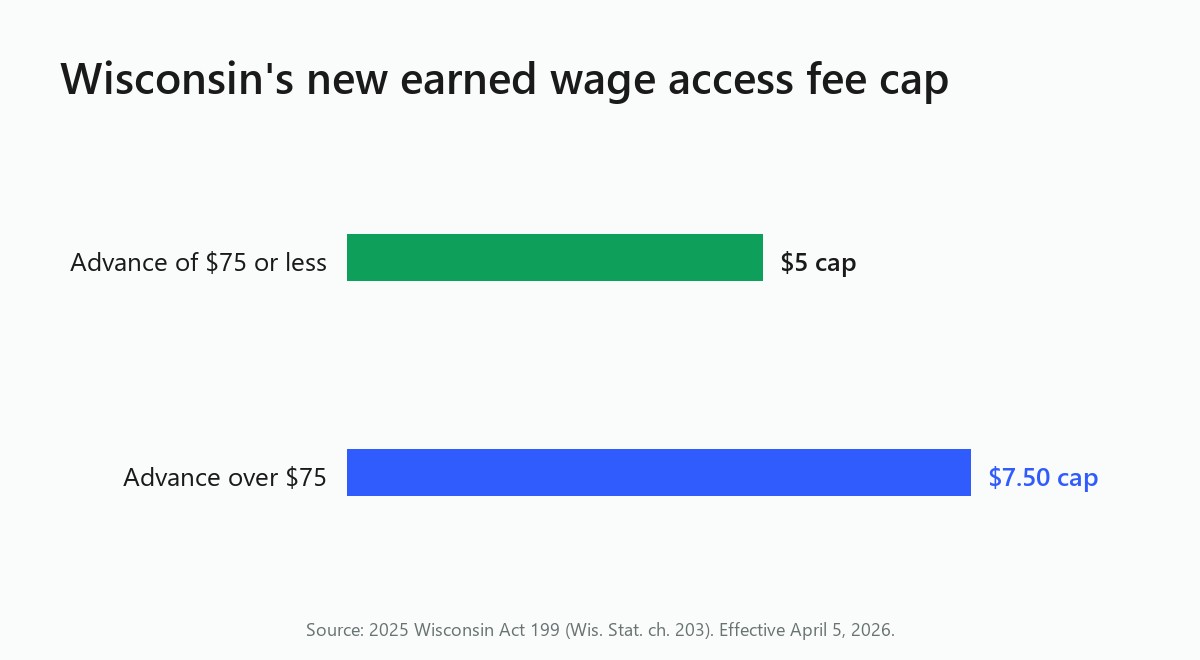
Wisconsin regulates earned wage access (EWA) under its own statute, Wisconsin Statutes Chapter 203, and the rules just changed. The Department of Financial Institutions (DFI) Division of Banking is the regulator. As of April 5, 2026, a licensed provider can charge you no more than $5 on an advance of $75 or less, or $7.50 on anything above that (Wisconsin DFI's EWA licensing page). If you're a Wisconsin worker with one of these apps already on your phone, here's what the law actually requires, and how to check whether your provider is following it.
Yes, and it has since 2024. Chapter 203, titled "Earned Wage Access Services," is Wisconsin's dedicated statute for this product. Lawmakers created it as a standalone statute, separate from the state's payday lending law.
The statute, Wisconsin Statutes section 203.01, defines an "earned wage access service" as the business of providing consumer-directed wage access services, employer-integrated wage access services, or both. Consumer-directed wage access services deliver that access based on your own representations about what you've earned and the provider's own determination. Employer-integrated wage access services deliver it based on employment, income, or attendance data the provider gets directly from your employer. In plain terms, that covers both the apps that ask you to link a bank account and estimate your own earned time, and the apps your employer plugs directly into its payroll or attendance system.
"Earned but unpaid income" is the statute's term for the money at the center of all this: wages, salary, or other compensation that a consumer or employer has represented, and a provider has reasonably determined, has already been earned but hasn't been paid out yet. That includes hourly, project-based, piecework, and independent-contractor work.
Chapter 203 started as 2023 Assembly Bill 574, which became 2023 Wisconsin Act 131. Governor Evers signed it March 21, 2024, and it was published the next day.
Wisconsin acts commonly take effect on the first day of a set number of months after publication. Goodwin Law's client alert on Act 131 puts the effective date at approximately September 22, 2024, the first day of the sixth month after publication. The date to rely on is fall 2024.
About two years later, Wisconsin came back and amended its own law: 2025 Assembly Bill 1025 became 2025 Wisconsin Act 199, which Evers signed April 3, 2026, effective April 5, 2026. That's confirmed directly on DFI's own EWA licensing page. Act 199 is what added the fee cap, and it also identified which parts of the Wisconsin Consumer Act and the state's marital-property law don't apply to earned wage access. DFI's page confirms that exemption exists, though it doesn't spell out the specific sections carved out.
Goodwin Law describes Wisconsin as the third state to enact an EWA-specific licensing law.
Under Wisconsin Statutes section 203.03, a provider, including one that isn't physically located in Wisconsin, may not offer earned wage access services in the state without a license issued by the Division of Banking. That "not physically located in this state" language closes an obvious loophole: an app headquartered in another state still needs a Wisconsin license to serve Wisconsin workers.
Banks, savings and loan associations, trust companies, credit unions, and their affiliates are exempt from this licensing requirement, since they're already regulated elsewhere. Everyone else applies through the Nationwide Multistate Licensing System & Registry (NMLS), submits applicant, officer, and director information for a character and fitness review, posts a surety bond, and pays initial and annual renewal fees set by the division, per Goodwin Law's summary of the enacted text. DFI also requires annual financial statements, a calendar-year-end balance sheet and income statement prepared under generally accepted accounting principles (GAAP), due each July 1, along with a minimum tangible net worth of $50,000 and positive working capital. DFI discounts intangibles, related-party receivables, employee advances, and overdue receivables when it checks those numbers.
For you as the user, that means a licensed Wisconsin provider has already passed a character and fitness review, posted a bond, and proven it holds enough capital to meet the $50,000 net-worth threshold before it ever advances you a dollar. That review, bond, and net-worth check are the price of legally operating in Wisconsin as an earned wage access provider, and DFI reviews each licensee again every year through the renewal process.
No. Wisconsin built earned wage access as its own regulatory category, separate from lending law, and licensed providers are exempt from the state's consumer loan and payday loan licensing laws, per Goodwin Law's summary. That's a deliberate legislative choice.
The disclosure rules, rate caps, and licensing requirements that apply to a Wisconsin payday loan don't automatically govern a compliant EWA advance, because the state doesn't classify the two the same way. An EWA fee is not treated as interest and not treated as a loan charge under Wisconsin law, so the annualized figures shown later in this section work only as a comparison tool, never as proof a provider broke a usury law.
A handful of consumer protections apply to every licensed provider, regardless of the fee a provider charges. Under the enacted text as summarized by Goodwin Law, providers must:
And they're prohibited from:
Wisconsin also requires overdraft or non-sufficient funds (NSF) fee reimbursement in certain circumstances; Goodwin's summary confirms the protection exists but does not state the exact trigger. Treat it as a real protection, without assuming a specific dollar amount or timeline attaches to it. On top of the state-specific rules, providers still have to comply with applicable privacy and information-security law and the federal Electronic Fund Transfer Act.
Read that no-credit-check rule again, because it's easy to skim past. A licensed Wisconsin provider legally cannot pull your credit report or use your credit score to decide whether to advance you money. If an app asks for that kind of check before approving a Wisconsin user, that's worth a second look.
This is the part of Wisconsin's law that's brand new. Before April 2026, Wisconsin had no dollar limit on what a licensed EWA provider could charge for a single advance. Chapter 203 required disclosure and a free option, but no statute capped the fee itself.
2025 Wisconsin Act 199 changed that. Effective April 5, 2026, a provider may charge no more than $5 for an advance of $75 or less, and no more than $7.50 for an advance greater than $75. That's the first dollar ceiling Wisconsin has ever put on what a provider can charge for a single advance, and it applies to the fee for delivery or expedited delivery of your money, in other words, the charge for getting your money faster than the free, standard schedule would deliver it.
The cap isn't frozen in place forever, either. Starting January 1, 2030, and every five years after that, the Division of Banking has to adjust those maximum fees for the Consumer Price Index for All Urban Consumers (CPI-U). The $5 and $7.50 figures can change over time as a result.
Wisconsin law treats a compliant EWA fee as not interest and not a loan charge, so an annualized-rate figure here works only as a cost-comparison tool, useful for putting a flat dollar fee into the same terms you'd use to compare a credit card rate or a payday loan rate.

Here's what the capped fees work out to when you annualize them (fee divided by advance amount, multiplied by 365 divided by days until repayment):
Notice the pattern: the shorter the repayment window and the smaller the advance, the higher that annualized number climbs, even though the actual dollar fee never moves past $5 or $7.50. That's simple math working against small, fast advances. A flat fee hits harder, proportionally, on a small advance repaid quickly, which is exactly the kind of advance a lot of EWA users take.
You don't have to take a provider's word for it. Wisconsin routes its EWA licenses through NMLS, and consumers can look up any company's licensing status through NMLS Consumer Access. Search the provider's legal company name; app marketing names often differ from the licensed entity's name.
If the company shows an active Wisconsin license, it's operating under Chapter 203's rules. If it doesn't show up at all, that's worth asking the company about directly, or reporting to DFI.
You can also contact DFI's Division of Banking directly with questions about a specific provider at DFI_LFS@dfi.wisconsin.gov or (608) 261-7578. Keep in mind that bank, savings and loan, trust company, and credit union affiliates don't need a separate EWA license under Chapter 203, since their existing regulator already covers them. A search of the Wisconsin Attorney General's consumer alerts turns up none specific to earned wage access apps, which makes DFI's Division of Banking your primary point of contact for a licensing question or a complaint.
Wisconsin licenses EWA providers under a dedicated chapter, the same general route Nevada took. Not every state made the same call.
Connecticut instead regulates EWA as a loan, which brings a different set of disclosure and rate rules into play, and California takes a registration approach through its California Department of Financial Protection and Innovation (DFPI) rather than a full licensing regime. If you split time between Wisconsin and another state, or you're comparing an app's terms against what you've read about a different state's law, know that the underlying legal category, loan versus licensed EWA versus registered EWA, is what actually drives which protections apply, more than the dollar amounts do.
Yes. Wisconsin regulates earned wage access under Wisconsin Statutes Chapter 203, created by 2023 Wisconsin Act 131 (effective fall 2024) and amended by 2025 Wisconsin Act 199 (effective April 5, 2026). This is an enacted, in-force law, not a pending bill.
No. Licensed EWA providers are exempt from Wisconsin's consumer loan and payday loan licensing laws, and the legislature created earned wage access as its own regulatory category, separate from lending law. A compliant EWA fee is not treated as interest or a loan charge under Wisconsin law.
As of April 5, 2026, a licensed provider can charge no more than $5 for an advance of $75 or less, and no more than $7.50 for an advance greater than $75, under 2025 Wisconsin Act 199. Starting January 1, 2030, and every five years after, the Division of Banking must adjust those maximums for inflation using the CPI-U.
Yes. Under Wisconsin Statutes section 203.03, any provider, including one located outside Wisconsin, must hold a license from the DFI Division of Banking to offer earned wage access services to Wisconsin consumers. Banks, savings and loan associations, trust companies, credit unions, and their affiliates are exempt from this specific licensing requirement.
Search the provider's legal company name through NMLS Consumer Access. Wisconsin routes its EWA licenses through NMLS, so an active license will show there. You can also contact DFI's Division of Banking directly at DFI_LFS@dfi.wisconsin.gov or (608) 261-7578 with questions about a specific company.
2025 Wisconsin Act 199 took effect April 5, 2026 and added Wisconsin's first dollar cap on EWA fees: $5 for advances of $75 or less, $7.50 for larger advances. It also identified which Wisconsin Consumer Act and marital-property-law provisions don't apply to earned wage access, though DFI's page does not list the specific sections.

Kansas has an enacted earned wage access law. See what K.S.A. 9-2401 requires of providers, the OSBC's role, and what it means for you.
Read article
Florida has no earned wage access law. See which Florida rules cover cash advance apps, what payday lenders must follow, and where to complain.
Read article
Where New York's earned wage access rules stand, the competing bills in play, and what an unsettled law means for users.
Read articleSee how the top earned wage access apps stack up on fees, limits, and speed. View the full ranking