September 30, 2026
Maryland Earned Wage Access Law: What Changed
Maryland now licenses EWA and cash advance apps, caps fees, and bans tips. Here's what the law requires and what to check before you use one.
Read article


Kansas has an earned wage access law, and it has been in force since July 1, 2024. If you pull money from a paycheck before payday through an app, Kansas is one of a small group of states where a dedicated statute sets the rules for that transaction instead of leaving it to general lending law alone. The law is the Kansas earned wage access services act, codified at K.S.A. 9-2401 through 9-2416, enacted through House Bill 2560.
Yes, K.S.A. 9-2401 through 9-2416 is officially known as the Kansas earned wage access services act, enacted by the 2024 Legislature and effective July 1, 2024. That is not a preview of something coming later, and it is not a bill still working its way through committee the way similar proposals stalled in some other states.
The statute has already governed earned wage access (EWA) providers doing business with Kansas consumers for more than two years as of this writing.
Kansas was reported as the fourth state to pass EWA-specific legislation, following Nevada, Missouri, and Wisconsin, according to a Goodwin Law analysis published when the bill passed. Three categories sit outside the act's scope: bank holding companies regulated by the Federal Reserve, depository institutions regulated by federal banking agencies, and subsidiaries of either that directly own 25% or more of the parent's common stock.
Everyone else offering earned wage access to a Kansas consumer falls under it, whether the product is marketed directly to you or delivered through your employer's payroll system. The statute defines two service types this way: consumer-directed wage access services, which are offered straight to you based on your own representation of income you have already earned, and employer-integrated wage access services, which draw on employment, income, and attendance data your employer supplies. Both fall under the same registration requirement under K.S.A. 9-2402 and 9-2403, so the label on the app does not change what it owes you under Kansas law.
The Kansas Office of the State Bank Commissioner, usually shortened to OSBC, is the state agency that licenses and supervises banks, consumer lenders, and now earned wage access providers doing business in Kansas. The earned wage access act puts registration, examination, and enforcement authority in the OSBC's hands. That is a meaningful detail on its own, since Kansas did not hand this market to a generic consumer-protection office. It sits with the same regulator that already examines the state's banks and licensed lenders.
The OSBC's authority goes beyond approving a registration and walking away. Under K.S.A. 9-2408, registrants must file annual reports with the commissioner, which the act treats as confidential, and those reports have to flag defined reportable events as they happen rather than waiting for the year-end filing.
K.S.A. 9-2409 also subjects providers to OSBC examination, and makes the registrant, not the state, pay the cost of that examination. For you, that combination means a Kansas-registered provider answers to the same regulator on an ongoing basis, with the state able to look at its books and practices whenever it decides to, well beyond the initial paperwork filed at registration.
Getting into the Kansas EWA market, and staying in it, comes with real paperwork. The act lays out a registration and bonding process the commissioner enforces directly.
None of that paperwork is visible to you as a user. What it means practically is that a company advancing you money in Kansas has already put its finances, its ownership, and its principals' backgrounds in front of a state regulator before it can legally take your first transaction.
K.S.A. 9-2406 lists the acts a registered provider is prohibited from taking against a Kansas consumer, and this is the section that carries the most weight for you day to day. A provider operating in Kansas may not:
Read that list next to how a payday loan's interest and rollover fees compare. In Kansas, an EWA provider is barred from all of it outright by state statute, not by its own goodwill.
K.S.A. 9-2405 requires registrants to treat every fee, tip, gratuity, or donation as a non-recourse obligation. In plain terms, a provider cannot use a court, a collector, or any other coercive means to force you to pay what you owe on an advance, a fee, or a tip you chose to leave.
The same section bars a provider from conditioning how much you can request, or how often you can request it, on whether you pay a fee or tip, or on how large that tip is. Combined with the deceptive-tip ban in section 9-2406, that is arguably the strongest consumer protection in the whole act: a Kansas provider cannot quietly throttle your next advance because you declined to tip on the last one, and cannot lie to you about whether tipping is truly optional.
Here is where I want to be precise instead of reassuring. Under K.S.A. 9-2406, the act requires any expedited or instant delivery fee to be reasonable, but it sets no dollar amount and no percentage as a numeric ceiling.
Interest, late fees, deferral fees, and finance charges are banned outright, as covered above. A specific cap on what a tip and an expedited fee actually cost per advance simply does not exist in Kansas law, whatever a comparison chart elsewhere might imply.
No, and Kansas settled that question directly instead of leaving it open. K.S.A. 9-2407 states that earned wage access services regulated under the act are not considered a loan or money transmission, and that the act controls over any conflicting provision elsewhere in Kansas law.
That puts Kansas in a different position than a state like Connecticut, which instead treats these advances as loans under its own lending statute. Kansas lawmakers made the opposite call and wrote it into the statute itself, so a Kansas provider following the act is not subject to Kansas's consumer lending license requirements the way a payday lender is.
Kansas gives the OSBC real enforcement teeth, and the penalty structure is worth reading carefully rather than rounding to a single number.
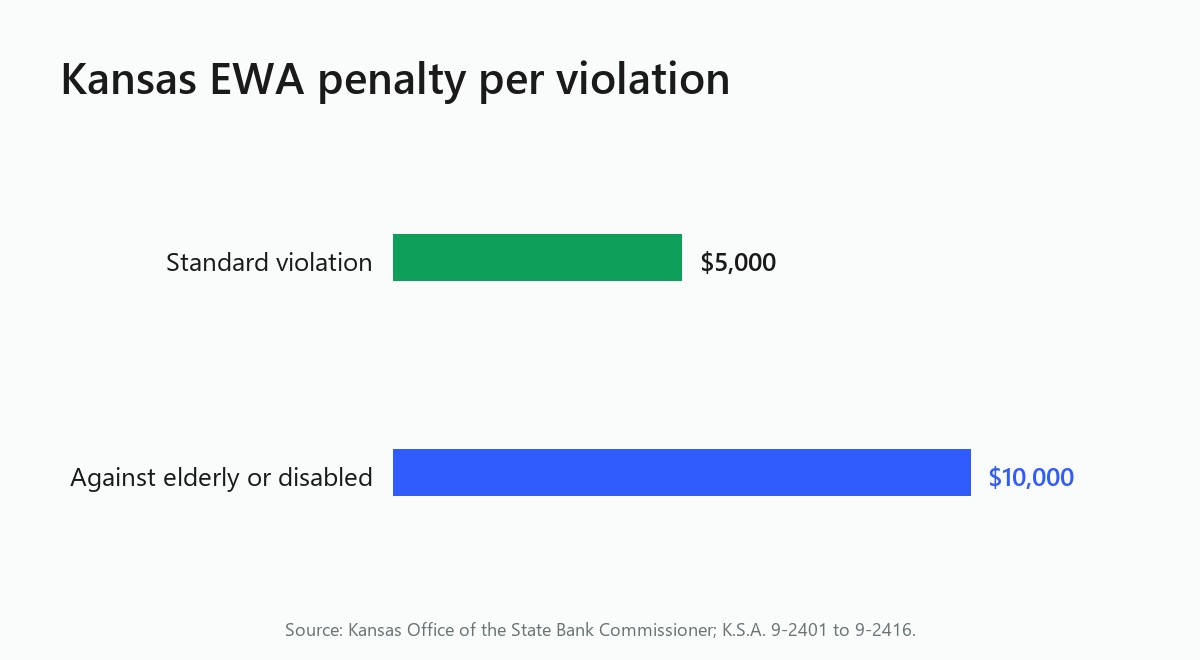
Under K.S.A. 9-2412, the commissioner can issue a cease-and-desist order and impose a civil fine of up to $5,000 per violation, after notice and a hearing under the Kansas Administrative Procedure Act. If that same violation involved an elderly or disabled Kansan, the commissioner can add a second, separate fine of up to $5,000 per violation on top of the first one.
Those are two distinct fines the statute authorizes, one base fine and one add-on fine, and together they can reach up to $10,000 per violation when an elderly or disabled Kansan is involved. Read that carefully, because it is easy to round it down to a single flat number. The statute sets two separate $5,000 fines that stack in the cases the legislature judged most serious, rather than a single $10,000 ceiling.
The commissioner also holds authority to deny, suspend, or revoke a registration under section 9-2410, and criminal penalties for certain violations exist under section 9-2414. The commissioner or the Kansas attorney general may also seek an injunction against a provider under section 9-2415. Money collected from fines and fees under the act is earmarked for the OSBC's consumer education efforts under section 9-2416.
Before you rely on an EWA app for a real paycheck gap, it is worth confirming the company behind it is actually operating under this framework rather than ignoring it. The Kansas Office of the State Bank Commissioner maintains its own earned wage access page describing the registration program and the act it administers, and that page is the right starting point.
If the OSBC's site does not make a company's current registration status obvious at a glance, contact the OSBC directly and ask. A provider that is genuinely registered should have no trouble confirming that status or pointing you to where the state lists it. Counts of registered providers published elsewhere can go stale, so check the regulator's own current page instead of relying on an older number.
Kansas expanded the OSBC's authority over EWA providers again in 2026 through House Bill 2591, a broader financial-regulation bill covering several unrelated topics, including elder financial exploitation protections and a new virtual currency kiosk consumer protection framework.
The provision that matters most for EWA users adds earned wage access registrants to the list of entities covered by the Kansas Financial Institutions Information Security Act. In practice, that gives the OSBC the same data-security examination authority over EWA providers that it already holds over other regulated financial entities like banks and consumer lenders. Before HB 2591, the act's examination language focused on financial responsibility and consumer-protection compliance. This addition means how a provider secures your income and banking data now falls under the same regulatory scrutiny as how it handles your money.
Kansas sits in the registration camp of EWA regulation, alongside Nevada, Missouri, and Wisconsin: a state agency registers providers, checks their finances and principals, and enforces a specific list of banned practices. Nevada's first-in-nation law used a similar registration model when it passed. California's Department of Financial Protection and Innovation registers providers a different way, under its own income-based advance rules, a related but distinct framework from Kansas's approach.

Connecticut took a different path entirely, treating these advances as loans under its lending law rather than creating a standalone EWA category, which means the loan-versus-not-a-loan question that Kansas settled through K.S.A. 9-2407 stays open there. Other states, including several that have debated bills without passing them, currently have no EWA-specific statute at all, leaving general lending and consumer-protection law to fill the gap however courts and regulators interpret it. Kansas workers do not have to guess: the rules are written down, in force, and enforced by a named agency.
Yes. The Kansas earned wage access services act, K.S.A. 9-2401 through 9-2416, took effect July 1, 2024, and has governed EWA providers doing business with Kansas consumers for more than two years as of this writing. Kansas was reported as the fourth state to pass EWA-specific legislation, following Nevada, Missouri, and Wisconsin.
It is the state law, codified at K.S.A. 9-2401 through 9-2416, that requires earned wage access providers serving Kansas consumers to register with the state, file a surety bond, and follow a list of banned practices such as charging interest or reporting missed payments to credit bureaus.
The Kansas Office of the State Bank Commissioner, or OSBC, registers providers, examines them, and enforces the act, the same agency that oversees the state's banks and licensed consumer lenders. Under K.S.A. 9-2408 and 9-2409, registrants also file annual reports with the commissioner and pay for their own OSBC examinations.
Not with a specific dollar or percentage number. Kansas law bans interest, late fees, deferral fees, and finance charges outright, and requires any expedited transfer fee to be reasonable, but the statute sets no numeric ceiling on that reasonable fee.
No. K.S.A. 9-2407 states directly that earned wage access services regulated under the act are not a loan or money transmission, and that the act controls over any conflicting Kansas law. Connecticut took the opposite approach and regulates these advances under its own lending law instead.
Start with the OSBC's own earned wage access page, which describes the registration program the agency administers. If a company's status is not clear there, contact the OSBC directly and ask, since a genuinely registered provider should be able to confirm it.

Maryland now licenses EWA and cash advance apps, caps fees, and bans tips. Here's what the law requires and what to check before you use one.
Read article
South Carolina has an enacted earned wage access law. See what S.C. Code 39-5-810 requires of providers, the SCDCA's role, and what it means for you.
Read article
Missouri regulates earned wage access under RSMo 361.749. See what registration, fee, and tip rules apply and what it means for you.
Read articleSee how the top earned wage access apps stack up on fees, limits, and speed. View the full ranking