October 2, 2026
Cash Advance Apps That Work With Chime (2026): Verified List
Chime's own SpotMe and MyPay fees and limits, plus which cash advance apps confirm Chime support on their own help pages.
Read article


The Klover cash advance app pairs its advances with a points system built on your personal data: link accounts, take surveys, watch ads, and the points you earn can raise your limit or cover fees. That data-for-points structure is worth understanding before you request your first advance, because it shapes both the fee math and what Klover collects along the way.
Klover's advance range runs from $25 to $750, according to Klover's own pricing information. That's the ceiling, but it's not what a new user sees on day one. Klover's own how-it-works content states that new users typically start between $40 and $90, with room to grow through repayment history and points earned inside the app.
That gap between the $750 ceiling and the $40-to-$90 starting range matters for planning. A first-time user requesting Klover for a larger expense should expect an offer closer to the lower end, with the ceiling something to grow into through repeat use and points earned along the way, not a number available on the first request. Readers weighing that ceiling against other apps can see how it stacks up in compareEWA's roundup of cash advance apps with high limits.
Klover sets eligibility from income and bank-account activity, per that same how-it-works content: regular deposits, account history and balance patterns, a user's prior repayment record with Klover, and state regulations that vary by where you live. There's no credit pull and no credit score gate.
The structure underneath the advance is worth naming plainly. Klover's terms and conditions describe Balance Advances as "a non-recourse product," and state that Klover users have no legal obligation to repay them. If Klover can't collect, it warrants that it has no legal or contractual claim against the user for that failure.
Klover's terms rule out debt collection and credit reporting entirely: the same terms say Klover won't pursue debt collection, won't sell the debt, and won't report unpaid advances to credit bureaus. Instead, if it can't collect, it can suspend a user's access to the app until it's able to successfully charge the linked account again.
Klover lets you earn your way to a bigger limit instead of only paying for speed. Points come from linking a debit card, connecting retailer accounts, connecting an email account, taking surveys, watching ads, spinning an in-app reward wheel, signing up for partner offers, and referring other users, all according to Klover's explanation of how the app works.
Klover's own materials describe three uses for points: raising the ceiling on cash advances, covering express-fee costs on instant advances, and funding points-only advances outright. Per Klover's pricing page, 500 points are worth roughly $1.00 in fee-offsetting value.
That math is where app-store sentiment gets sharper. One App Store reviewer of the Klover app wrote that "every 900 points is a $30 Boost which REALLY isn't $30 once you subtract the $5 transaction fee." That $5 figure is not something Klover's own pricing or terms pages confirm anywhere, so treat it as one user's account of what redemption cost them, not a published Klover fee. Still, the complaint underneath it tracks with the arithmetic: earning enough points to matter takes real time and real personal data, and the value on redemption can end up smaller than it looked while you were racking up the points.
Basic Balance Advances are free. No interest, no mandatory fee, according to Klover's terms and conditions. But "free" comes with a catch that's easy to miss on a first read: Klover doesn't commit to a specific timeline for those standard transfers.
The terms state that Klover charges and funds "any time after" it sees evidence of income deposited, or on a date the user selects, with no fixed number of business days written into the language. If you need money today, the free tier isn't built to promise that.
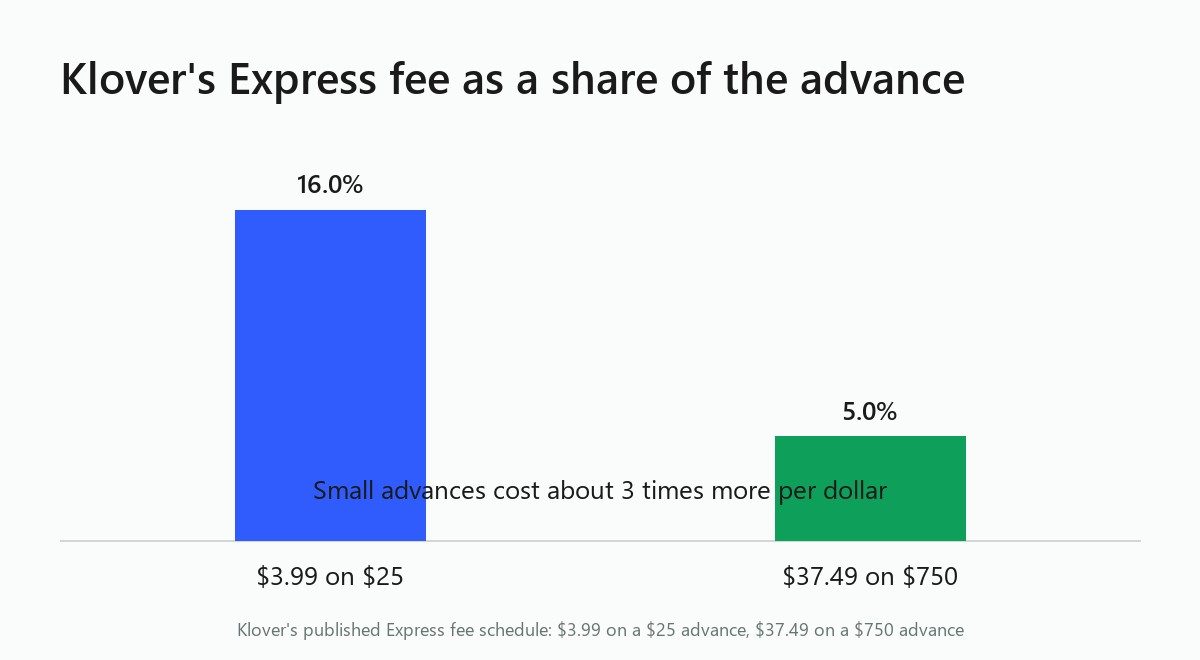
That's what the Express option is for, and it's where the Klover instant cash advance app earns its name. Express fees are optional, and they scale with the size of the advance. Klover's pricing information lists $3.99 as the fee on a $25 advance, climbing to $37.49 on a $750 advance.
Any advance between those two amounts falls somewhere on the same scaled schedule, not a flat rate everyone pays regardless of size. There's one state-specific carve-out to flag: per Klover's terms, users in Connecticut and Maryland cannot be charged Express Fees at all.
Putting a number on what that Express fee costs over time helps, the same way you'd annualize a loan's APR to compare it against other borrowing. Klover isn't a loan and doesn't charge interest; the figures below are an illustrative comparison built from its published fee schedule, not a rate Klover discloses itself. Take the $25 advance with its $3.99 Express fee, repaid on a typical two-week pay cycle: that's a 15.96% cost for two weeks, which works out to roughly 415% if you annualized it the way you would a loan's APR.
The $750 advance with its $37.49 fee tells a different story at scale: about a 5% cost for two weeks, or roughly 130% annualized under the same illustrative math. Same product, same fee logic, but the smaller the advance, the more the express fee stings in relative terms.
Put another way: at the $25 end, the Express fee runs close to sixteen cents on every dollar borrowed for that two-week span. At the $750 end, it's closer to a nickel on the dollar. The dollar cost is higher on the larger advance, thirty-seven dollars and change versus four, but the relative bite is smaller, which is exactly why comparing cash advance apps on a single flat percentage can be misleading. CompareEWA's broader look at instant cash advance apps and their real cost walks through that same math across other providers.
Klover also sells an optional subscription called Klover+, priced at $4.99 a month on Klover's pricing page, though Klover notes the price can vary by state. What you get is access to points that can offset express-fee costs and, over time, help raise the ceiling on advance amounts. Klover+ works as a way to accelerate the same points economy described above rather than a separate, simpler pricing tier.
Whether that's worth $4.99 a month depends entirely on how often you'd actually engage with the points system anyway. A reader who was already planning to link accounts, take surveys, and watch ads to build up points might find the subscription speeds up something they'd do for free. A reader who wants to open the app, request an advance, and move on with their day gets less obvious value from paying monthly for faster access to a rewards system they're not otherwise using, and may prefer to see how Klover compares against compareEWA's list of cash advance apps with no monthly fee. The math only works in the subscriber's favor if the points earned meaningfully exceed that $4.99 monthly cost, which circles back to the same time-for-data tradeoff the points system carries everywhere else in this review.
According to Klover's own privacy policy, the company states it "sell[s] and share[s]" personal information with advertising partners for cross-contextual behavioral advertising. California residents can opt out through cookie settings or an online form, but the baseline behavior is disclosed plainly in the policy itself.
What counts as "personal information" here is broader than most people expect from a cash advance app. Klover's privacy policy lists bank-linked transaction and purchase history, bank account and routing numbers, card numbers, IP address, zip code, device ID, physical receipt data, and loyalty-card transaction data reaching back up to 24 months of linked-account history. That two-year lookback window applies to linked-account history broadly, not just the transactions needed to evaluate a single advance request.
It also explicitly flags "health data (e.g. if you upload a receipt for a health related purchase)" as sensitive information the app may collect. Klover names this as a specific, tracked category, tied directly to the receipt-upload feature that also earns you points.
Klover names its financial-data partners directly in that same privacy policy: Plaid, Pathward, Payliance, Tabapay, and Array, all under data processing agreements. Residents of eligible states can request deletion of their personal information, though Klover may deny a request that would prevent it from delivering the service or that would violate a legal obligation. Deletion requests go through support@joinklover.com or Klover's privacy portal.
Set this next to the non-recourse, no-credit-reporting terms from earlier and you get the real shape of the Klover trade. Klover's advance terms are unusually forgiving. Its data terms are unusually broad. Neither cancels the other out, and a reader deciding whether to use this app should weigh both sides rather than only the one that shows up in the marketing.
One more term to flag before moving on: Klover's terms and conditions include a binding, individual arbitration clause. Disputes go to arbitration rather than court, and users waive the right to sue or to join a class action. Users can opt out of arbitration within 30 days of accepting the terms by emailing legal@joinklover.com.
Klover's Apple App Store listing carries a 4.8 out of 5 rating from roughly 385,000 ratings. Its Google Play rating sits around 4.6 stars, per third-party search-indexed summaries of the listing, a figure that could not be confirmed directly from the Play Store listing and should be read as approximate rather than exact.
The praise in App Store reviews tends to focus on speed. One reviewer wrote that "within minutes, you can receive an advance on your paycheck," which matches the Express option's whole purpose. But not every review lines up with the app's advertised range. Another reviewer noted that the "max amount I have gotten was $100" despite seeing advertised limits of $250 to $750 elsewhere in the app, a gap between the ceiling Klover markets and the limit an individual account actually reaches.
Then there's Trustpilot. Klover's joinklover.com listing on Trustpilot shows a 2.0 out of 5 rating from 12 reviews as of verification, a sharp contrast against the app-store numbers above. Recurring complaints there include continued debit attempts after a user believed they'd cancelled, with one reviewer writing "they are continuing to try and debit money out of my account," along with complaints about slow or absent human customer support and about promotional offers or points not being honored as advertised.
App-store prompts can nudge ratings upward right after a smooth transaction, while a site like Trustpilot tends to draw people who had a specific problem they wanted documented. Both figures are real, and a reader weighing Klover should read the two ratings side by side rather than picking whichever one flatters the app.
Klover fits a reader who's willing to spend time earning points, who's comfortable with the app's data collection and sale practices as disclosed in its privacy policy, and who values a non-recourse advance structure that won't hit their credit report if repayment goes sideways. That reader gets access to a wide advance range, a free standard tier, and a points system that can genuinely reduce or eliminate express fees over time if they use it consistently.
This app is a poor fit for a reader who wants a fast, low-effort advance without engaging a rewards or survey system, and for anyone who wants to minimize how much financial and personal data they hand over to get $50 until Friday. If speed matters more than points, the standard transfer's lack of a committed timeline is a real limitation, and the Express fee is the only guaranteed way around it, with no single flat number to plan around since it scales with advance size. Readers still weighing their options can work through compareEWA's framework for choosing a cash advance app before committing to one.
Klover is an operating cash advance app with a 4.8 out of 5 Apple App Store rating from roughly 385,000 ratings, published terms and conditions, and a privacy policy on its own site, joinklover.com. Its Trustpilot rating is considerably lower at 2.0 out of 5 from 12 reviews, so "legit" here means an active, disclosed business rather than a guaranteed smooth experience.
No. Per Klover's how-it-works content, eligibility is based on income and bank-account activity, including deposit patterns, account history, and prior repayment history with Klover, rather than a credit score or credit pull.
Klover's terms and conditions state that Klover does not report unpaid advances to credit bureaus and does not pursue traditional debt collection on them. Instead, if it can't collect, it may suspend the user's access to the app until it's able to successfully charge the linked account again.
Standard Balance Advances are free, per Klover's terms and conditions. Express funding scales by advance size, per Klover's own pricing information: $3.99 on a $25 advance up to $37.49 on a $750 advance. Klover+ is an optional subscription that offers points to offset express fees and raise limits over time. It costs $4.99 a month on Klover's pricing page, though Klover notes the price can vary by state.
Klover's privacy policy discloses that it collects bank-linked transaction history, account and routing numbers, card numbers, IP address, zip code, device ID, and receipt data, including a specific flag for health-related purchase data uploaded via receipts. The policy states Klover sells and shares personal information with advertising partners, and California residents can opt out through cookie settings or an online form.

Chime's own SpotMe and MyPay fees and limits, plus which cash advance apps confirm Chime support on their own help pages.
Read article
Gerald advertises zero fees, but a store purchase unlocks the transfer. Limits, speed, eligibility, and who it actually suits.
Read article
We verified Money App's fees, limits, and BBB record so you know exactly what to expect before you link your bank account.
Read articleSee how the top earned wage access apps stack up on fees, limits, and speed. View the full ranking