September 2, 2026
Cash Advance Apps: What Reddit Users Warn About
We read through Reddit's cash advance app threads to sort real complaints from real advice, app by app.
Read article


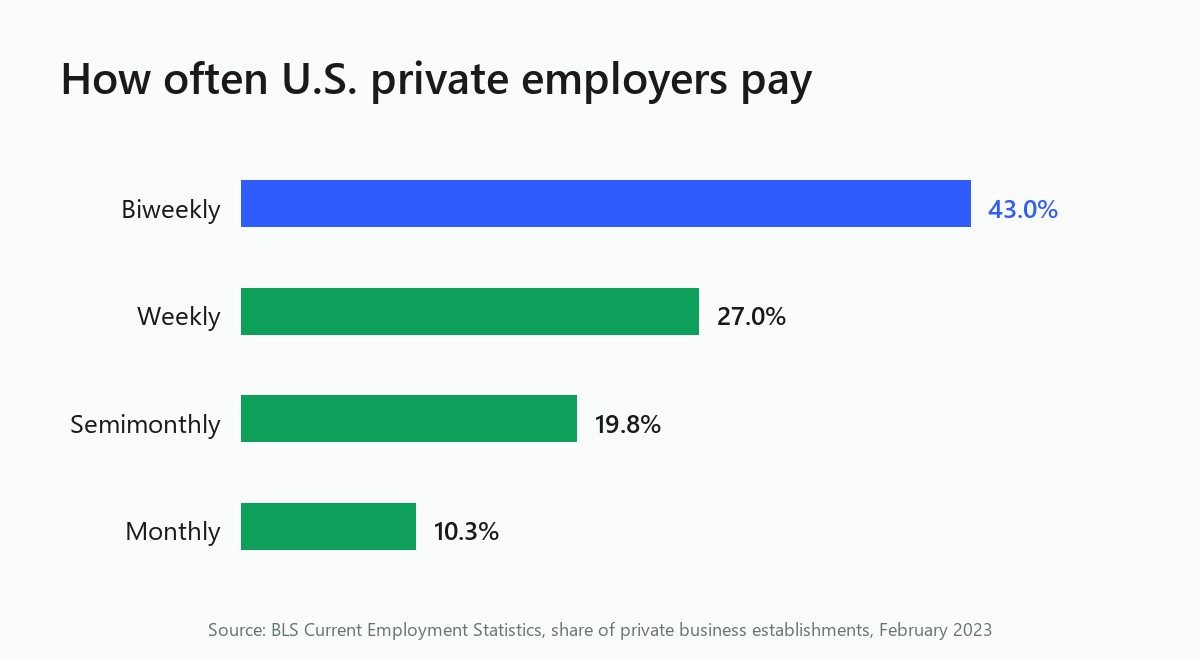
As of February 2023, 43.0% of U.S. private establishments paid their employees biweekly and another 27.0% paid weekly, according to the Bureau of Labor Statistics' Current Employment Statistics survey. That's employer-reported pay periods rather than a worker headcount. Even so, it tells you something important: a monthly paycheck is not the default at most private employers.
If your money lands every week or every other week, a paycheck budget planner built around your actual pay schedule works better than one built around the calendar month.
Your landlord, your electric company, and your car lender did not get that memo. Rent is still due on the 1st. The car payment is still due on the 10th. Nobody moved a single due date to line up with your Friday deposit, and that gap between when bills are due and when money actually shows up is the real source of the strain, well before spending choices even enter the picture.
A paycheck budget planner fixes the mismatch by working from the bill backward instead of from the calendar forward. You are not building one big monthly budget and hoping it survives contact with two or four paychecks. You are building a plan for each check, one at a time, so every dollar coming in already knows its job before it lands.
Most budgeting advice assumes one paycheck a month, or treats two biweekly checks as roughly interchangeable halves of a monthly number. Divide the month in half, pay half the bills from each check, done. It sounds reasonable until you actually lay out the due dates.
Real bills cluster. Rent, a car payment, and a phone bill can all land in the same ten-day window, right after a check that also has to cover groceries and gas. Meanwhile the next check, two weeks later, looks comparatively light.
Split the bills 50/50 and you'll often find one paycheck can't cover what it's supposed to, while the other has money sitting around with nowhere urgent to go. That's a timing problem with a mathematical solution, and a method fixes it far more reliably than willpower ever will.
There's a second layer for a lot of hourly and shift workers: hours vary even when the rate doesn't. A slower week at the store or a cut shift changes what actually lands in the account, on top of the timing mismatch. The Fair Labor Standards Act only guarantees non-exempt hourly workers at least minimum wage for hours actually worked, not a consistent number of hours, so the paycheck itself can move even before you get to when it arrives.
Roughly 20-25% of U.S. consumers reported income that varies "somewhat" or "a lot" from month to month in CFPB's 2020 Making Ends Meet survey. That's older data, but it still makes the case for keeping a buffer even when your hourly rate itself stays fixed.
The fix is simpler than it sounds, and it does not require a new app or a spreadsheet degree. You work backward from each bill's due date to figure out which paycheck has to be sitting in your account, cleared, before that date hits. Then you write that assignment down.
This method skips the 50/50 split entirely, along with any guessing about which half of the month feels heavier. Every bill gets assigned by due date, first, and the same logic works whether you're filling out a weekly paycheck budget template or a biweekly one. The only thing that changes is how many rows you're working with.
Copy this structure into a notebook, a spreadsheet, or the notes app on your phone. Leave the amounts and dates blank until you've listed your own bills. This is the actual paycheck budget template, the one you fill in yourself, not a worked example dressed up as a form.
| Bill | Amount | Due Date | Assigned Paycheck | Running Balance Needed |
|---|---|---|---|---|
| ___________ | $______ | ______ | Check ___ | $______ |
| ___________ | $______ | ______ | Check ___ | $______ |
| ___________ | $______ | ______ | Check ___ | $______ |
| ___________ | $______ | ______ | Check ___ | $______ |
| ___________ | $______ | ______ | Check ___ | $______ |
| ___________ | $______ | ______ | Check ___ | $______ |
"Running Balance Needed" is the cumulative total for that paycheck, not just the one bill's amount. If two bills land on the same check, add them together in that row so you can see the full number that check has to clear before anything else gets spent.
If you're paid weekly instead of biweekly, the table above still works, just with more rows on the "Assigned Paycheck" column. A weekly paycheck budget template usually needs four "Check" rows in a typical month instead of two, since most months hold four weekly paydays. The assignment logic doesn't change: each bill still goes to whichever check lands before its due date, with a few days of cushion built in.
Numbers make this concrete, so let's build one from scratch. Say Maria earns $18 an hour and averages 32 hours a week at a retail job, paid biweekly. That assumption is illustrative rather than a typical-worker statistic, though it lands close to the BLS-reported median hourly wage for retail sales workers, $17.46 as of May 2025. Cashiers are also one of the larger low-wage hourly occupations BLS tracks.
Her gross pay per biweekly check: $18 x 32 hours x 2 weeks = $1,152.
Here's her bill list for this particular month, with due dates assigned to whichever paycheck arrives on the 1st (Paycheck A) or the 15th (Paycheck B). Because biweekly paydays drift from month to month, Maria re-checks this assignment every pay period rather than assuming the 1st and 15th stay fixed:
That car insurance bill is exactly the kind of expense that wrecks a naive 50/50 split, because it doesn't show up every month, it shows up twice a year in a lump. The fix is the savings-envelope formula from step 4: monthly-equivalent cost x 12, divided by 26 pay periods. For Maria that's $110 x 12 = $1,320 a year, divided by 26 = $50.77 set aside from every single check.
Now the totals:
| Bill | Amount | Due Date | Assigned Paycheck | Running Balance Needed |
|---|---|---|---|---|
| Rent | $900.00 | 3rd | Check A | $900.00 |
| Car payment | $310.00 | 10th | Check A | $1,210.00 |
| Cell phone | $75.00 | 14th | Check A | $1,285.00 |
| Insurance envelope | $50.77 | ongoing | Check A | $1,335.77 |
| Electric | $140.00 | 22nd | Check B | $140.00 |
| Internet | $60.00 | 27th | Check B | $200.00 |
| Insurance envelope | $50.77 | ongoing | Check B | $250.77 |
Paycheck A needs $1,335.77 to clear its assigned bills, but Maria's gross pay per check is only $1,152. That's a $183.77 shortfall on this one specific check, even though her income for the month, $2,304 total, comfortably covers the full $1,586.54 in monthly bills (900 + 310 + 75 + 140 + 60 + 50.77 + 50.77) with $717.46 left over for groceries, gas, and everything else.
The total was always there. Only the timing was off. Paycheck B, by contrast, only owes $250.77, leaving $901.23 for the rest of that pay period.
Both leftover figures, the $717.46 and the $901.23, are gross numbers before taxes and any other paycheck deductions. Maria's actual take-home cushion on each check runs smaller than shown, which means the real-dollar gap on Paycheck A is larger than the $183.77 headline number suggests.
This is the exact failure mode the planner exists to catch before it becomes a missed payment. We'll come back to Maria's $183.77 gap in the troubleshooting section below.
Biweekly pay works out to 26 paychecks a year, because 52 weeks divided by 2 equals 26. Most months contain exactly two of those 14-day pay cycles, and your planner assumes that pattern every time.
But 26 pay periods times 14 days equals 364 days, one or two days short of a full calendar year, and calendar months don't divide evenly into 14-day blocks to begin with. That mismatch means two months out of every year end up containing three paydays instead of two, for anyone on a biweekly schedule.
Which two months depends entirely on your employer's specific first payday of the year, so there's no fixed date this always lands on and it shifts depending on your job and the year. If someone tells you it always happens in the same months, they're describing their own paycheck calendar, which varies by employer and by year. Weekly earners get a version of the same thing, an extra fifth paycheck in a month, roughly four times a year, since 52 weeks divided by 12 months comes out to about 4.33 weeks per month.
The mistake to avoid is treating that extra check like a windfall to spend. Your regular bills are already assigned to your normal checks using the planner above, which means a third-paycheck month gives you a paycheck with no bills assigned to it. That's real, useful money: extra debt paydown, or a small emergency buffer so the next tight month has somewhere to pull from instead of starting from zero. Treat those as the two paychecks a year that get to work for your goals instead of your due dates.
One thing to watch: the savings-envelope amounts you set aside for irregular bills, like Maria's insurance envelope above, are calculated using all 26 paychecks a year, not just your normal 24. That means an extra paycheck still owes its envelope contribution before it's free to spend on anything else.
Go back to Maria's $183.77 shortfall on Paycheck A. Work through these options in order, because each one costs you less than the next.
None of these options are about cutting deeper into an already tight budget. They're about moving the same dollars to where the calendar actually needs them, which is the entire point of assigning bills to specific paychecks in the first place.
If the shortfall shows up on nearly every check rather than once in a while, that's a sign worth taking seriously: the planner is surfacing a structural gap between income and expenses that's worth addressing directly. That's the moment to step back and look at breaking the paycheck-to-paycheck cycle more broadly, especially if your hours (and therefore your paychecks) genuinely vary week to week, which changes the math in ways worth planning for separately when your income itself is irregular.
For the general habits that make any paycheck stretch further, whatever your pay schedule, our guides on simple budgeting tips that actually work and making your paycheck stretch until payday cover that ground in more depth than we can here. And if you're starting the buffer mentioned in step 2 from nothing, our piece on building an emergency fund on low income walks through how to start one even when there's not much room to spare.
A paycheck budget planner assigns every bill to the specific paycheck that has to cover it, based on due dates, instead of splitting a monthly budget evenly across checks. It works from the bill backward to the paycheck that arrives before it's due.
A monthly budget treats income as one lump sum for the month. A paycheck-based plan treats each check separately, which matters because bills often cluster onto one paycheck while another sits comparatively light, something a monthly total can hide.
Convert it to a per-paycheck savings amount using the formula: monthly-equivalent cost x 12, divided by 26 for biweekly pay or 52 for weekly pay. Set that amount aside from every check so the lump sum is ready when the bill actually arrives.
Biweekly pay adds up to 26 paychecks a year, and 26 pay periods of 14 days equals 364 days, which doesn't divide evenly across 12 calendar months. That mismatch pushes two months a year to contain three paydays instead of two. Which months depends on your employer's payday schedule, so it varies by job and year.
Treat it as money without a pre-assigned bill, since your regular expenses are already covered by your normal two paychecks. Use it for debt paydown or to build the buffer that covers a shortfall on a tighter paycheck later.
Try shifting a flexible expense to the other paycheck first, then draw from a buffer or emergency fund, then ask the biller about moving the due date. Only consider pulling pay early through earned wage access as a last-resort bridge, not a routine habit.

We read through Reddit's cash advance app threads to sort real complaints from real advice, app by app.
Read article
Bill due this week? Compare the fastest emergency cash advance apps, real instant-transfer fees, and cheaper options to try first.
Read article
Need quick cash now? Six ways to get 200 dollars today, ranked cheapest first, from 0 dollars to 60 dollars over 30 days, with the math shown.
Read articleSee how the top earned wage access apps stack up on fees, limits, and speed. View the full ranking