September 25, 2026
Earned Wage Access Explained: How EWA Works
What is earned wage access? How the two EWA models work, what they cost, and how to tell if your employer offers it.
Read article


Type "paycheck loans no credit check" into a search bar and you'll get a mix of results that have almost nothing in common except one phrase. Some are cheap, legal, and genuinely helpful when your bank account is running low before payday. Others are storefront lenders charging triple-digit interest, or scams built to take a fee from you and disappear. That one phrase covers all of it, which is why the search term is worth slowing down on before you tap "apply."
This piece sets aside the cost math between products (that comparison lives in this site's own breakdown of how EWA and payday loans compare on cost) and focuses instead on the four categories that search term can actually surface, which ones are legal where you live, and how to tell a real no-credit-check option from one that's designed to hurt you.
When people search "paycheck loans no credit check," they generally land on one of four things.
First up is a traditional storefront or online payday loan: a short-term, small-dollar loan due in full on your next payday, typically carrying a flat fee per $100 borrowed. The Consumer Financial Protection Bureau's payday loan factsheet puts the average payday loan at roughly $375, with a typical fee of $15 per $100 borrowed, and finds that the median borrower takes out eight of these loans a year.
Next is a high-cost short-term installment loan. It's structured like a payday loan's cousin, repaid over several weeks or months instead of one lump sum, but it can carry a similarly steep rate depending on the state.
Rounding out the list are the newer entrants: earned wage access (EWA) apps, which advance money you've already earned before your scheduled payday, and cash-advance apps, which extend a small short-term advance against your next deposit. This site covers how a cash advance app actually works and which cash advance apps skip the credit check in separate pieces, so this article won't re-walk that ground.
Here's the part that trips people up: only two of these four categories, EWA apps and cash-advance apps, can usually advertise "no credit check" honestly. A payday lender skips the credit-bureau check too, but it's pricing that risk into a triple-digit fee instead of screening it out. An EWA or cash-advance app skips the check because there's no credit risk to underwrite: it's confirming that you're employed and that the money you're drawing against already exists. Same three words, different businesses.
Payday lending is regulated state by state rather than under one national rulebook, and the differences are large enough that the exact same loan can be a normal transaction in one state and a crime in another.
Georgia criminalizes payday loans of $3,000 or less under O.C.G.A. § 16-17-2. Lenders who want to offer small installment credit legally in the state operate instead under the Georgia Installment Loan Act, O.C.G.A. § 7-3-1 through § 7-3-52.
State courts have also rejected the argument that a lender's claimed tribal affiliation exempts it from this ban, holding in West Sky Financial v. Georgia that tribal sovereign immunity does not shield a lender from the state's payday-loan ban.
What that means for you: if a "no credit check" payday offer targets a Georgia address, the underlying loan may be void under state law, and no borrower owes a debt that Georgia never permitted to be created.
New York doesn't have a payday-specific ban. It doesn't need one. The state's civil usury cap is 16% APR under General Obligations Law § 5-501 and Banking Law § 14-a, and charging more than 25% APR is criminal usury, a Class E felony under Penal Law § 190.40. The New York Department of Financial Services states plainly that payday lending is illegal in New York.
A payday loan's typical cost, that $15 fee on $100 borrowed for two weeks, works out to roughly 391% APR, according to the CFPB's APR explainer. That's roughly 24 times New York's 16% civil usury cap, which is why the product simply doesn't operate there legally.
Illinois took a different route. Rather than banning payday loans by name, the Predatory Loan Prevention Act (815 ILCS 123), signed March 23, 2021, caps the military annual percentage rate (MAPR) on nearly all consumer credit, including payday loans, at 36%. By the time the cap took effect, the number of licensed payday storefronts in Illinois had already fallen from 518 in 2011 to zero, according to a Mayer Brown and Woodstock Institute analysis of the statute.
Texas shows what happens when a rate cap exists but has a hole in it. The state's constitutional usury baseline sits around 10%, but payday and auto-title lenders route around it through the Credit Access Business, or CAB, structure: the CAB acts as a broker and charges a fee on top of a loan actually made by a separate third-party lender, instead of charging interest directly. A 2025 study from the Texas Office of Consumer Credit Commissioner found CAB payday APRs running between 365% and 496%.
Beyond these four, coverage varies widely: 43 states plus Washington, D.C. cap what a lender can charge on a $2,000, 24-month installment loan, while Delaware and Missouri do not, according to a National Consumer Law Center state APR cap fact sheet.
A high-cost installment loan isn't automatically illegal the way a payday loan is in Georgia or New York. Whether it's legal, and at what price, depends entirely on the state you live in.
Not every "no credit check" result is dangerous, but some of them are built to take your money and give you nothing back. The Federal Trade Commission and the CFPB have both brought enforcement actions against lenders using these tactics, including the FTC's advance-fee loan crackdown and the CFPB's case against Golden Valley Lending and related tribal-affiliated lenders, both described below.
This is the single most common paycheck-loan scam. A "lender" promises approval, then asks for a fee before the money arrives: a processing fee, an insurance fee, a membership fee. The loan never shows up.
An FTC enforcement release aimed at exactly this scheme puts it bluntly: "Beware of lenders who 'guarantee' or say that you are likely to get a loan or credit card before you apply, especially if you have bad credit, no credit or a bankruptcy." The same release adds: "If you don't have the credit offer in hand, or confirmed in writing, and a telemarketer asks you to pay up-front for a guaranteed loan or credit card, hang up. It's fraud."
A legitimate lender's fees, if any, come out of the loan proceeds or get billed after funding, never as a wire transfer or gift card you send before you've seen a dollar.
No real lender approves you before reviewing your application. Guaranteed-approval language on an ad or landing page skips that step entirely, and the FTC guidance quoted above treats that as a fraud signal. Treat any promise of guaranteed approval before you've submitted an application as the warning itself.
Some online lenders claim a partnership with a Native American tribe and argue that tribal sovereign immunity puts them beyond the reach of state licensing and usury law, a structure consumer advocates call "rent-a-tribe" lending. The CFPB has pursued several of these operations as unlicensed lenders regardless of the tribal claim: in CFPB v. Golden Valley Lending, Silver Cloud Financial, Mountain Summit Financial, and Majestic Lake Financial, filed April 27, 2017 in the Northern District of Illinois, the Bureau argued the loans were void because they were made in violation of state licensing law.
Being asked for a Social Security number or a bank login isn't automatically a scam sign on its own. Legitimate "no credit check" lenders commonly pull from alternative-data bureaus, specialty consumer reporting agencies that track income, employment, and banking history, instead of the three major credit bureaus. Source: CFPB, "What are specialty consumer reporting agencies." What separates normal underwriting from a phishing attempt is whether you're asked to pay before you've been approved and funded.
Credit union PALs and regulated EWA apps are the two options here that can truthfully advertise "no credit check," because they underwrite income, employment, or membership standing instead of a credit score. The bank and nonprofit options below are not marketed as "no credit check," but they are regulated, transparently priced, and far cheaper than a payday loan.
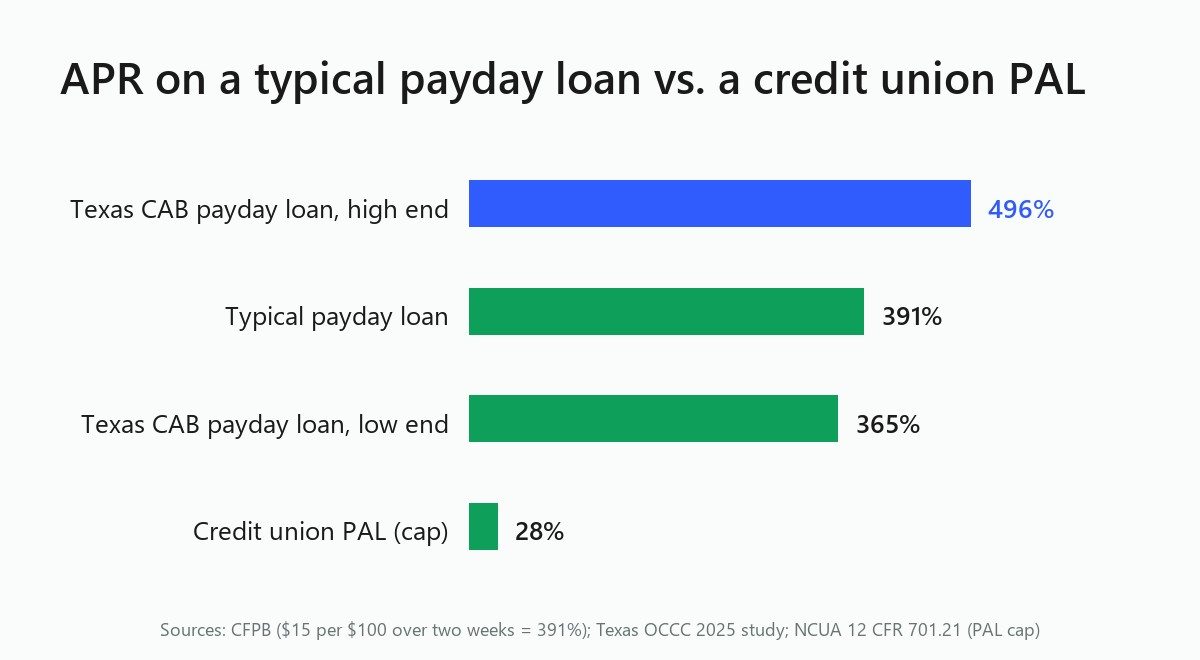
Federal credit unions can offer Payday Alternative Loans, known as PALs, under a National Credit Union Administration rule. PAL I covers $200 to $1,000 over up to six months, capped at 28% APR with a maximum $20 application fee. PAL II goes up to $2,000 over up to twelve months at the same 28% cap, and doesn't require a minimum membership period. Source: NCUA, 12 CFR 701.21.
Twenty-eight percent APR against a 391% payday APR is the difference between a loan you can plan around and one that compounds into a crisis.
Apps that partner directly with your employer, drawing against wages you've already worked for rather than lending against a future paycheck, sit in a different regulatory category than a payday loan. Under a CFPB interpretive rule issued December 23, 2025, qualifying EWA products, both employer-partnered and certain direct-to-consumer products that meet four specific conditions, are treated as not constituting "credit" under the Truth in Lending Act and Regulation Z. That means no APR disclosure is legally required for those products, and optional tips or expedite fees aren't counted as finance charges. This site's full comparison of how EWA and payday loans compare on cost covers the fee structures in detail; the point here is narrower: this is why a regulated EWA app can say "no credit check" and mean something structurally different from a payday storefront saying the same three words.
Banks including US Bank and Bank of America now offer small, short-term loans built to undercut payday pricing. US Bank's Simple Loan charges around $6 per $100 borrowed, working out to roughly 35.65% APR, according to NerdWallet's analysis of the program.
Bank of America's Balance Assist charges a flat $5 fee for up to $500, repaid in three installments over 90 days, according to Bank of America's own program details. These aren't free, but they're a fraction of what a payday loan or a CAB-structured Texas loan costs.
When money runs short every month rather than just this one time, a loan of any kind only delays the same problem. The National Foundation for Credit Counseling connects people with more than 1,500 certified counselors and has served over 35 million people since 2006.
None of these routes require the underwriting gymnastics of a "guaranteed approval, no credit check, cash today" ad. What they require instead is an employer, a bank account, or a credit union membership, and a lender that expects to be repaid on ordinary terms. If none of these fit and you still need cash quickly, this site also rounds up other fast, legitimate cash options. If your situation calls for ongoing budget help rather than a one-time gap, the NFCC's certified counselors are a reasonable next step before you borrow again.
No. "No credit check" describes how a product underwrites risk. Payday lenders, credit union PALs, and EWA apps can all truthfully skip a traditional credit-bureau pull. Watch for a fee requested before the money arrives, or a promise of guaranteed approval before you've applied: those are the actual red flags.
It depends on where you live. Georgia bans them outright, and New York effectively bans them through its usury law. Illinois caps all consumer credit at 36% APR under the Predatory Loan Prevention Act, and licensed payday storefronts there had already fallen to zero by the time the cap took effect, while Texas technically allows them but lets lenders route around its usury cap through broker-fee structures a 2025 state study found charging 365% to 496% APR.
It's a structuring tactic some online lenders use to argue they're immune from state licensing and usury rules, sometimes called "rent-a-tribe" lending. The CFPB has pursued such lenders as operating illegally regardless of the tribal claim, and Georgia's courts held in West Sky Financial v. Georgia that tribal affiliation does not exempt a lender from the state's payday-loan ban.
A federal credit union Payday Alternative Loan, capped at 28% APR by NCUA rule, is far cheaper than a traditional payday loan for any credit-union member. Employer-based earned wage access and bank small-dollar programs like US Bank Simple Loan or Bank of America Balance Assist are also priced well below a payday loan.
Walk away if you're asked to pay any fee before funds arrive, if the site promises guaranteed approval before you've submitted anything, if there's no verifiable business address, if you're pressured to act within an hour, or if payment is requested by wire transfer or gift card rather than through a standard business payment method.

What is earned wage access? How the two EWA models work, what they cost, and how to tell if your employer offers it.
Read article
Don't want Plaid reading your bank data? See which cash advance apps offer a real non-Plaid path, and what you trade off to get it.
Read article
No credit check does not mean no underwriting. See what cash advance apps really read in your bank data, and what a denial means.
Read articleSee how the top earned wage access apps stack up on fees, limits, and speed. View the full ranking