September 30, 2026
Maryland Earned Wage Access Law: What Changed
Maryland now licenses EWA and cash advance apps, caps fees, and bans tips. Here's what the law requires and what to check before you use one.
Read article

There is no Florida earned wage access law. Not a weak one, not a pending one, not one sitting on the governor's desk. Lawmakers filed four earned wage access bills across the 2024 and 2025 sessions and all four died in committee, and a full text search of the 2025 Florida Statutes for "earned wage access" returns no matching results as of August 12, 2026. So if you work hourly, gig, or shift jobs in Florida and you have a cash advance app on your phone, no state rule sets what that app may charge you, when it may debit you, or what it must disclose first. Here is what does apply instead.
As of August 12, 2026, Florida has no EWA statute, no EWA regulation, and no license category for an earned wage access provider. The Office of Financial Regulation (OFR) licenses Florida's lenders and money services businesses, including deferred presentment (payday) providers. A review of flofr.gov on that date turned up no page, rule, or guidance addressing earned wage access at all.
This is the record from the Florida Senate's own bill system, checked August 12, 2026:
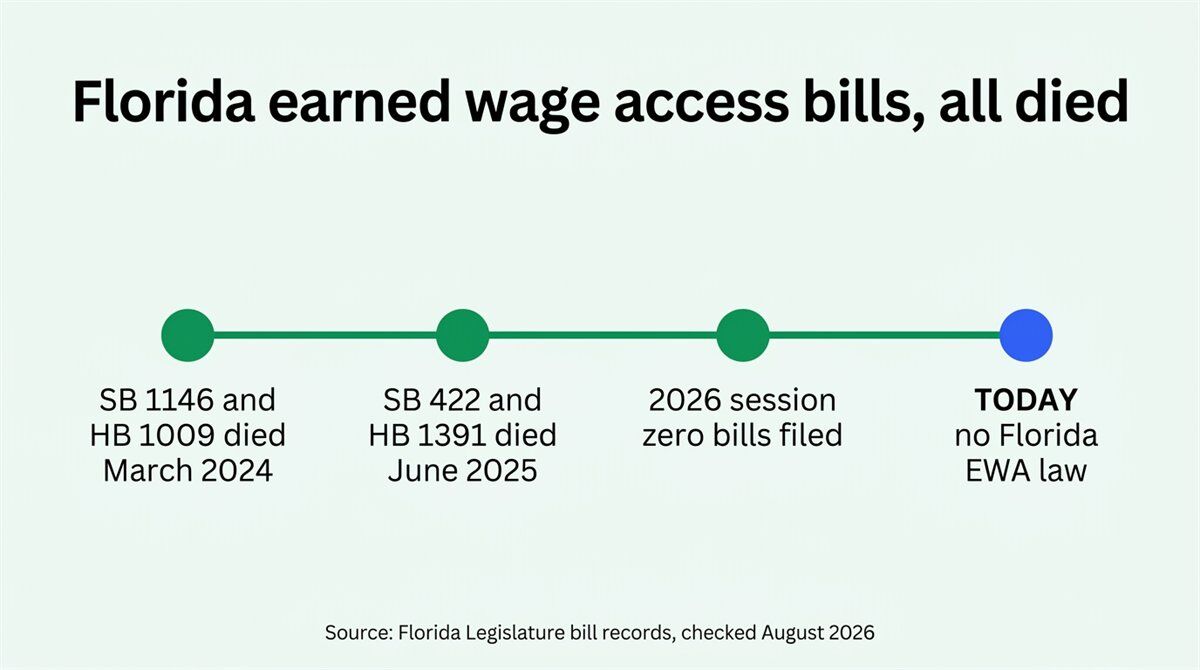
Notice how quietly they died. Neither Senate bill page carries a committee bill analysis, which in Florida practice means the bill was never taken up for a hearing in its first committee of reference.
Then 2026 came and went. The same Florida Senate bill text search, run across the 2026 regular session, Senate and House, all versions and amendments, returns zero bills. That session adjourned sine die on March 13, 2026, and the special session produced nothing either.
The 2025 Senate bill is worth reading precisely because none of it is in force. Its filed text is a list of protections Florida workers do not have. SB 422 would have required a provider to:
One clause in that bill mattered more than all of those combined. Under SB 422's filed text, a compliant provider would not be "considered ... a loan or other form of credit," not a "creditor, debt collector, or lender," and not a money transmitter.
That was the declaration the industry wanted from Tallahassee. Because the bill died in committee, Florida never made it, and what these advances legally are stays an open question.
An unregulated product is not a lawless one. Florida's general lending statutes were on the books long before anyone had an app, and none of them carves out a fee-funded paycheck advance.
Civil usury sits at 18 percent. F.S. 687.02 makes a contract usurious when it charges more than "the equivalent of 18 percent per annum simple interest" on a loan of $500,000 or less.
Interest is defined broadly, on purpose. F.S. 687.03 reaches anything taken "by way of commission for advances, discounts, or exchange, or by any contract, contrivance, or device whatever" that makes a debtor pay back more than the principal received, and it requires a charge taken up front to be spread across the term when the rate is computed. Nothing there exempts a voluntary tip, and no Florida court has decided whether a tip counts as a charge under 687.03.
Criminal usury starts at 25 percent. Under F.S. 687.071, charging more than 25 percent and up to 45 percent per year is a second degree misdemeanor, and anything above 45 percent is a third degree felony. That section carries no loan size threshold.
Consumer lending needs an OFR license. F.S. 516.02 says a person "must not engage in the business of making consumer finance loans" without one, and bars unlicensed lending above 18 percent on loans of $25,000 or less. The teeth sit in the same section: a loan made at a greater rate or charge than the chapter allows "is not enforceable in this state."
The honest answer is that it operates in a gap. No Florida statute bans it, no Florida statute authorizes it, no Florida court has ruled on it, and OFR has published no determination. Searches of OFR and Attorney General materials on August 12, 2026 surfaced no Florida enforcement action, consumer alert, or guidance naming earned wage access or cash advance apps. Read that as untested rather than approved.
Storefront payday lending here is regulated down to the dollar. F.S. 560.404 caps a single payment deferred presentment transaction at a $500 face amount, limits the fee to 10 percent of the amount provided, sets the term at 7 to 31 days, and bans rollovers. OFR's consumer page adds the details the statute leaves out: a $5 verification fee on top, one outstanding loan at a time tracked in a statewide database, a 24 hour wait between loans, and a 60 day grace period at no extra charge if you complete credit counseling.
Now hold the app in your pocket against that list: no dollar ceiling in law, no fee cap, no state database, no waiting period, no grace period. The difference is not a policy judgment that app advances need lighter oversight. It is four bills dying without a hearing.
Scale is why the contrast bites. The Center for Responsible Lending, using Florida regulator data for 2022, counted 3,579,443 payday loans in the state and $252 million in fees, with Florida's fee volume up 17 percent over 2021. The regulated half of this market is already enormous, and the unregulated half is the one growing on phones.
Because Florida set no rate for these advances, nobody can point you to a legal ceiling. What you can do is annualize the fee and set it beside numbers Florida law already uses. The formula: divide the fee by the advance, then multiply by 365 divided by the days until repayment.
Two reference lines from Florida statute: civil usury begins at 18 percent under 687.02, and criminal usury begins at 25 percent under 687.071.
Read those figures for what they are. An annualized fee is a cost comparison, not a court finding. These are illustrative calculations using typical fee amounts, not Florida survey data. No Florida agency publishes usage or fee data for these apps, and none was found as of August 12, 2026.
Other states did not all land in the same place: California registers providers with its state financial regulator, while Connecticut treats these advances under its lending law. Nevada passed the first state licensing law of its kind, and New York has moved through its regulators while legislation stays pending. Texas is in the same position as Florida after its own bills failed. Florida is the third largest state and shows up on every national EWA map as a blank tile.
Three Florida laws reach a cash advance app without ever naming one.
FDUTPA, the Florida Deceptive and Unfair Trade Practices Act, bans unfair and deceptive acts in trade or commerce. Under F.S. 501.211, an aggrieved person may seek declaratory and injunctive relief, and a consumer who suffered a loss "may recover actual damages, plus attorney's fees and court costs." The Attorney General's Consumer Protection Division is the civil enforcement authority. A monthly membership charge you never knowingly agreed to, or a fee that does not match what the app actually took, is FDUTPA territory.
The Florida Consumer Collection Practices Act reaches further than the federal rule. F.S. 559.72 opens with "In collecting consumer debts, a person may not," which binds anyone collecting, including the company that made the advance, not only outside collection agencies. It bars communicating with a frequency that can reasonably be expected to harass the debtor, threatening to enforce a debt the person knows is not legitimate, and contacting a debtor between 9 p.m. and 8 a.m. without consent.
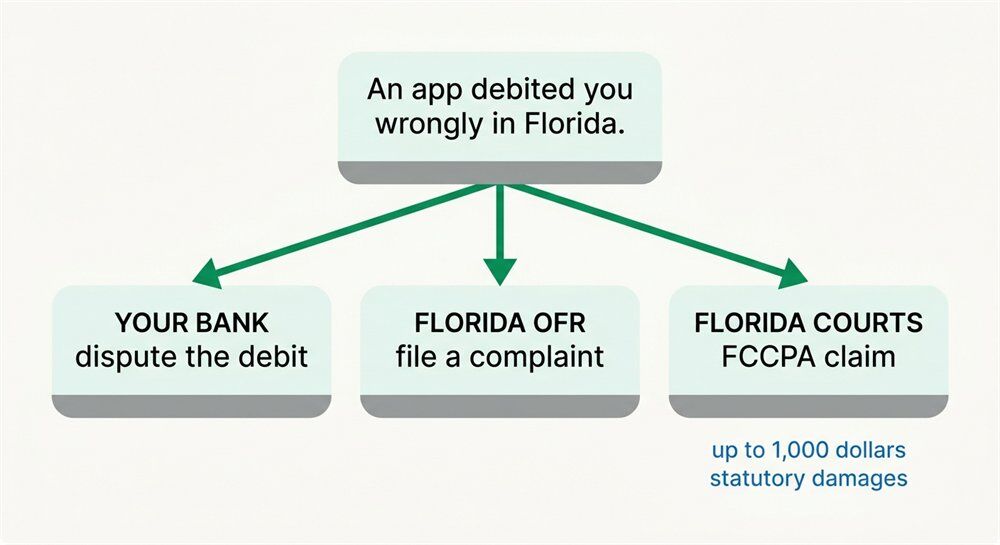
That act comes with a private right of action. F.S. 559.77 lets a debtor recover actual damages, statutory damages up to $1,000, plus court costs and reasonable attorney's fees, within two years of the violation.
The head of family wage exemption is the one most Florida workers have never heard of. F.S. 222.11 exempts all disposable earnings of a head of family earning $750 a week or less from garnishment, and those wages keep the exemption for six months after they reach your bank if they can be traced and identified as earnings. Read the limit as carefully as the protection: an app's auto debit is not garnishment, so 222.11 will not stop a scheduled ACH pull.
Which leaves the protection you actually control, the ACH authorization you gave the app. Revoke it in writing with both the app and your bank, keep a dated copy, and dispute anything that lands after you revoked.
Congress is moving faster than Tallahassee on this. H.R. 9330, the Earned Wage Access Consumer Protection Act, was introduced June 18, 2026 by Rep. Bryan Steil, and the House Financial Services Committee ordered it reported on June 30, 2026 by a vote of 29 to 22, per the official bill status record. Keep its status straight: it is a bill under consideration, it has not passed the House, and it is not law.
In Florida, watch the 2027 regular session. Should a fifth EWA bill appear, you can track it yourself on flsenate.gov by searching bill text for "earned wage access." Until one passes, the fee you pay on a Florida advance is set by the app, not by the state.
No. As of August 12, 2026, no Florida statute mentions earned wage access. Four bills were filed in the 2024 and 2025 sessions (SB 1146, HB 1009, SB 422, and HB 1391) and all four died in committee. No EWA bill was filed in the 2026 regular session.
They operate in a legal gap. No Florida law bans fee-charging advance apps and none authorizes them, and the Office of Financial Regulation has published no guidance or enforcement action naming them as of August 12, 2026. Florida's usury and consumer finance statutes exist, but no court has applied them to these apps.
Florida has no earned wage access license category. Depending on how a company structures its product, a Chapter 560 money services license or a Chapter 516 consumer finance license could apply, but OFR has published no determination that these apps need either. You can check any company through OFR's license lookup.
No. The F.S. 560.404 limits (a $500 maximum, a 10 percent fee cap, 7 to 31 day terms, and the statewide database) apply only to licensed deferred presentment providers. An unlicensed cash advance app is not covered by them or by the 24 hour cooling off period.
Not if you are a head of family earning $750 a week or less. F.S. 222.11 exempts all of those disposable earnings from garnishment, and it follows the money for six months in your bank account when it can be traced as wages. An auto debit is not garnishment, though, so 222.11 will not stop one.
Start with your bank to stop or dispute the debit. File unlicensed activity tips with the Office of Financial Regulation, and deceptive or unfair practice complaints with the Florida Attorney General's Consumer Protection Division under FDUTPA. FDACS at 1-800-435-7352 is the general consumer clearinghouse.

Maryland now licenses EWA and cash advance apps, caps fees, and bans tips. Here's what the law requires and what to check before you use one.
Read article
South Carolina has an enacted earned wage access law. See what S.C. Code 39-5-810 requires of providers, the SCDCA's role, and what it means for you.
Read article
Missouri regulates earned wage access under RSMo 361.749. See what registration, fee, and tip rules apply and what it means for you.
Read articleSee how the top earned wage access apps stack up on fees, limits, and speed. View the full ranking